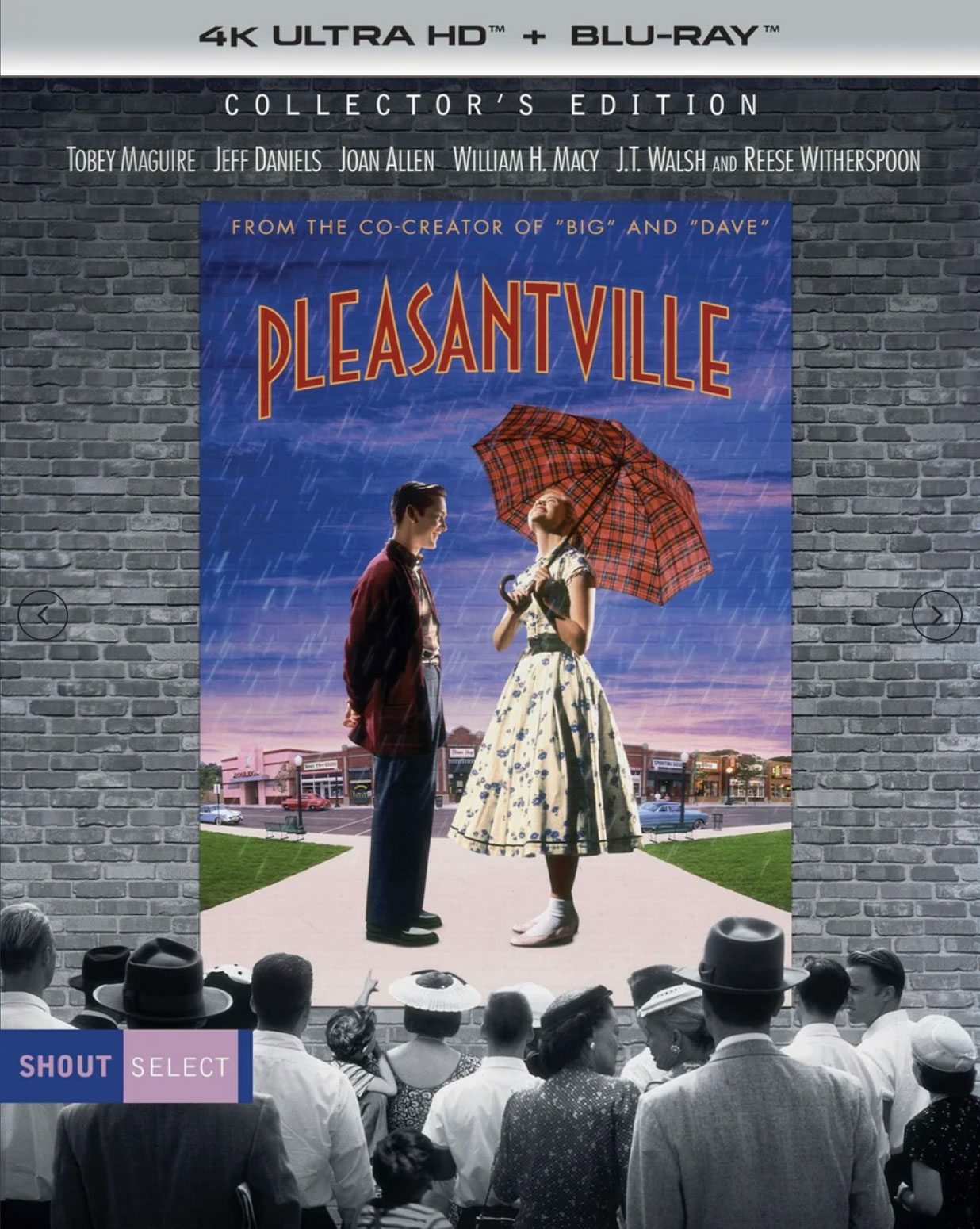
Plot: What’s it about?
“I did the slut thing, David. Got kind of old.”
David (Tobey Maguire) and Jennifer (Reese Witherspoon) are siblings who both control of the living room one night while mom is out of town. Jennifer wants the room for her date, and David wants to watch a marathon of his favorite show, Pleasantville. Pleasantville is the typical 50’s sitcom, where everything is perfect and abundant. They fight over the remote control that night, and it breaks. Mere seconds later, a strange TV repair-man (Don Knotts) is at the door with a new one…much to their surprise. The repair-man quizzes David on Pleasantville trivia, and discovers David knows everything about the show. After he leaves, the siblings once again tussle over the remote, and this time get zapped into the television, right smack dab in Pleasantville. Black and white even. Not only are they in Pleasantville, but they are now the kids of the main couple, they are the stars!
After a while, Jennifer seduces the most popular boy, and has sex with him. The next day, he is in color, and for the first time ever, he misses a shot in practice. He tells his friends about sex, they tell people, so on and so forth, until the town, save a few staunch committee members, are enjoying this new way of life, and turning color! The committee takes his harshly, and tries to get everything back to normal. There is now fire, rain, and books, none of which ever appeared before. It becomes sort of a battle between the b/w people, and the colors. It’s a hard movie to fully explain, and it has to be viewed to understand. The story is fantastic, and the visuals, oh my god, the visuals.
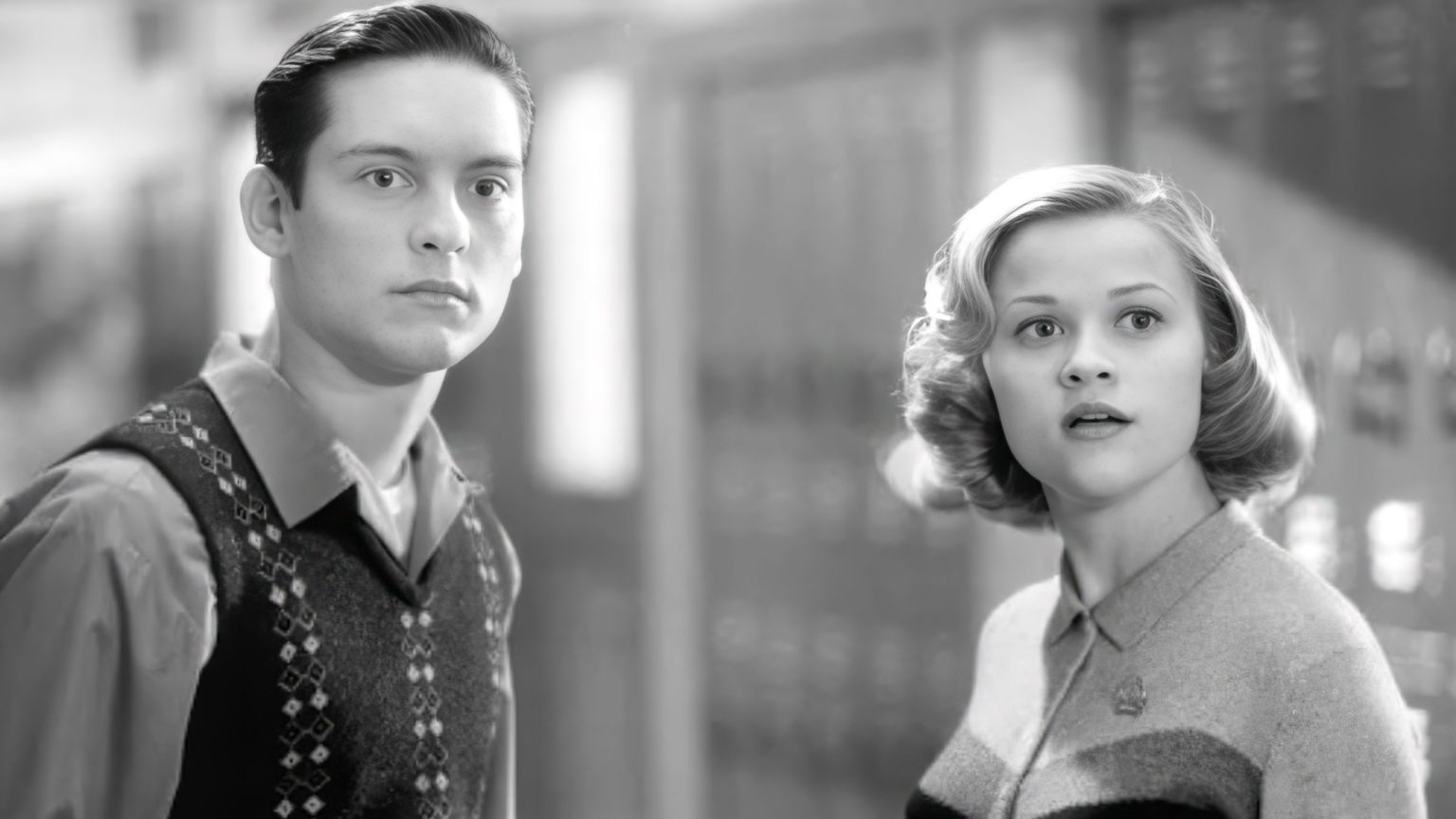
The black and white and color scens are mixed together so well, it’s breathtaking at times. The movie is a true masterpiece of visuals and cinematography, to say the least. You have to see it to believe it. Fleshing out the cast are William H. Macy, Jeff Daniels, Joan Allen, and J.T. Walsh, all of whom put on a superb show, and really bring Pleasantville to life.
Video: How does it look?
This film was one of the first to be released on the then fledgling DVD format and I can remember when I first popped the disc into my player. Things have changed in the nearly three decades since, we’ve been graced with a Blu-ray back in 2011 and now we’ve got this movie in all its 4K glory. Not too many films mix color and black and white, but this one pulls it off nicely with the use of spot color as a plot point. The new 4K scan was done under the supervision of writer/director Gary Ross and now has Dolby Vision which gives the film an added bump. To quote Reese Witherspoon’s character “I’m…pasty!” And while that’s true, the black and white scenes embrace the stark contrast while the color scenes seem to have warmed up a bit. The 1.85:1 HEVC 4K image has never looked better and this is a perfect film to show off your system.
Audio: How does it sound?
Surprisingly there’s no Dolby Atmos mix to be found, but it’s not the end of the world. The same DTS HD Master Audio mix from the 2011 Blu-ray is included which paves the way for a nice, robust track that’s sure to please. Randy Newman’s impressive score gives the film some backbone while the vocals are sharp, crisp and pure. The front stage is particularly active during the film’s second and third acts, but the surrounds come into play later on as the film “comes to life” (for lack of a better term). Just as the use of color starts to show change in the film, so too does the film’s track which provides for an overall satisfying experience.
Supplements: What are the extras?
We’ve got some legacy supplements as well as a new one on this two disc set.
Disc One (4K)
- Audio Commentary – Gary Ross, who wrote and directed the film, voices his comments on the film, its tone and message along with the casting choices, the use of color (and black and white) and, well, pretty much everything in between.
- Isolated Score with Commentary – The film’s composer, Randy Newman, also has his own track. I’ve not listened to many composers’ audio commentaries and this one wasn’t really that great. Newman’s a great composer, but this really wasn’t his thing.
Disc Two (Blu-ray)
- The Color of Change: Making Pleasantville – This new supplement, oddly found only on the Blu-ray, takes us on a journey with Gary Ross, who tends to reflect a bit more on this a few decades after its initial release. It’s nice to have a new supplement, especially on this one.
- Audio Commentary – Gary Ross, who wrote and directed the film, voices his comments on the film, its tone and message along with the casting choices, the use of color (and black and white) and, well, pretty much everything in between.
- Isolated Score with Commentary – The film’s composer, Randy Newman, also has his own track. I’ve not listened to many composers’ audio commentaries and this one wasn’t really that great. Newman’s a great composer, but this really wasn’t his thing.
- The Art of Pleasantville – This “vintage” featurette was found on the first DVD, made its way to the Blu-ray and here it is once again. I’m guessing if you’re reading this review, you’ve already seen it. If not, it’s nothing mind-blowing.
- Theatrical Trailer
The Bottom Line
The quote I used to start this review wasn’t arbitrary. It’s been removed from this version. I don’t know why (or care, really) but figured it was worth mentioning. Pleasantville was a good movie and it paved the way for three very young stars in Reese Witherspoon, Tobey Maguire and Paul Walker who would go onto great careers. Not to be outdone, the film also featured Joan Allen, Jeff Daniels and William H. Macy. Nearly three decades after its release, I don’t know if I’d call this a “landmark” movie, but it was nice to revisit and it’s never looked better than in this new 4K version.