Plot: What’s it about?
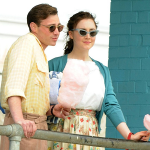
There’s just something about Cate Blanchett that intrigues me. Not only is she a fine actress, but there’s a certain elegance to her, something similar to Nicole Kidman as well. In Carol, Blanchett plays the title character in a film set in the 1950’s in New York. Carol is an older woman and is married. Her life seems to be straight out of a storybook in that she fits perfectly well in society and has a certain poise about her. She meets Therese Belivet (Roony Mara) one day and the two soon develop a relationship. Therese is a clerk who has a boyfriend, but is unsure what to do with her life. The film develops slowly and we see the effects that this relationship has on these women and their husband and boyfriend. Carol is married to Harge (Kyle Chandler) who doesn’t approve of Carol’s relation with Therese, and we see their ugly divorce battle over the course of the film. Harge argues that Carol isn’t fit to look after their daughter.
I’m a fan of both, Rooney Mara and Blanchett as they both deliver top notch performances here. It’s just that the film itself didn’t do a whole lot for me. I recently reviewed Brooklyn which had a similar setting and took place in the 1950’s. Both films were accurate to the era and pretty to look at, but the story is where both films lag. I don’t mind if a film takes its time to develop, but Carol is almost too slow at times that we begin to eagerly await something, anything to happen. There are scenes where we watch the couple check into a hotel or shop, or eat. There just isn’t a lot of substance here. Obviously, the world we live in today is much more accepting of diversity, but there still wasn’t a lot of that seen in this film. There are indeed some powerful scenes such as when Carol confronts a photographer who is in cahoots with her husband. I just can’t say the majority of the film did a lot for me. The performances are a big selling point here, but there’s not much else to it.
Video: How’s it look?
Breaking away from the technology, Carol was shot in Super 16 (16mm) and still manages to look near flawless on Blu-ray. I say “still manages” in that there is a fair amount of grain that’s associated with most everything shot in 16mm, but colors and hues still have a vibrance about them. I’m always in awe of period pieces in that we’re looking back on style and fashion that’s nearly 60 years “old.” That said, the contrast remains steady and solid, detail is better that what I’d expected and though it’s not quite as polished as some other new Blu-ray releases, I was more than impressed. Shown in a 1.85:1 AVC HD image, this is quite the visually-pleasing effort.
Audio: How’s it sound?
The movie relies on dialogue, well I suppose most movies rely on dialogue, and as such we might expect it to sound a bit dull and lifeless. That’s not exactly the case. The included DTS HD Master Audio track has a surprising amount of life in the surround channels and while they’re only offering up some ambient effects – the result is captivating. Certainly vocals take front and center (in the most literal sense of the word) and sound as we’d expect. Blanchett’s voice sounds crisp and clear. While this isn’t a reference-quality soundtrack, I was a bit impressed by the depth that it contained. Again, a nice effort.
Supplements: What are the extras?
- Behind the Scenes Gallery – An oddly-named segment that’s actually not what someone would think (if they were looking at the back of the box). In truth, it’s a series of eight short featurettes that cover the film’s production. I was going to detail each one of these individually, but in essence – they’re all about the same thing. Each runs only a couple of minutes and pretty much has the same information covered.
- Cate Blanchett
Rooney Mara
Todd Haynes, Director
Phyllis Nagy, Screenplay
Edward Lachman, Cinematography
Sandy Powell, Costume Design
Judy Becker, Production Design
Carter Burwell, Composer
The Bottom Line
Despite two strong lead performances, Carol didn’t do much for me otherwise. The story isn’t bad, but’s it’s the overly slow nature in which it develops that hurts it in the end. There’s just not a lot of substance or spark to this story.