Plot: What’s it about?
The odds are that if the United States had not won the battle of Midway, that I would probably not be writing this review right now. That’s an assumption, of course, based on a battle some thirty years before I was even born. But World War II had many turning points and the battle of Midway was one of the earliest, and one of the biggest in the South Pacific…maybe even in the whole war. What Midway has that other movies don’t have is a great plot. Not to say that other movies don’t have a great plot, I am referring to World War II movies in particular. Midway is much more like our modern movies like “Titanic” and “Pearl Harbor” in the sense that they spend a majority of the time building up the plot before the final execution. While this may result in an “all plot no action” storyline, I feel that it’s a good way to get to know all of the characters in the story. And Midway has plenty of name power to go around…a few times. While most other World War II movies show our forces winning battles (as well they should…we did win the war), Midway shows the plot and strategy of both sides.
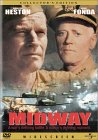
With the whole world involved, there’s bound to be a lot of the brass involved in a World War. The main players of Admiral Chester Nimitz (Henry Fonda), Captain Matthew Garth (Charlton Heston), and Rear Admiral Raymond Spruance (Glenn Ford) take center stage. Accompanied by plenty of other officers, the fate of the United States was in the hands of the Navy and the brave commanders of the battleships that fought in the Pacific. Names like the Yorktown, Hornet and Enterprise may not mean a lot to some people, but during World War II, they helped turn the tide of the war. Midway is based on true events, and is more like a documentary than a movie (which is usually based on a work of fiction). The “stars” of the movie are Heston and Fonda. Heston, whose son is involved in somewhat of an annoying subplot, is moving ships and trying as best he can to get the war won. His son has fallen in love with a Japanese girl who has been arrested (along with her parents) after going back to Hawaii. Normally, this wouldn’t be much of a problem, but six months after Pearl Harbor…most anything involving the Japanese is!
What Midway does that I really liked is that it dispelled the image that we’re so used to seeing in these World War II movies. Midway portrayed the Japanese as intelligent soldiers trying to win the war. Gone is the image of the “Kamakaze” pilot dive-bombing into a naval carrier, the movie showed them as people and gave the entire movie a more realistic feel to it. Odds are that you know what happens if they make a movie about it, but for those who don’t I dare not ruin the fun. While Midway is a bit short on action, until the last 30 minutes that is, it makes up for in plot. It’s almost tense, even though we know what will happen. As I mentioned before, this movie features an all-star cast up to and including Charleton Heston, Henry Fonda, Robert Mitchum, Hal Holbrook, Robert Wagner, James Coburn and in smaller parts look for Erik Estrada, Tom Selleck and Pat Morita (wax on/wax off). I was pleasantly surprised by Midway and think it’s a movie that I’ll not only watch again, but will want to as well. Also considering that Universal has given it a wealth of extras…that doesn’t hurt either!
Video: How does it look?
Midway has been reissued with a brand new anamorphic transfer and what a difference it makes. While the film uses a mix of actual footage from the battle and different types of film (take the opening credits, for example) the 2.35:1 actual “movie” part of it looks very clear. There is some artifacting, which is to be expected and also a bit of edge enhancement problem. However, flesh tones don’t have that really overexposed look that is so common in World War II movies. Then again this was made in the late 1970’s, so that might explain that. Black levels are near perfect, but this film has just enough errors and compression artifacts to be a bit distracting at times. Again, not all of the film was shot at the time the movie was being made, some is actual footage, but this was not taken into consideration when I graded the movie. A solid presentation, and a much needed improvement over it’s previous issue.
Audio: How does it sound?
Midway was one of only a few movies to be originally presented in the awesome “Sensurround”. Yes, that’s right…Sensurround. Movies like Rollercoaster and Earthquake also had the same sound mix (which is essentially a mono track with a LFE channel, aka subwoofer) and they even attributed it to the success of the movie. Of course, this soundtrack is nothing compared to the modern movies whre we have 5.1 and 6.1 mixes, but for the time, Midway sounded pretty darn good. There’s even a featurette on the disc dedicated to the Sensurround sensation. The disc is encoded with a 1.1 mix, which again is the center channel plus the subwoofer. I have to say that I was pretty impressed with the way it sounded. Naturally, we’re all spoiled with the way movies sound these days, but for the age of the film, this 1.1 mix certainly exceeded my expectations. It almost takes a mix like this to make you appreciate your subwoofer, too. With a 5.1 mix, you tend to only concentrate on the front effects or the surround effects, always forgetting the sub if providing most of the action. Again, the film does have it’s limitations when it comes to sound, but I think most will be pleasantly surprised when they hear this mix.
Supplements: What are the extras?
Labeled as one of Universal’s “Collector’s Edition” series, they prove once again that it’s not just an excuse to jack up the price. The most prominent extra is a 38 minute documentary entitled, cleverly enough, “The Making of Midway”. With interviews by Walter Misch, Charlton Heston and Jack Smight (the Director), this tells the tale of not only how this movie was made but how the inspiration from previous documentaries got the ball rolling on this one. Plenty of stock footage and interviews with “real life” veterans of the battle of Midway. A great documentary and recommended viewing. “The Sound of Midway” is a brief featurette with the legendary John Williams. Williams tells of his history with Walter Misch and how he had worked with him on “Fiddler on the Roof”. Williams also recalls how he composed the music as more of a band score than more of a “war movie” score. The Sensurround featurette explains a bit more on the phenomenon of this remarkable audio encoding system. Before the days of “Dolby 5.1”, there was Sensurround. Large subwoofers were installed in movie theaters so that the audience could “experience and feel” more of the movie. Naturally, today, this is common-place; but movies like this may take credit for the whole home theater rage. One thing I found interesting was that they wanted to include a high frequency sound effect too (to compliment the bass), but supposing the sound card failed, it would be enough to blow out the audience’s eardrums. So that idea was scrapped!
Some ten minutes of additional scenes shot for the Network Television version are shown too, but without any sort of commentary, it’s a bit hard to tell what’s going on. Still, the deleted scenes are a welcome addition to the disc. A series of 30 or so production photographs are also included, but I’ve never really felt that this feature was an asset. Still, plenty of pictures of the stars and shots from the set are included and if you like this feature, then you’ll be in heaven. A theatrical trailer is also included as are some DVD Recommendations and a link to the DVD Newsletter. How nice would it be to link to an original screenplay? And as with most all of Universal’s releases, there are some production notes and very detailed cast bios. All in all, Universal has taken a bare bones release and made it into a great Special Edition. Sporting a great cast (look for early appearances by Tom Selleck, Erik Estrada and Pat Morita), Midway is hard to beat when it comes to truly classic World War II movies.