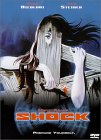
Plot: What’s it about?
You’ve all seen a movie before where a well to do family moves into a new home, when their new place turns all evil on them, and things go right to hell, right? Well, that’s the basic idea behind this film by Mario Bava. While you might have this story before, you’ve never seen it quite like this, and you’ll be shocked (no pun intended) how different this spin on the tale is. This new house the family has moved into has some secrets, the kind of stuff realtors wouldn’t dare tell you about during the open house, if you catch my drift. In any case, the house holds the spirit of a man who was murdered by his wife and her lover, and he might be dead, but he’s still pissed off. This estranged spirit decides to find a vessel in the young boy of the family, and of course, the bodies start turning up, and blood soaks the walls and floors of the house. Will the family be able to fend off the evil long enough to put the “For Sale” sign back up, or will they become just another victim of the house’s rage?
While this film is not Bava’s finest work, I am pleased to see it issued on this beloved format. I think this is perhaps the most normal of Bava’s resume, but that doesn’t mean the movie sucks, because it doesn’t. When compared with other Bava and Italian horror films, Shock is average at best, but it shines when compared to most American horror of the same era. When you think of Italian horror, you rightfully think of suspense, gore, and nudity, all of which are staples of the giallo genre. But Shock is less reliant on these elements, using more typical devices, such as dialogue, cheap scares, and bumps in the night. That’s not to say this isn’t worth the time, because the visuals alone keep it above similar themed films. Bava was known for his visual brilliance, and even though not his best, this movie is a testament to his greatness. The hallucination scenes certainly have his personal trademark on them. If you’re a Bava fan or have a soft spot for Italian horror, Shock is a title worth looking up, although I would rent before you buy in this case.
This film was directed by Mario Bava, who is widely held as a pillar of the Italian horror legacy. This film proved to be his final feature film, but his resume reads like a what’s what among giallo horror. If you find yourself liking this movie, you owe it to yourself to look up other Bava films, such as Twitch Of The Death Nerve, Black Sunday, Blood And Black Lace, and Kill, Baby…Kill! Bava has a reputation as one of the finest horror directors of his time, and I believe his long list of excellent films is more than enough proof that he was. The cast of Shock features several actors who worked in the horror genre before, and that experience seems to show here. While the acting is good, it isn’t great, so don’t expect Oscars to be presented to these folks any time soon. The main roles are played by Daria Nicolodi (Tenebre, Phenomena, Deep Red) and John Steiner (Caligula, Yor The Hunter >From The Future, Tenebre), who offer up the best, although still only decent, performances. Others appearing in this film include Ivan Rassimov (Brutal Justice, Cannibal), David Colin, Jr. (Beyond The Door), and Nicola Salerno, who also served as a second unit director on the movie.
Video: How does it look?
Shock is presented in a 1.85:1 anamorphic widescreen transfer. Who ever though we’d have a 16X9 enhanced widescreen version of this film? Not me, but I am pleased as punch to have one in my greedy little hands. This movie has never looked this good, with the only problems being some slight grain which softens the image just a tad. The colors look vivid, especially those wonderful reds, which appear so often. The contrast looks good also, with great looking shadows and high visible detail level. The transfer is also free from compression errors, thankfully.
Audio: How does it sound?
As with most mono tracks, the audio is limited from the start, but has the chance to be good. This track is not of the best I’ve heard, but it is indeed far from the worst as well. The effects and dialogue sound quite good, no issues to speak of at all. You can choose from English, Italian, or French language tracks, but be forewarned, no subtitles are provided, so factor that into your choice. The only beef I have with this mono track is the music, which sounds a little whacked out and distorted at times.
Supplements: What are the extras?
This release contains the original Italian theatrical trailer, with optional English subtitles, two television spots for the film, talent files, and a nine minute interview with assistant director Lamberto Bava, who is also the son of Mario Bava.