Plot: What’s it about?
“What a Glorious Feeling!”
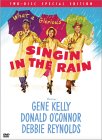
It’s hard to imagine, but it’s been fifty years since Singin’ in the Rain graced the silver screen for the first time. Granted, “yours truly” was still about twenty years in the future; but watching a movie like this makes me want to capture the feeling of what it must have been like for audiences seeing it for the first time. The movie is so magical that it, like others, has become immersed into the American culture. Most likely kids will be singing the familiar title song long before they actually see the film–I did. And what of that title song? How many of us instantly recognize the image of Gene Kelly hanging off a light post, a closed umbrella in one hand singing the dictates of his heart? It’s just as recognizable as Dorothy and Toto, Scarlett and Rhett and E.T. flying across the moon. The accolades don’t stop there, either. Not only was Singin’ in the Rain recognized commercially and critically at the time of it’s release (though it only garnered two Oscar nominations, more on that later); but it’s enduring appeal has yet to diminish. Recently the American Film Institute saw fit to rank it the 10th best movie of all time, the 16th funniest and 16th most romantic (and that’s from a pool of some 40,000 movies, folks). The tagline says it all…”What a glorious feeling!“
Part of the enduing appeal of the film is the fact that it works on many different levels. Not only is it considered the best musical of all time, but even without the music it’s still a very good film. It’s hard to imagine without the music, but the comedy is still there as is the romance. Another aspect of the film is the fact that it uses actual events from Hollywood’s past to center the plot around. The film takes place in the late 1920’s and the world of Hollywood is going full swing. Then a movie called The Jazz Singer opens to commercial acclaim. What’s different about The Jazz Singer is the fact that it combines synchronized sound and music (i.e. it’s the first “talkie”) and the public craves more. The two Hollywood leading stars are Don Lockwood (Gene Kelly) and Lina Lamont (Jean Hagen) who give off the impression that they’re just as hot of an item off the screen as they are on. When it comes to silent films, Don and Lina are on top of the world; but as their latest film “The Dueling Cavalier” receives a less than stellar reaction at a test screening, the studio decides to make it into a talking picture. In a nutshell, that’s the plot; but there’s more and that’s where the film gets interesting…
Don Lockwood and his partner, Cosmo Brown (Donald O’Connor) have come to Hollywood via the “long way”. From their early days of playing their musical act in bars, they have finally made it into show business as musicians. While all of the other stars shine bright, Don and Cosmo are watching from the sidelines. Then, by chance, Don is given a chance to fill in for a stunt man. Giving it his all, he succeeds and he becomes the star that he always thought he could be. Cosmo lives in his shadow, but Don hasn’t forgotten his friend and the two remain close. This is told in a sugar-coated version by Don at the screening of his new movie and gives us a peek at a dance number with Don and Cosmo (Fit as a Fiddle). The new Lockwood/Lamont movie is set to be another silent one, entitled The Dueling Cavalier. However, based on the reaction at a test screening; the picture is scrapped until they can figure out what to do with it. This is where Kathy Seldon (Debbie Reynolds) enters the scene, quite literally. As Don is being mobbed by some adoring fans, he literally makes a break for it and lands in her car. Claiming to be a “serious actress” of the stage, she professes not to know who he is and the two’s initial meeting isn’t a good one. Things don’t change much when she tries to throw a pie at Don at a party and ends up hitting Lina in the face. Kathy is therefore fired from her job and the future between Don and her don’t look too good.
During all of this, the movie is still being made and despite some obvious setbacks, it’s progressing. Sound adds another angle to the film (within the movie) that no one had taken into consideration. Lina’s voice is equivalent to that of nails on a chalkboard! Dictation coaches are hired for the two stars which gives rise to my personal favorite song in the film, ‘Moses Supposes’. Eventually, a plan is hatched between Don, Cosmo and Kathy (after a long brainstorming session which leads into the ‘Good Morning’ song) in which Kathy will use her voice in place of Lina’s for the film. Sacrificing her own career for the love of Don, the plan works…only too well. Lina wants her to become her permanent voice for all pictures, much to the dismay of Don.
Singin’ in the Rain is one of those movie musicals you just have to see to appreciate. The images stay with you forever and it’s actually one of the movies that get better upon repeat viewings. The story is fresh and fun, and though the only consistent thing that I have heard “wrong” with the film is the overly-lavish last musical number, ‘Broadway Melody’ in which Kelly tries to top his own dance number from the previous year in An American in Paris. However, if this is the only thing people can find “wrong” with the film, then it’s still a winner. The film has held up for five decades and with the new DVD, it’s a sure bet that this movie will be winning over new fans for decades more to come. Truly an example of “they don’t make ’em like they used to”. The film gets better and better with age and viewings and it’s a literal no-brainer that this should be a part of anyone’s collection. Highly recommended.
Video: How does it look?
Singin’ in the Rain was originally released as a bare-bones MGM release and then re-packaged into a bare bones release by Warner. Warner, who now controls the rights to a majority of MGM’s titles, has done a brand new 2002 digital restoration and the image is literally nothing short of spectacular. Films this old really don’t and shouldn’t look as good as this does, but it’s a great thing that this looks as good as it does. I have done some side by side screen shots with the older Warner version and the new version and I think that you’ll agree that the difference is amazing. Originally shot in 1952, the movies were still in their full-frame format and therefore this movie can’t take advantage of the anamorphic enhancement that so many other films benefit from.
My first reaction was that the image was a lot sharper than the previous version. The edge enhancement that had plagued the other was nowhere to be seen here. The saturation has also been taken down a few notches (the screen shots have some explanation and it will make more sense to look at those to further illustrate my point). The three strip Technicolor that was originally used is what I credit the film for looking so great on this DVD. Additionally, the colors used in the entire movie are bright and vivid, this is illustrated in the prelude to the ‘Beautiful Girl’ song as well as the ‘Broadway Melody’ number at the end. I could go on and on, but as far as films go, this is a winner and I can’t convey how great (er…glorious) it is to have this film looking this good!
Audio: How does it sound?
The soundtrack has been remastered in Dolby Digital 5.1 and though it pales by comparison to the soundtracks of today, this doesn’t really sound that bad. The songs, of which there are many, all have a very strong sound stage to them. During the ‘Moses Supposes’ number, the tap dancing between Cosmo and Don sounds as if they’re in the same room with you. Dialogue sounds sharp and as crisp as well; probably a lot better than the original release. The surrounds aren’t used a lot, but during some scenes I caught myself turning around to check out the sound. Again, this isn’t Twister, but for a 50 year old movie, this sounds very good indeed. What better way to hear these songs than in Dolby Digital 5.1! Additionally, the original English mono track is provided; a nice touch and for true “purists” this should please most everyone.
Supplements: What are the extras?
I’m paraphrasing here, but I believe that I ended my original review by saying “it would be nice if some day we could get a special edition of this great movie”. Well, no less than a year after I typed those words, here it is! Partially due to the success of other two-disc versions like Doctor Zhivago and Citizen Kane, Warner has hopped on the special edition bandwagon and now plans to release a few of their immense catalog titles as Special Editions a year! Very cool indeed. As if the amazing picture and sound weren’t enough, we get a couple of discs; both bursting with extras.
The first disc contains a feature-length commentary track by Debbie Reynolds, Cyd Charisse, Kathleen Freeman, Stanley Donen (Co-Director, Gene Kelly was the other), Betty Comden and Adolph Green (Screenwriters), Rudy Behlmer (Film Historian) and Baz Luhrmann (Moulin Rouge). The tracks are recorded separately and each segment is introduced by a moderator. The actors’ tracks are essentially that of the shoot, how long it took and the dance numbers. Luhrmann’s is the most interesting as he is in awe of such a great movie (he is trying to re-invent the Hollywood musical with Moulin Rouge). All in all, it’s a great track, though there are some spots here and there as they are most likely just watching the magic on the screen. Some other features can be found on the first disc as well. “Reel Sound” highlights the other silent films of the era (1925-28) and aside from a text-based description, you can click on the posters to the right. My personal favorite is the full “Toot, toot, tootsie” song by Al Jolsen from The Jazz Singer. Interesting and a bit of an easter egg as well. A real bonus was the “Singin’ Inspirations” which is essentially the entire movie with a little highlight reel that can be selected with your remote control (or mouse). Clicking on this gives you some additional information about the movie and it returns once the supplement is over. A bit like the Infinifilm that New Line has for a select number of their titles. Lastly (on the first disc), some additional features are a bit hidden, but nevertheless still there. The awards section has a few text-based screens of the various awards that the film has garnered over the years and some very brief cast and crew bios are shown as well. The original theatrical trailer (the only supplement from the original “movie-only” disc) is included as well. This brings us to the second disc…
First up on the second disc is the new documentary, “Musicals Great Musicals” (note the initials). This is more than what I expected as this isn’t so much to do with the film, but it’s more of a concentration on the great Arthur Freed unit of MGM. Mr. Freed was responsible for some of the greatest musicals ever known including this, An American in Paris, Meet Me in St. Louis, The Wizard of Oz, The Harvey Girls and Annie Get Your Gun (just to name a few). Rare footage and interviews only add to the allure of this great documentary. “What a Glorious Feeling” is a new extended featurette hosted by Kathy Seldon herself (Debbie Reynolds) that concentrates solely on Singin’ in the Rain. From script to screen, almost every base is covered and if you’re like me (and if you’re at this point in the review, you are) you’ll enjoy every minute of it. Amazing to think that Gene Kelly’s title song wasn’t even in the first draft of the script! Something that I was unaware of was that most of the songs from Singin’ in the Rain were taken from old movies (“old” then being the late twenties and thirties) and rehashed into new numbers for the film. All the songs are covered and you can select your favorite song and see the film from which it was originally taken. A clever and very interesting concept for this film. An outtake of a song that was cut from the film was the song “You are my Lucky Star” sung by Debbie Reynolds. You can view this in its entirety here. Not a bad song and I think it would have been just fine if left in the film, but nevertheless it’s nice to have it here. A gallery of about 20 photos is also included, though some are obviously from the set of An American in Paris, is also included. Lastly (yes, we’ve reached the end) the “Scoring Stage Sessions” are included. The songs were recorded in a studio and then dubbed into the movie and here you can select a number of songs (complete with mess ups) to listen to.
This disc truly has it all, almost all the extras any fan of this would want. The movie is timeless and has even creeped its way into my top 5 favorite movies of all time. The sound and picture are a noticeable improvement over the previous edition(s) and that alone would merit a purchase. The only thing that really puzzles me is the fact that the menus are anamorphic, while the movie is full-frame. No big deal, I suppose. In any case, Warner has and will make a LOT of people happy with this release and it’s one that I recommend you run, don’t walk, to pick up.