Plot: What’s it about?
“You’re Norma Desmond. You used to be in silent pictures. You used to be big.”
“I am big! It’s the pictures that got small!”
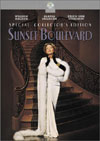
Lines like that can only be associated with one movie…Sunset Boulevard. And I’ll come right out and say it, I’ve never seen it before. Ever since I was alerted to the DVD coming out I’ve been anxiously awaiting it’s arrival, and I suppose I could have gone out and rented the video, but I wanted my first time to see this classic be on a DVD, looking and sounding its best. I’ve read reviews, seen clips from The American Film Institute’s Top 100 lists and such, but have never seen the film. Not many films can really hold up to all of the hype and expectations that are associated with them. I’m pleased to say that this not only met my expectations, it exceeded them by leaps and bounds. Forged from the mind of Billy Wilder, Sunset Boulevard is a slap in the face to Hollywood – no wonder it was (and is) so popular! Nominated for Best Picture (it was nominated for ten Academy Awards in all), it lost to another great movie, All About Eve. It is widely accepted that had this movie not been about the business of making movies, it would have won. This shouldn’t take anything away from Eve, as it’s a great movie as well. But perhaps the most intriguing thing about the film is the fact that it uses real characters from “real” life and that it hit so close to home for two of the main stars (Swanson and Von Stroheim). Join me, if you will, for a look inside Sunset Boulevard.
We meet Joe Gillis (William Holden) dead, floating in the middle of a swimming pool. Yet he narrates the movie from beyond the grave. Right away we know we’re in for something special. Gillis is a starving writer who has moved out to Hollywood in search of a new career. Originally from Dayton, Ohio, Gillis has a few “B” movies to his credit, but is still trying to live the dream and make it big. While trying to avoid some men who are after him (to repossess his car), he gets a blow out and ends up off of, coincide dentally enough, Sunset Boulevard. Thinking the huge mansion to be abandoned, he hides his car in the garage in hopes that the men won’t find him or his car. As he wonders into the house, he finds that it is indeed inhabited by none other than Norma Desmond (Gloria Swanson), a former silent film star who now lives as somewhat of a recluse in this huge house. Thinking that Gillis is here to help her with her dear departed friend (a monkey), the two don’t hit it off at first. Finding out that Joe is a screenwriter, she confides in him her script that she’s been working on. She plans her comeback in a remake of Salome. Joe seizes the opportunity to work with her, having nothing of his own. He stays the night only to awaken to his belongings in her house. He’s moved in whether he likes it or not!
Joe becomes a reluctant gigolo, in as many senses of the word. He pretends to refuse her gifts (new suits, gold cigarette cases, etc.) but yet eventually takes them anyway. There’s attraction on both sides, yet Joe longs to be done with his “assignment” and to hopefully get on with his career. On the “outside world”, Joe has tried to pitch a movie entitled “Bases Loaded”, but a reader at Paramount (Nancy Olsen) has dismissed it as “…a rough re-write of something that wasn’t very good to begin with”. As time passes, Joe seems to have gotten accustomed to the lifestyle in which he supposedly hates. And what of the life? He has no real responsibilities except to be there for Norma whenever she needs him. Part of the same resentment that angers him also keeps him in control when he realizes what he has with her. Perhaps the most amazing thing is how art imitates life. Swanson was actually a silent film star that all but disappeared when “talkies” came out. Her butler, Erich Von Stroheim, was married to her in real life and was the director of several of her films. They bombed and she vowed never to work with him again. Additionally, she was a friend of the legendary Cecil B. DeMille and made films with him. DeMille plays a part in the story and it’s a bit awkward for us to see them together.
Gillis manages to get away from time to time, meeting with Betty Schaefer (the reader from Paramount) to help her re-write a story that was done by Joe. Only a few short months earlier, he would have given his soul for a chance like this, but now he tells her that she can have the story and take the credit for writing it. Amazing the changes that have happened. The conflict arises when Betty professes her love for Joe, even though she’s already engaged to someone else (Jack Webb). This chain of events is what sets in motion the ending of the film.
Sunset Boulevard remains a classic for one reason, it’s use of real people and real-life situations. Somehow, we can relate to the movie better when we know the names they use (Cecil B. DeMille, Alan Ladd, etc.) and even a few silent movie stars turn up in Buster Keaton and H.B. Warner (Desmond has them over for a poker game and Joe has decided to call them the “waxworks”). The biting dialogue, the great story and the sheer subject matter are some things that we see often these days, but this was the first to cross that threshold. If you can accept the fact that Norma Desmond is essentially playing herself, and “over the top” is how the role was meant to be played; then you’ll enjoy the film as much as I did. It’s well-known that the movie is great, earning high spots among the American Film Institute’s Top 100 movies of all time (#12) and the readers of the Internet Movie Database have placed it in the Top 20 as well. Sunset Boulevard is simply superb, I’ve already watched the DVD a few times and I envision a lot more viewings in the future. This DVD is what a lot of people have been waiting for and it deserves a spot in every collection. Highly recommended.
Video: How does it look?
When it comes to Paramount’s transfers, we usually can expect something good, but not great. I’m happy to report that this, like the movie, far exceeded my expectations. The transfer was “meticulously restored” frame by frame by the folks at Lowry Digital Images. Those of you might recognize the name as they’re responsible for some of the best transfers out there when it comes to classic movies. DVD’s like Citizen Kane, Doctor Zhivago, North by Northwest and Snow White and the Seven Dwarfs are all to their credit as well. The film itself is presented in a full-frame transfer that obviously shows how much effort was put into the transfer. There are hardly any signs of artifacting and the film has a very dark, smooth look to it. Only in some scenes could I tell that there was anything out of the ordinary going on. In the scene with Max and Joe talking in the garage, there seemed to be a blinking in the background that had the source material to blame (most likely). Still, for a movie that’s now over 50 years old, this transfer is stunning; no doubt about it. I could go on and on, but trust me when I say that this is top notch (not perfect), it’s top notch. Great job Paramount!
Audio: How does it sound?
There are two tracks on the disc, an English and a French; both of which are in mono. A commentary track is also included, but I’ll get to that later. With mono, there’s not a whole lot that can be done. Movies that have 5.1 tracks from the original mono sound weak and hollow and with the dialogue in this movie, we need to have it sound as clear as possible. The score, by Frans Waxman, sounds great, even though it emits from one channel. The dialogue does have a bit of a “hiss” to it, but that’s to be expected for a movie of this age. Surround effects, as you might expect, are non-existent and the overall nature of this film tends to border on bleak. The sound is better than I expected, but it certainly can’t compete with that of today’s films (it doesn’t need to). Much like the recent releases of this timeframe by Paramount (To Catch a Thief, Houseboat and Roman Holiday) this sounds similar to them. No disappointment here.
Supplements: What are the extras?
Sunset Boulevard is labeled as a “Special Collector’s Edition” and it’s got some supplements to help earn that title. There’s one glaring disappointment that I was shocked to see so blatantly labeled, but I’ll cover that in a minute. First up, we have a feature-length commentary track by Ed Sikov who wrote the book “On Sunset Boulevard: The Life and Times of Billy Wilder”. Sikov knows his stuff here and he’s featured on the other supplements as well. My only complaint with his commentary track is that it sounds like he’s reading it! Yes, really! Don’t get me wrong, it’s informative, well thought out and very perceptive (he’s obviously seen the film countless times), but his dry voice sounds like he’s reading his lines off a piece of paper. Granted, I’ve never been to a commentary track recording, so I don’t know what’s involved, but I found this rather distracting. Next up is “The Making of Sunset Boulevard” which features new interviews with Sikov, Nancy Olsen (who played Betty in the film) and the composer’s son. This might be considered to be your typical featurette, but I was so enthralled with the movie that I was eating up every supplement that I could find. And, I might add, Ms. Olsen looks pretty good for her age! Next up is a Hollywood location map that tells of some of the land marks attached with the movie.
Paramount studios has its own section and we get to see the famous Schwab’s Drug Store, the “used to be” hoppin’ place for Hollywood. Also included are some facts about Norma’s car, house and a little factoid about Joe Gillis’ apartment. We then come to some photo galleries which are divided into Production, The Movie and Publicity. Interesting, to say the least. One of the things that most of us never saw was the original opening to the movie, in which Joe is brought to the morgue. The film was screened in Illinois and the people started laughing when the bodies started talking to one another. Wilder took this to heart and we now have the opening that so many of us are now acquainted with. “The Music of Sunset Boulevard” is a tribute to one Frans Waxman, who went onto become one of the most famous composers in the industry. His son tells most of the story, but evidently he and Wilder were pretty close and it came through in the music of his films. A feature not included on many Paramount discs is a theatrical trailer, well we have one here and it’s a nice addition to an already great disc. My only major complaint is the featurette with Edith Head: The Paramount years. This is the exact same featurette that is found on the To Catch a Thief DVD as well as the Roman Holiday DVD. I’ve no problems with featurettes, but to pass the same one off on multiple discs is just tacky. I hate to end on a sour note, but this is one DVD that needs to be viewed at least once, and preferably part of anyone’s collection. The highest recommendation!