Plot: What’s it about?
Some may not realize that Director John Ford directed over 100 movies in his career. He holds the "record" for Best Director Oscars with 4 (How Green Was My Valley, The Quiet Man, The Grapes of Wrath and The Informer) though most people associate the name with him and long time co-star, John Wayne. What is even more interesting is that Ford was known for his Western’s, but it’s clear to see what the critics liked from him. Ford always used the same slew of actors, ranging from The Searchers or Stagecoach to his non-Western movies. Originally The Quiet Man was a short story published in a magazine, Ford bought the rights to it for $10 and promised to pay the author more should it ever be made into a movie. Though he already had three Academy Awards under his belt at the time he wanted to film The Quiet Man, no studio in town would back him financially, they all thought the movie would fail. Finally, Republic Pictures, which was known for their "B" movies and low-budget Westerns, stepped in and gave him some support. The catch was that he had to make a profitable film before he could work on the movie. So it was Rio Grande with John Wayne and Maureen O’Hara (the same two starred in The Quiet Man as well) which proved to be a success. The rest, as they say, is history!
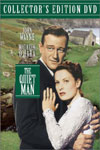
In this, we find a much different John Wayne. He’s not the shoot ’em up cowboy that is so acquainted with his image, he plays Sean Thornton. Sean was born in a small Irish village and he has come back to reclaim his homeland. Thornton has spent the majority of his life in America, where he was a boxer. The trouble is that he had killed another boxer in the ring and the guilt overwhelmed him. He has vowed never to fight again. I couldn’t help but think that this was the subject of From Here to Eternity with Montgomery Clift’s character struggling with the same issues. Sean catches the eye of one Mary Kate Danaher (Maureen O’Hara) and falls instantly in love. The trouble is that her meddling, bossy older brother Will (Victor McLaglen) doesn’t want to see her get married. Eventually they do, but Mary Kate wants the relationship to be as equals, hence the struggle of her dowry, which she isn’t allowed to have. Many several "sexual" references are thrown out, but this being the early 50’s, nothing was shown. The challenge for Sean and Mary Kate is for them to have a normal life together. The town seems to be against them and it seems that a simple fist fight will solve all of their problems. But Sean’s vow never to fight again plays with Mary Kate’s feelings and things may or may not work out for them.
The Quiet Man is a flashback to the way Hollywood used to be. When stories were inspired by things that we just don’t see or hear about anymore. When the phrase "They don’t make ’em like they used to." is uttered, they’re most likely referring to a different breed of actor and movie. John Wayne is synonymous with toughness and Maureen O’Hara is truly the picture of beauty her in her native Ireland. This was one of the first films that was actually shot on location, something that just didn’t happen back them. While the differences in the studio scenes and the Irish is noticeable, it doesn’t detract from the action on screen at all. Wayne and O’Hara were a great couple on screen and if you look close, you might even think that their emotions during some scenes affected the weather (you’ll most likely have to watch it a few times). The Quiet Man ranks up there with my favorite films, and no matter how many times I try and watch The Searchers, I find myself coming back to John Ford/John Wayne and Maureen O’Hara in this fine film.
Video: How does it look?
Like many other releases on DVD, this is now the second incarnation of The Quiet Man. Celebrating its fiftieth anniversary is certainy cause for giving us this new transfer. The Technicolor transfer is remarkable, especially for a film of this age. Then again, Singin’ in the Rain is this old and looks a LOT better. Still, the full-frame transfer holds true to the original look and feel of the film. Shot on location in Ireland, something that was uncommon at the time, there is a plethora of green in the film. Flesh tones look natural, but appear to be a bit over-saturated at times. While some of the scenes looks very clean, some don’t make out too well. This seems to be a off and on transfer, but for the most part it looks great and for a film of this age, it’s hard to make it look better than it does.
Audio: How does it sound?
Much like High Noon which was also released by Artisan at the same time as this disc, this features two audio tracks, an “original” and a “restored”. Also, like the aforementioned title, the original is the way to go as the restored version just sounds too loud and fake. Dialogue is very clear, though it has some patches where that “hiss” comes into play. The Duke never had any trouble being understood, that’s for sure! Obviously made before any sort of “Surround Sound” was thought of, there isn’t much to come into play. A good-sounding mono mix is what you’ll get here and that’s all you really need.
Supplements: What are the extras?
Sporting an ample share of extras, we’re led off with a feature length commentary by Maureen O’Hara. Yes, she’s still alive! O’Hara talks of the movie, though doesn’t really add any pertinent information. Still, the woman is a living legend and it’s admirable that she took time out to record a commentary track for a film that’s 50 years old when some of our “current” Hollywood stars won’t do a commentary track unless they’re paid. Another featurette hosted by Leonard Maltin is aptly titled “The Making of The Quiet Man”. Maltin seems rather comfortable by the roaring fire as he gives us a very detailed recount of how the film came to be. This is a pretty good featurette and it tells much more of the origins of the story (how it was cast, what studio, etc.) and you’ll learn a lot about the movie; unlike some “modern” featurettes. Next up is another 30 minute documentary with Maureen O’Hara entitled “The Joy of Ireland” that essentially tells a lot of the same things. She recounts her experiences with the film, John Wayne and the scenic Irish countryside. On a side note, I found it interesting that no one mentioned how O’Hara fractured her hand. I managed to catch the airing of the AFI’s 100 Years…100 Passions and in that brief segment where this film was mentioned (#76 if you’re curious), O’Hara mentions that when she went to slap John Wayne, she was very angry with him. He put his hand in front of his face (he knew she was really mad and was going to hit him) and as a result of her hand hitting his, she fractured her hand. Not a huge deal, but I found it interesting that they made no mention of it.
In any case, we next are greeted with a three minute montage of images from the film set to music. While not that interesting, it’s a bit moving. Some theatrical trailers are also included as well. I feel The Quiet Man stands up as one of John Wayne’s better movies. His collaborations with John Ford produced some real winners and this is clearly among them. I’ve never been too much of a fan of The Searchers so this would have to be my pick as best Wayne/Ford movie. If you don’t own this DVD, then this is the version to get. It looks and sounds good and is a reminder of how colorful (in as many senses of the word) films used to be. Highly recommended.