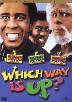
Plot: What’s it about?
Leroy Jones (Richard Pryor) is an overworked, underpaid farm worker and even when he goes home after work, he finds little solace. He lives with his father Rufus (also Richard Pryor) and while his dad is always getting some lovin’ from his woman, Leroy’s wife seems to have a permanent headache. So he is unable to find relief in any aspect of his life, even his coworkers crack wise on him more often than not. But when a labor leader comes to the farm and Leroy falls off a ladder, he is assumed to have joined forced with the labor union, which sends into motion a chain of events that sends Leroy’s life into a tailspin. As the union breakers make him leave town, Leroy heads off to the city and finds himself without work. When he is revealed to be the man who took action back home, he is given a job with some painters, during which he meets the sexy woman of his dreams, though she spurns him at first. Soon enough, Leroy has to manage two women, a climb up the corporate ladder, and what seems like two lives, which is enough to get anyone down. Can Leroy manage to live a normal life once again, or will he forever be wondering which way is up, as he spirals through a chaotic lifestyle?
Although this film was made during Richard Pryor’s most successful years, Which Way Is Up? has remained a little known, underrated picture. I don’t think it is as humorous as Pryor’s finest efforts, but it is a very funny and well crafted movie, one I think will find a broader audience with this DVD release. Pryor handles three roles and is hilarious in them all, which adds immense humor to some scenes, especially the ones where the father and son characters interact, classic Pryor, to say the least. But Which Way Is Up? is not a gimmick picture that relies just on Pryor’s trio of characters, it provides real laughs and some solid writing, but don’t misunderstand, this is not a social message kind of flick. Still, it does have a credible storyline and even some decent character development, but it never lets these elements stall the humor, since the filmmakers know we came to laugh, not to learn. So if you’re a fan of Pryor or just can’t get enough 1970s comedy, then Which Way Is Up? is more than worth a look. Universal’s disc is slim on extras, but I doubt a new version will be released, so this one is still recommended.
Long before Eddie Murphy discovered he could create box office gold by playing a stable of characters in one movie, good old Richard Pryor has used the same formula here, though with less success. This is a movie made to just let Pryor be funny and little else, as he is on screen at almost all times and if you ask me, that’s a lot of pressure. But as usual, Pryor is able to remain in the zone and deliver laugh after laugh, in all three of his roles here. I think having three roles could make it easier to keep up the humor, since each one has unique traits to exploit for laughs, whereas one role has only so many outlets, so to speak. In any event, Pryor is hilarious here and more than handles his trio of characters. Other films with Pryor include Moving, Stir Crazy, The Toy, Brewster’s Millions, Bustin’ Loose, and Superman III. The cast also includes Lonette McKee (Men of Honor, Jungle Fever), Margaret Avery (The Color Purple, Hell Up in Harlem), and Morgan Woodward (Battle Beyond the Stars, Cool Hand Luke).
Video: How does it look?
Which Way Is Up? is presented in a 1.85:1 anamorphic widescreen transfer. This is a better looking treatment than I expected, but of course, the image is still dated and shows more grain than more recent pictures. But for a movie from 1977, I think the transfer looks good and is an obvious improvement over previous home video editions. The print shows some wear and grain, but nothing too serious, so the image remains sharp, though softer than more recent films, but that is natural and should be expected. The colors look a little faded and black levels are on the soft side, but all things considered, I think this is a solid, stable visual effort.
Audio: How does it sound?
Your basic, run of the mill mono option is used here, but given the material involved, it never hinders the experiences. The music sounds a little stifled at times, but aside from that, this mono track is able to handle all the needed tasks involved. I heard little hiss and other age related defects, though as expected, the audio is rather thin at times. But the sound effects come through well enough, while dialogue is clean and sharp, so I see no reason to complain much. This disc also includes subtitles in English, Spanish, and French.
Supplements: What are the extras?
This disc includes some talent files, as well as a selection of production notes.