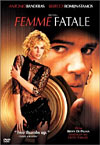
Plot: What’s it about?
You don’t expect to hear the voice of the All-American Fred MacMurray when you go to the movies these days. But in Brian De Palma’s Femme Fatale, we are immediately greeted by his amicable Walter Neff in one of the greatest film noir’s ever made – Double Indemnity. As the camera pans back, we see a near naked Rebecca Romaijn-Stamos as she seems to not only be watching the film, but learning from it as well. A sign of things to come, perhaps? Perhaps. Brian De Palma has been rather hit or miss lately, and though his recent efforts of Snake Eyes and Mission to Mars were rather not well-received, I rather enjoyed them. I was also looking forward to this movie because, well, Roger Ebert called it one of the best movies of the year. I’m a film critic (in a manner of speaking) too, but I’ll take his word over mine any day of the week. A former supermodel (Romaijn-Stamos) and a commercialized import (Banderas) that’s starting to show signs of *gasp* age? This could only lead to one of two things: A great movie in the style and sensibility of Hitchcock…or the worst movie ever. As it turns out, Femme Fatale is more in the sense of Hitchcock, though some might condemn it for being too hard to follow. That’s what happens to movies that are truly original; they get panned and live a short life.
We start out as we see Laure Ash (Rebecca Romaijn-Stamos) getting ready to do her job as a “photographer”. Looking more like a star at the Cannes film festival, we see her don a camera and start taking pictures. The announcers are making noise over one of the starlets and what she’s (not) wearing. As it turns out, the outfit is worth quite a pretty penny and it’s not long that we find ourselves in the same setup as the characters in De Palma’s Mission: Impossible. But, in a strange turn of events, Laure manages to escape with the loot and double-crosses every one of her teammates. She ends up in a house mistaken for a grieving widow complete with a plane ticket to the states. The passport happens to be of a woman that looks exactly like her.
It’s then that we meet Nicolas Bardo (Antionio Banderas), who is always introduced with a split screen. Nicolas is an ex paparazzi and now makes his living doing some more freelance work. He manages to snap a picture of Laure and we then find ourselves transported to the near future (2008), where he is paid to take her picture again (though unknowingly). This is where the movie takes a turn, not here actually, but earlier. To tell too much more would most certainly ruin the film, but the time theory in Back to the Future seems to make sense in explaining what does happen. Maybe one moment in time does, in fact, change the future. Not sense Memento, Sliding Doors and Mulholland Drive will a movie make you second guess what you’re seeing. Or will it?
Brian De Palma is back. I enjoyed the movie so much that I started watching key parts again and the film is much better the second time around. There is a lot of reading involved in the movie. It takes place entirely in France and a majority of the dialogue is in French, but with English subtitles. We don’t know what to expect, what to watch and, really, what the entire plot is all about. We know fragments of what happened to whom and who is looking for what; but we don’t know who is really bad and who to root for. That’s good. While I’m not sure what to make of the lead actors here, they both performed in a magnificient manner and I can’t imagine two others in the lead role. Though a new film, it does play like one of years past. To quote Roger Ebert “…De Palma manipulates images and characters for the simple joy of being good at it. It’s not just that he sometimes works in the style of Hitchcock, but that he has the nerve to.” De Palma, who not only directed the film, but wrote it as well, is back in true form. Highly recommended.
Video: How does it look?
Femme Fatale is presented in an anamorphic ratio of 1.85:1. This surprised me as most of De Palma’s work, both new and old, has been in a wider (2.35:1) ratio. Nevertheless, the image is consistent with most new movies. There are some spots that aren’t so great, exhibiting some grain (more so than that of most newer movies) and a bit of edge enhancement at times. A majority of the movie is dark, very dark and the transfer doesn’t really have a problem with it. The entire color palette is muted and not just because it takes place in France! Though scenes do appear crystal clear at times, there was a quality to the transfer that appealed to me. It didn’t seem to be great on purpose, but it’s good enough (and lives up to the high standard that Warner usually sets for its titles) to not distract you and leave you concentrating on the movie.
Audio: How does it sound?
Brian De Palma must have a natural inclination for music as some of his movies have had the most invigorating soundtracks that I heard. From the opening moments of The Untouchables to the operatic sequence in Mission to Mars, he has never continued to amaze me when it comes to the surround music. Naturally presented in a Dolby Digital 5.1 mix, the ambiance is consistent with that of De Palma’s movies. For a movie two hours long there isn’t a lot of dialogue spoken, or what we would consider to be a lot anyway; but the sound is used effectively. Dialogue, for what is spoken, is sharp and crisp and though the surrounds mainly function to display Ryuichi Sakamoto’s brilliant score. Not so “in your face”, but a great-sounding track that will keep you entertained.
Supplements: What are the extras?
Though not fully-loaded on supplements, Femme Fatale essentially features four featurettes (that essentially say the same thing). Housed in a section all their own, three of the featurettes are pretty self-explanatory. The first, “Visualizing Femme Fatale” is more of the journey from script to screen, how it was made, cast and essentially put together by De Palma and his crew. He does tell of how Romaijn-Stamos was cast (he considers her an “unknown” actress) and of the work that went into her part and the shoot. The next featurette, “An Appreciation” is essentially more of the same. He tells of how the film was shot, how it was made and how he came up with the idea for the movie. The much shorter “Femme Fatale: Dressed to Kill” is more of a collage of images than anything narrative, but still informative nonetheless. Finally, we come to an individually-labeled “Behind the Scenes” featurette, which is actually five more minutes of the telling of the story. True, these tend to become a bit redundant, but each has its own unique label to bring to the DVD and add to the glamour of the film. Some cast bios and a theatrical trailer (and a French one, too) round out the supplements.