Plot: What’s it about?
Sergeant Joe Enders (Nicholas Cage) is a Marine decorated with all kinds of honors, medals, and awards, but his most important mission lies ahead. After some trickery on his medical exams, the usually by the book soldier is allowed to return to service, but his assignment is not a typical one, not by any means. He has been ordered to protect a codetalker, but unlike all the other codes used by the United States forces, this code has never been broken. As such, it is a vital and most important weapon in the battles, so Enders’ assignment is a serious one, though he is reluctant and displeased at the start. Enders is paired with a Navajo codetalker named Ben Yahzee (Adam Beach), while a fellow Marine “Ox” Anderson (Christian Slater) has been told to protect the other codetalker, Charlie Whitehorse (Roger Willie). As the trek begins, Enders is doubtful of the true worth of these codetalkers, but as time passes, he sees their value and when he realizes this, the assignment goes beyond normal duty. Soon enough, Enders and Yahzee are more than fellow soldiers, but if the enemy should capture the codetalker, how far would Enders go to bring back the military’s best secret weapon, who also happens to be his friend?
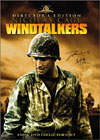
A movie that cost over one hundred million dollars to make, Windtalkers needed to be a hit to turn profits, but instead, audiences turned cold. Even with Nicholas Cage as the headliner and action master John Woo in the director’s chair, Windtalkers failed to spark box office numbers, due in part to bad word of mouth. And while I am a fan of Woo’s career, I was let down with this picture, as he moved away from the story too much, in order to focus on large scale war sequences, which lessens the film’s impact. As well all know, Woo is known for his over the top action scenes and he delivers those here, but he has often been able to weave in a great story also, which doesn’t happen with Windtalkers. The true life material lends itself well to such a movie, but Woo’s focus on action instead of story pushes it to the back, so aside from some window dressing at times, the codetalker aspect is downplayed. Even so, I think fans of war movies and Woo’s films should enjoy the battle sequences, if nothing else. MGM has revisited Windtalkers and given us not only a director’s cut of the movie itself, but a virtual vault of new supplements, including three audio commentary tracks and two discs devoted to extras. If you own the previous edition, be sure to send that one down the river, as this three disc Director’s Edition is superb and highly recommended.
The name player here in front of the camera is Nicholas Cage, who seems to be stuck in some less than rewarding roles. If the subject of the codetalkers was better explored here, Cage might have been able to do more, but with this being more action than drama, he can’t do much more than give a solid performance. I mean, his character isn’t looked at too much beneath the surface, save a few cliche turns, so Cage is unable to open up much here. A little more work on character development and story depth could have allowed a better effort, as we all know Cage can score when he has the right material. Even with limited material to work with, Cage does the best he can and that provides a decent turn, though an unmemorable one. Other films with Cage include Honeymoon in Vegas, Face/Off, Bringing Out the Dead, Leaving Las Vegas, Kiss of Death, and Captain Corelli’s Mandolin. The cast also includes Adam Beach (The Last Stop, Joe Dirt), Peter Stormare (The Million Dollar Hotel, The Big Lebowski), and Christian Slater (True Romance, Interview with the Vampire). If you want more of John Woo’s direction, check out The Killer, Once a Thief, Hard Boiled, and Mission: Impossible 2.
Video: How does it look?
Windtalkers is presented in 2.40:1 anamorphic widescreen. The new footage has been inserted without a hitch here, so you won’t see any noticeable changes in terms of visual quality, which is great news. In the end, this looks much like the previous disc’s treatment, which means we couldn’t ask for a better presentation. Not just an excellent visual effort, but one of the best visual treatments out there on home video. This is a reference level treatment in all aspects, starting off with a pristine source print that has no grain, marks, or other blemishes to discuss. The colors stream in vivid hues, with rich and full textures, while flesh tones are consistent throughout also. I was blown away by the black levels, which are razor sharp and highly refined, simply top notch work here. This is easily one of MGM’s best transfers to date and beyond that, one of the best I’ve seen period, terrific work in all respects.
Audio: How does it sound?
The audio here is solid, but given the smashmouth style used in the action driven scenes, I expected more power & dynamic presence. I do think the bass is deep & effective, but beyond the super loud stuff, the included Dolby Digital 5.1 soundtrack falters somewhat. The scenes lack depth, with just a lot of well placed loud impact noises, but without the more subtle and background effects, it all seems rather flat at times. So the mix is by no means thin, but it could have been much better, with more work on the smaller touches. The music and dialogue always sound excellent though, so no worries on those fronts. This disc also includes a French language track, as well as subtitles in English, Spanish, French, and Portuguese.
Supplements: What are the extras?
As this is a three disc release, we’ll run down the extras disc by disc, with the movie disc up first. In addition to the extended director’s cut of the film itself, this first disc also houses a trio of audio commentary tracks. On the first track, we have director John Woo and producer Terence Chang, the second track features stars Nicholas Cage and Christian Slater, and the third session is with star Roger Willie and Navajo consultant Albert Smith. As you can imagine, each track has a unique perspective and when combined, these sessions provide a broad, insightful look into how Windtalkers was produced. I am always glad to hear from Woo, so I found the first track to be the best, but all three are well worth a listen. The first disc also includes an introduction by Woo, as well as two of the film’s theatrical trailers. The second disc has a featurette on the music of Windtalkers, as well as a tribute piece to the men who served as Navajo Codetalkers. The real draw of this second disc is The Code Talkers, an extensive documentary that explores the path the codetalkers endured. This piece adds a lot to the film’s impact, as we get a better idea of the trials & tribulations, as well as a more personal look at the men involved. The third and final disc is all about the behind the scenes experience, so prepare to go inside the production. You can browse four scene diaries, as well as a special look inside the actors’ boot camp, which is quite cool, since we’ve heard so much about these camps. This final disc also includes a talent file on Woo, some behind the scenes photos, and multi-view features on four action sequences.