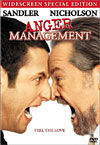
Plot: What’s it about?
Dave Buznik (Adam Sandler) was involved in a mishap on an airplane, one which should have been simple, but spiraled out of control. Although he never crossed a line of conduct, Buznik was found to be at fault and wound up sentenced. He wasn’t sent to prison or even put on probation however, though he might wish he were before its all said and done. Instead, Buznik is ordered to attend anger management sessions and not just any sessions, but ones with one of the nation’s most respected therapists. Buznik is to take the classes with Dr. Buddy Rydell (Jack Nicholson), a well known therapist with some unusual methods. The sessions are loaded with offbeat clients, some of whom have worse cases of anger management than others. But Dave feels out of place at the meetings, as if he was placed in the class by total misunderstanding. For some reason, Rydell is abrasive to Buznik at every chance, while he lets other clients slide, even when they act out on their moments of rage. This drives Buznik up the wall, as Rydell is giving him problems all the time and shows no sign of letting up on the abuse. When yet another mishap lands Buznik back in hot water, Rydell moves in with him, to step up the treatments. But will this prove to help Buznik, or simply send him straight off the deep end?
The previews for this movie were quite offbeat, so I hoped to see star Adam Sandler return to his bizarre roots. His more recent films have had all of his trademarks, but just haven’t been as strange in the overall tone. If you go back to Billy Madison and Happy Gilmore, those two flicks can be as weird as can be, but his later works have lost much of that oddball texture. Some touches of the bizarre can be found in all of Sandler’s films, but I was looking for Anger Management to be a return to those old days. As it turns out, this is a more reserved picture than expected and while some odd moments are strewn about, Anger Management isn’t as off the wall as I expected. Sandler has a more restrained presence here also, which means his costars have to bring much of the needed chaos, though that never proves to be a problem. Jack Nicholson gives yet another way, way over the top performance, while a chain of impressive cameos makes sure you’ll pay close attention, or else you might miss one. This is your basic Sandler picture in most respects, with the same kind of formula found in his other productions. So if you’re not a fan of Sandler’s brand of cinematic humor, don’t expect to be won over here. But if you are into his kind of laughs, then you’ll want to check out Anger Management.
He’s played the same role over and over again, but he never seems to lose steam with his dedicated fanbase. I know a lot of folks bash Adam Sandler for his lack of diversity with his roles, but when an actor finds a type of role he can nail, should he be forced to expand his horizons? After all, Sandler’s films have done very, very well at the box office and his fans keep their support strong, so why should he switch lanes? In truth, his roles have started to show some signs of change, as he moves from his more bizarre work to more sentimental kind of stuff, look at the differences between Billy Madison and Big Daddy for evidence. But while his character is becoming more mature and reserved, the movies have remained over the top and silly, though with a little more sentiment with each passing film, it would seem. Anger Management is more of the same from Sandler, which is good news for some, and more bad news for others. Other films with Sandler also include Happy Gilmore, The Wedding Singer, Bulletproof, Mr. Deeds, and Punch-Drunk Love. The cast also includes Jack Nicholson (About Schmidt, Batman), Marisa Tomei (The Watcher, Four Rooms), and Luis Guzman (Boogie Nights, The Salton Sea).
Video: How does it look?
Anger Management is presented in 2.40:1 anamorphic widescreen. This is a Columbia new release, so of course, it looks excellent. The print looks very clean, as expected, though some light grain is evident in some scenes. The visuals remain crisp and sharp at all times, as softness is never an issue in this presentation. I found no signs of compression flaws or edge enhancement either, which is great news, of course. No trouble with the colors to be seen, as hues come off as bright and vibrant throughout. I also found flesh tones to be warm and natural, while contrast offers refined and consistent black levels. So we have another top notch new release treatment from Columbia, but did we expect anything else?
Audio: How does it sound?
The included Dolby Digital 5.1 track won’t disappoint, but this material isn’t that powerful, so don’t expect too much. The main surround presence comes from the musical soundtrack and a few audio intensive scenes, which gives the mix some moments of life. The atmosphere is active when it needs to be, but that it isn’t often and as such, the front channels handle most of the burden. This is how it should be however, as the film is dialogue driven and the vocals are well presented, with no real issues to report. This disc also includes a French language track, as well as subtitles in English and French.
Supplements: What are the extras?
A rather dull audio commentary is found here, as star Adam Sandler and director Peter Segal sat down to discuss the picture. A lot of time is spent repeating what is happening on the screen, which can be quite boring, to say the least. Some nice tidbits manage to sneak through, but all in all, this is a lackluster session. This disc also includes two behind the scenes featurettes, some deleted scenes, a brief blooper reel, and the film’s theatrical trailer.