Plot: What’s it about?
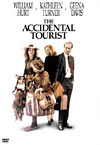
“The Accidental Tourist” is one of those movies from the 80’s that seems like it was somehow overlooked when it first arrived on screen; yet it wasn’t. When the film came out, I was in High School, a fan of movies, but not like I am now. I was familiar with William Hurt and Kathleen Turner only for their great performances in “Body Heat”, a loose remake of “Double Indemnity” with some more steamy sex scenes. Screenwriter and Director Lawrence Kasdan has done a superb job adapting the novel to the screen and it shows in nearly every frame. Kasdan, known for countless efforts in writing (“Raiders of the Lost Ark”, “The Empire Strikes Back” and “The Big Chill”) for the screen has come up with a modern day movie that many can relate to. The movie features a great cast with William Hurt, Geena Davis, Kathleen Turner, Ed Begley Jr. and a young Bill Pullman rounding out the well-known actors. But the real treat of watching the movie is seeing it again…
Hurt plays a travel writer by the name of Macon Leary. He’s rather unhappily married to his wife, Sarah (Kathleen Turner), but it’s a relationship that seems to work because of their son. All of the sudden, the son is killed and Sarah announces to Macon that she can’t handle the married life anymore and the two split. Macon accepts this and takes the family dog and lives by himself. Macon is a man of rhythm and routine. His books are written so that when Americans travel, they can feel more at home. He travels all of the time, yet doesn’t really like to. It’s only because of his upbringing that has been so conditioned into him, that he’s able to make it on his own. When he can’t take the troubles with the dog anymore (most likely because it’s a break in his routine), he goes to a kennel. There he meets it’s owner, Muriel (Geena Davis). Muriel is essentially the opposite of everything that Macon is. She’s a free-spirit, doesn’t follow structure and lives life to the fullest. Macon has moved back in with his brothers (Davig Ogden Stiers and Ed Begley Jr.), who still live at home, and reluctantly agrees to accompany Muriel on a date.
The movie is all about change, human change at that. Macon has become so conditioned to do things a certain way, that he has missed out on most of the fun of what life is supposed to be. Muriel manages to try and change all of that, but when she accompanies him to Paris, Sarah shows up to try and rekindle their marriage. What I found so intriguing about the film is how naturalistic everyone was. From Macon’s publisher (Bill Pullman), to just about everyone that he meets. You don’t believe that these are characters in a movie, but moreover friends who you might have in everyday life. The direction is superb and Kasdan brings that same spark that he brought to “The Big Chill” and “Grand Canyon”, oddly enough, both films seem to have the same echo of humanity that this does. Aside from this being the movie that Geena Davis won an Oscar for, this is a portrait of a family that isn’t necessarily limited to the bounds of marriage. Highly recommended.
Video: How does it look?
The video transfer for “The Accidental Tourist” is shown in an anamorphic 2.35:1 ratio. The movie uses a lot of different light to express the varying moods of the film. For instance, when Macon identifies his son in the hospital, a very green almost “Matrix-like” tint is used as we see the expression in his eyes. The majority of the movie relies on a very muted palette that correctly identifies the look and feel of the movie. Artifacting is not a problem and though there are a few areas in which the transfer could have been improved (very minor, though), I found the transfer to be on par with most films of the day. All in all, not the best transfer out there, but certainly not the worst.
Audio: How does it sound?
Audio-wise, the movie boasts a Dolby Surround track, while not on par with today’s 5.1 tracks, this has a few moments when it’ll make your head turn. Certainly “The Accidental Tourist” isn’t a movie for truly dynamic audio, but the mostly dialogue-driven track takes full advantage of what it can. At certain points during the movie, surrounds (matrixed at that), take effect and for a movie made in the late 80’s, I would have to say that this is right on par with movies of it’s genre and age. Viewers shouldn’t be disappointed with the audio, either.
Supplements: What are the extras?
As far as extras go, there is a screen-specific audio commentary with Geena Davis. Though not really too insightful, and we hear most of the same thing in the featurettes, it’s nice to have this option. Davis naturally has a soft spot for this film as it gave her the Academy Award for Best Supporting Actress. A new introduction with Writer/Director Lawrence Kasdan is shown as he tells us about how the film came to be and how he adapted it from the best-selling book. Coupled with some archived footage of Kathleen Turner, Geena Davis and himself (circa 1988), this featurette and “It’s Like Life” pretty much spell out the story. So be warned, if you’ve seen the film before, it’s safe to watch these, otherwise some spoilers are shown. Some deleted scenes (entitled “Lifted Scenes”) are shown as well, though it’s clear why they didn’t make the final cut. A theatrical trailer is also included.