Plot: What’s it about?
Charlie Babbitt (Tom Cruise) is a ruthless businessman, a man who never thinks of anyone else but himself, unless he has a lot to gain by doing so. The world revolves his wants and needs, or at least that is how he treats his existence. He wants to succeed, to have a massive house, the coolest automobiles, and a substantial bank account. Charlie has hustled people his entire life, doing so without a second thought or second of remorse. As a young man, he was thrown out by his father, a moment that has remained within Charlie ever since. Now, his father has passed on and left his son a surprise inheritance. Charlie always knew his father would remember him, but he wasn’t sure how much money, property, or other goods would be his. As it turns out, he was left with an antique vehicle and no other material possessions. No cash, no land, just a slick car and another surprise that rocks Charlie’s world. The rest of his father’s worldly goods were left to a man named Raymond (Dustin Hoffman), a man Charlie didn’t know existed. But Raymond is Charlie’s brother, which means if he wants the cash, Charlie must take his brother into his life. This won’t be easy, as Raymond is autistic and has some unusual patterns to his life. Can Charlie put his own life on hold, while he discovers a new life with his newfound brother?
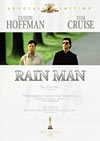
A lot of dramas are reliant on emotional manipulation, that is to say that the emotional impact is due to a sucker punch. But the elite level pictures don’t need to resort to such tactics, as the story, characters, and atmosphere set the emotional stage. One such film is Rain Man, the acclaimed motion picture directed by Barry Levinson (Disclosure, Liberty Heights). Rain Man took home four Oscars in 1988, including Best Actor for Dustin Hoffman, Best Director for Barry Levinson, and the crown jewel of all awards, Best Picture. I admit that this movie pulls the heartstrings, but I think the emotion that the movie builds is genuine. Barry Morrow and Ronald Bass were awarded with an Oscar for Best Original Screenplay for good reason, as the story is well told and allowed to develop at a natural pace. This ensures the emotion isn’t forced or rushed, but instead allows the audience to become invested in the characters. Hoffman and costar Tom Cruise deserve immense credit also, as their performances are excellent in all respects. Cruise proved he was more than a sex symbol, while Hoffman continued to establish his place as one of the best actors of his time. This is just a well made, effective picture that remains on your mind long after the end credits. I am thrilled to see MGM release a new Special Edition, as this is a movie that deserves such treatment. So if you’re a film buff of any kind, Rain Man is highly recommended.
His costar might have won a lion’s share of the attention, but no one could overlook the intense, memorable performance of Tom Cruise. At the time, Cruise had been a major star for a while, but hadn’t proven his dramatic skills. His work had been in comedies or action flicks, movies that didn’t require much beyond his looks and screen presence. But with Rain Man, Cruise established that he was a talent beyond his physical traits, as his skills as a dramatic actor were proven beyond a shadow of a doubt. He is simply incredible as Charlie here, a role which should have earned him an Oscar and immense praise, but didn’t. Sure, Cruise was given more respect thanks to his effort here, but he was still better known for his lighter, less demanding material. His costar’s performance might have overshadowed his own, but the chemistry was obvious and both men made the most of their gifted coworkers. These days, Cruise is back to action movies for his paychecks, but a return to real drama would be most welcome. Other films with Cruise include Mission: Impossible, The Firm, The Color of Money, Top Gun, and The Last Samurai. The cast also includes Dustin Hoffman (Straw Dogs, The Graduate), Valeria Golino (Immortal Beloved, The Indian Runner), and of course, Michael D. Roberts (The Ice Pirates, Most Wanted).
Video: How does it look?
Rain Man is presented in 1.85:1 anamorphic widescreen. This is a fine visual treatment, one which captures the atmosphere of the material well. Of course, the full frame edition has been left off this time around, which is excellent news. The print has some minor defects at times, but looks clean and allows for a crisp, refined visual presence. The colors have a bright, but natural look, as intended, while flesh tones remain warm and normal. No troubles with contrast either, as black levels are stark and consistent, with no visible detail loss. All in all, a terrific visual presentation from MGM that should please fans.
Audio: How does it sound?
This movie is not designed to test your home audio system, but even so, included Dolby Digital 5.1 option is a solid soundtrack. The material is rather reserved, which means focus is on dialogue and low impact audio, so don’t expect a rush of raw power. A few scenes do spark up the surrounds, but only to a basic extent. The added presence spices up the experience, but it still only makes middling use of the channels. I wouldn’t complain however, as the material sounds just as it should, added presence could lessen the entire soundtrack. So while surround use is faint, it is just as the material dictates. The musical score sounds lush and well placed also, while dialogue is strong and never hard to understand. This disc also includes Spanish and French language tracks, as well as subtitles in English, French, and Spanish.
Supplements: What are the extras?
If you’re a fan of solo audio commentary tracks, then this release is going to thrill you beyond all belief. The first track is with director Barry Levinson, who provides an in depth, candid take on how the movie was produced. He discusses his cast at length, especially the two leads, then moves between numerous other subjects. You can also listen to sessions with screenwriters Ronald Bass and Barry Morrow, who detail the creation process. Morrow talks about the genesis of the material, while Bass deals with how it was brought to the screen. This disc also includes a deleted scene, some production photos, and the film’s theatrical trailer.