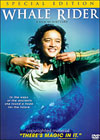
Plot: What’s it about?
“Whale Rider” is the story of a young girl who refuses to sit in the back of the bus. More specifically, it’s the story of a young Maori who refuses to take a seat on the back bench while her male classmates sit up front learning about what it takes to be a leader in their New Zealand tribe. This budget-minded film that’s racking up awards on the festival circuit is a feminist manifesto, for sure. It also wants to make a point about the importance of cultural identity. First and foremost, though, “Whale Rider” is just a good story.
It begins when a young man named Porourangi (Cliff Curtis) watches his wife die after delivering their twins. One of the children, a boy, dies too. Afterward, Porourangi’s father, Koro (Rawiri Paratene), can’t stand to look at Pai, his granddaughter, who survived. All he can think of is the lost son, the boy destined to be tribal leader. This, he tells us, was the day when things started going wrong for his people. Despite his father’s hostile views, Porourangi leaves Pai (Keisha Castle-Hughes) to be raised by her grandparents. At first it seems as if Koro has learned to love the girl, but it isn’t long before he’s consumed by his obsession to find a leader for the tribe. When she isn’t allowed to join Koro’s leader-training school for first-born boys, Pai sets upon teaching herself what she needs to know to fulfill her destiny.
The spectacular New Zealand setting makes the perfect backdrop for the movie’s blend of realism and fantasy. And the blue hues of the up-close-and-personal whale footage adds to the mystique. The film does have its disappointments. After Koro affectionately drives Pai around in circles on his bicycle, the bad-guy routine he adopts in the second half of the film doesn’t ring true. Then there’s the way writer-director Niki Caro tries to paint Koro’s wife, Nanny Flowers (Vicky Haughton), as the one who really runs the household. If that were the case, Koro wouldn’t get away with being cruel to their children and their only grandchild. Pai is a more complex and convincing character. With the forgiving nature of a true leader, she continues to love Koro even when he treats her badly. Caro was lucky to find Castle-Hughes to play Pai. The young actress clearly knows the role inside out.
In the final moments of the film, “Whale Rider” transforms from fantasy to fairy tale with Pai’s version of a white knight riding her off into the sunset. It’s an ending young girls will love, but jaded adults may find themselves jarred by the too-sweet note. Although the two films share similar themes, “Whale Rider” doesn’t rise to the level of John Sayles’ magical “The Secret of Roan Inish.” But it’s a likeable tale, one that’s sure to win over kids and adults who still believe that all things are possible.
Video: How does it look?
Columbia presents Whale Rider in 2.35:1 anamorphic widescreen. Colors are bright and well-saturated. Also, there are the occasional blue overtones, but most of the presentation sees a lot of different colors. Minor grain appears here, but other print flaws don’t exist. The print quality is in very good shape. Dark tones and black levels are solid and have good depth. Overall, this is a very good presentation.
Audio: How does it sound?
Whale Rider features an English 5.1 Dolby Digital Surround Sound. This presentation really doesn’t have much sound to utilize the surround sound medium. Except for a few songs and Lisa Gerrard’s score, the soundtrack is pretty quiet. Yes, dialog scenes are clear and easy to understand, although many of the sound effects are hardly accentuated across the soundfield. I didn’t expect a lot here so I wasn’t very disappointed with this presentation. I mean, it’s fine, but doesn’t do a whole lot to make this a truly surrounding experience. An English 2.0 Dolby Surround Sound option is also available.
Supplements: What are the extras?
Taking in just above $20 million at the box office earlier this year, Sony gives Whale Rider a pretty nice and above all deserving special edition treatment.
Director Niki Caro may be heard in an full-length audio commentary. The track contains some good information and discussions, yet Caro sometimes ventures off into other things. She is very soft-spoken and passionate in her chat.
Next is the 27-minute Behind the Scenes of Whale Rider which focuses on the performance of Keisha Castle-Hughes and the adult actors, as well as a little on the the background of the story, filmmaking process and scoring music with Lisa Gerard. Also available is a ten-minute look at the construction of the giant Maori canoe in a featurette called Te Waka: Building the Canoe. It’s a neat little presentation for a scene that holds much significance in the film.
Following that are eight deleted scenes with optional commentary by Niki Caro and producer Bill Gavin. Some of them are nice to watch, but overall these scenes don’t add too much valuable information. Rounding out the extras is the film’s theatrical trailer, TV spots, art & photo gallery, and soundtrack presentation.
You can select to view the film with optional English and Spanish subtitles. The 101-minute feature is organized into twenty-seven chapters.