Plot: What’s it about?
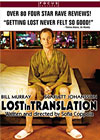
“Lost in Translation” is the sophomore effort from Sophia Coppola. Her first work (as a director, she has also acted) was with an ensemble cast in the acclaimed “The Virgin Suicides” a few years back. Coppola has teamed with Bill Murray, who is turning into a very respected dramatic actor even though he’s been known primarily for his roles in comedies for some twenty years. Murray doesn’t disappoint and the film doesn’t, either. The cast is small when it comes to big name stars, with Murray and Scarlett Johansson and one of my favorite actors, Giovanni Ribisi headlining. The movie moves at a pretty slow pace, we’re not really sure what to expect, yet it’s all spelled out for us pretty quickly. Confusing, huh? Essentially anything with the name “Coppala” attached to it will attract moviegoers. In this case, though, it’s Sophia who is pulling the strings and not her acclaimed father. What is more interesting is that the entire Coppola family must have talent running in the blood, because Talia Shire (aka “Mrs. Rocky”), Jason Schwartzman (“Rushmore”) and Nicholas Cage all stem from the same bloodline. Talk about a talented family! But let’s get right down to it, what is “Lost in Translation” all about?
Bob Harris (Bill Murray) is a movie star, though his stock seems to be falling. He’s getting older, yet still gets attention on the street and has just been paid $2 million dollars to endorse a Japanese brand of whiskey (which he drinks on any occasion he can think of) and hates himself for it. He’s obviously not a happy man, though he has a family. He loves his kids “…they’re a miracle…” he confesses to Charlotte. Though on the same token, his wife calls and ribs him about unimportant things. “Do I need to worry about you, Bob?” – “Only if you want to.” He replies. On the other end of the spectrum we have Charlotte (Scarlett Johansson), a recent graduate of Yale who has been married for two years. Her husband (Giovanni Ribisi) is a workaholic photographer. She’s came along with him to Tokyo because she literally has nothing better to do and even in Tokyo, wanders aimlessly around looking for some meaning to her life. Bob notices Charlotte in the elevator and after a few chance encounters, the two start to become friends. Though the age difference is quite obvious, they discover that they have a lot in common. Both are searching for happiness and though their situations dictate their actions, the two feel a strong attraction. For Bob, he’s pondering life, his health and what the future holds. Charlotte, just starting out, is having second thoughts on her marriage, dislikes having nothing to do and is doing some soul-searching of her own. Now that these two have found each other, what’s the next logical step?
Movies like this can go one of two ways, into a predictable “affair” type movie or just the opposite. Yet, every time we think we know what will happen, something else takes place that takes our minds off the previous scene. Take, for instance, a scene in which Bob and Charlotte come back to their hotel after a night of partying, he tucks her into bed and we think the two might sleep together. The next scene, Bob is on the golf course! We’re not intentionally led down a path and a lot of the emotion that we feel for the characters comes from the stigma that we think all they want to do is sleep with each other. The chemistry between Bob and Charlotte is something they both know they have and it makes both of their lives much happier for it. “Lost in Translation” has been nominated for four Academy Awards including Best Picture, Best Actor and Best Director. Murray gives a great performance that is anything but over the top. It’s hard to imagine him as Carl from “Caddyshack” after seeing this film. The movie may not be for everyone; it moves at a gentle pace and rarely picks up. Still, I look forward to more work from Bill Murray (who will hopefully return to comedies someday) and Sofia Coppola as well.
Video: How does it look?
“Lost in Translation” comes to us in two versions, a full-frame and an anamorphic widescreen version. The 1.85:1 image looks great in some scenes and downright poor in others. Shot on a low budget, this isn’t your typical glossed-over Hollywood production. The scenes seem gritty and a few have problems with edge enhancement and fuzzy edges. There are some scenes, though, that are so beautifully shot and look great on the screen. Take, for example, the scene in which Charlotte crosses the pond. The clever use of the camera does help the story, but I kept thinking to myself how good this could look. Fleshtones are on target, though the entire picture tends to use de-saturated colors. While I was expecting more from a day and date DVD, this certainly won’t disappoint.
Audio: How does it sound?
Universal has been a strong supporter of the DTS format ever since it appeared a few years back. The disc comes equipped with dual Dolby Digital and DTS tracks and either one will more than satisfy. While the movie doesn’t exactly scream audio, there are a few spots in which it gets to shine. The soundtrack has a very rhythmic tone to it, such that it fills the room. While the dialogue is clear, we don’t get a lot of action from the surrounds. The front three channels are very active and during a few spots (the party and the casino), they get a chance to shine. As mentioned before, the dual tracks are great and either one you choose will generate great results.
Supplements: What are the extras?
Let me preface this by saying that before you even get to the movie, there are 5 minutes of trailers. You can fast forward to the menu, but some of the older players out there won’t let you do this. I feel this is tacky and consider watching this in a few years, we’ll be forced to see trailers for movies that have been on whatever format for years…Given the attention that the movie has been getting, Universal has added a few supplements to the disc. Missing, though, is a commentary track! The main supplement is “Lost” on Location. This is a documentary that starts in September 2002 and follows the cast and crew through the filming of the movie. While it runs thirty minutes, we get a feel for the mood and the rushed shooting schedule. One thing I noticed is that Sofia Coppola (who also wrote the screenplay) has a distinct passion for the movie. Being the writer/director, there’s really no one to blame except the actors. Five deleted scenes are shown in non-anamorphic widescreen and a few of them I wished would have been in the movie. There’s a theatrical trailer included as well as a music video “City Girl”. A 15 minute discussion with Bill Murray and Sofia Coppola is also shown, they’re in Rome in September 2003 talking about the movie. In this, they explain their motivations about the film, why they decided to do it and even reflect a bit on it. Though not as informative as I would have hoped, it’s not without value. Lastly, the full version of “Matthew’s Best TV Show” is included. This is the show that Harris (Murray) appeared on in the movie, this is shown in its entirety. I was as lost as the next non-Japanese speaking person…