Plot: What’s it about?
[quote author=”- Mary”]I finally had an orgasm, but my doctor told me it was the wrong kind.[/quote]
After the critical success of “Annie Hall”, where would Woody Allen’s career as a director and actor go (and yes, it was the right choice for Best Picture, even with “Star Wars” in the running)? Allen has often been criticized for portraying the same character in every movie and while this is a valid argument, I think in a few he is a bit different. Actually, I feel like his character in the beginning of “Manhattan” in which he is trying to phrase the first chapter of his book and trying to get it exactly right. He finally decided on a way to introduce the story, whereas I feel that I’m not doing so great. Many feel that this movie is second only to “Annie Hall” and though many of the same elements exist in the two, I liked a few of the elements here better. First of all, any time you set a movie to the music of George Gershwin, you’re going to have and advantage. “An American in Paris” had several songs set to the Gershwin tune and walked away with a Best Picture Oscar (though many feel “A Streetcar Named Desire” or “A Place in the Sun” should have taken that honor). “Manhattan” is not only an ode to the city that never sleeps, but an intelligent and engaging romantic comedy. Here’s why…
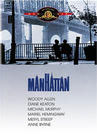
Isaac (Woody Allen) is 42 years old. He’s enjoying his life as a writer for television and working on a book in his spare time. He’s also dating Tracy (Mariel Hemingway), a 17 year-old High School Student who is in love with him. Isaac realizes the dilemma he’s in (besides committing statutory rape) and constantly tells Tracy that she has her whole life ahead of her, she’ll meet other men, etc. Tracy, wise beyond her years, doesn’t want to accept his words but rather enjoys his company. Yale (Michael Murphy) is a close friend of Isaac and is somewhat happily married to Emily (Anne Byrne), but is having an affair with Mary (Diane Keaton). Lest we not forget Isaac’s ex-wife (Meryl Streep) who has just left him for another woman and is in the process of writing a tell-all book about her marriage to Isaac (anyone detect a familiar theme here…”Friends” anyone)? As Isaac breaks off his relationship with Tracy, Yale breaks off his affair with Mary. Mary and Isaac then start seeing each other; though in a very different way than in “Annie Hall”, and everyone appears to be happy. This is, until, Yale decides that he is still in love with Mary and she with him. Confused yet?
What makes “Manhattan” stand out from other Woody Allen works is that it’s original, but yet still oozing with that Woody Allen persona. He’s still the typical neurotic and cynical character that he is in most all of his films, but it seems right here. He’s also a lot more human and not the lonely and desperate person we see in other films. Though the music of George Gershwin makes the film a bit more memorable, it’s not as present as one might think. The opening scenes feature a skyline bursting with fireworks set to “Rhapsody in Blue” and really set the stage for what is a great movie. Diane Keaton isn’t the same ditzy character of Annie Hall, she’s a more intelligent individual who philosophizes too much and finds somewhat of a connection with Isaac. Those looking for Meryl Streep may want to look a bit further, she’s only on screen about ten minutes of the movie and hers is a subplot that the film may do better without. Fans of Woody Allen have probably already seen this time and time again, but for those (like me) who are starting to look at his older movies, this one is a good place to start. Additionally, Hemingway earned a Best Supporting Actress nomination for her work here and Allen for Best Original Screenplay. Both, however, lost.
Video: How does it look?
“Manhattan” is somewhat of a rarity in that it’s shot in a wider scope that the rest of Allen’s movies. Also, bucking the trend, the movie is shot in black and white. The 2.35:1 anamorphic image is one of the better movies that I can think of that really shows off the beauty of a widescreen image. Consider the opening titles in which we see fireworks exploding over the skyline. I can’t imagine how this would look cropped off on regular television. There’s a scene in which Tracy and Isaac are in his house, with a spiral staircase on the right side of the screen. It really sets the scale for that scene and is chopped off on any other format. As far as the image itself goes, there is a bit of grain to it, though the errors aren’t as evident in black and white as they are in color. There seems to be some scenes that are razor sharp and others that appear soft. A few of the scenes are totally black, thereby leaving us to rely on the dialogue to follow the story. The truth is that “Manhattan” is one of the better-looking films on DVD not because of the image quality, but because of the way the images look.
Audio: How does it sound?
Dialogue, dialogue, dialogue…if there’s something that Woody Allen movies are associated with it’s the ever-present dialogue. As with most of his movies, the soundtrack is mono only, but I found it to be particularly strong. The Gershwin songs seem to boom out of the center channel and there was no loss with the sound. The film is now twenty five years old, but for a mono soundtrack of this age, I was pretty surprised. There’s no “hiss” that’s associated with some films of this age and all of the dialogue is faithfully reproduced here. Everything sounds clean and natural and even the Gershwin score sounded terrific. I was pleasantly surprised here.
Supplements: What are the extras?
Sadly, only the original theatrical trailer is included.