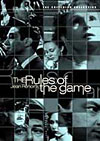
Plot: What’s it about?
My, what a difference twenty years makes. Jean Renoir’s “Rules of the Game” came out in a year that was literally one of Hollywood’s best. This was the year when “Gone With the Wind” picked up so many Oscars and movies like “Mr. Smith Goes to Washington”, “Stagecoach” and “The Wizard of Oz” came out as well. Though, for as good as all of those movies are, it’s this French film that has had critics raving (though not audiences…until later) since it got a touch up some twenty years after it came out. Huh? What? The film, originally much shorter than the 106 minute running time we know now, was criticized and audiences hated what they had just seen. In an equivalent to “burning down the house”, they not only wanted their money back, they wanted justice! Some years later, movie historians added some footage back into the film, thereby giving it about twenty five more minutes of running time and – viola – instant film classic. What was once bad is now “good”. Amazing what a little time and some more character development (in the form of additional scenes) can do to a movie. But aside from that, “The Rules of the Game” angered the French as it portrayed them in a negative light. So what was all the fuss about to begin with?
Aviator Andre Jurieux (Roland Toutain) has just returned from a historic transatlantic flight. Upon his arrival, he discovers that his lover isn’t in the crowd of his admirers. Breaking the first rule of society, he declares his pain over the radio. At the same time, Christine de la Cheyniest (Nora Gregor), preparations are being made for a shooting party and she and her husband, Robert (Robert de la Cheyniest) have heard the broadcast of Andre. Christine, fears that Robert will get the wrong idea and clarifies that Andre is nothing more than a friend. This leads Robert to fly off to his mistress to break off the affair that he’s having. But Octave (Director Jean Renoir), knowing all of the involved parties, suggests that everyone be invited to the shooting party and clear the air; and, presumably, to establish everyone’s innocence. This works, to a point, and it seems that everyone is fine and dandy. Though, flirtations start up and as the hormones start to take effect, the mood turns more severe. By the end of the night, suffice it to say, a gun will be fired and this changes things forever.
“The Rules of the Game” is a hard movie to comprehend, really it is. Though not so shocking by our standards today, at the time it was immensely appalling and offensive to, mainly, the French. While most will never know how the original movie looked, the rest of the world has been exposed to this new “restored” version from 1958. And now the movie is near the top, if not at the top, of most every film critic’s list. Jean Renoir, a great director in his own right, has more gems in his crown than most realize. Movies like “Grand Illusion” and this were so powerful that they evoked a reaction in the real world, not for the movie itself, but for what they represent. In a taped interview, Renoir both identifies with the movie, but can’t seem to understand why this was so powerful as to evoke this type of response. For fans of “modern cinema” or more American-based films, this might seem like it’s not too controversial; but in its day “The Rules of the Game” raised a lot of eyebrows. Criterion has done a wonderful job restoring the movie and if there’s any way to see the film (for the first time or since), it’s this way. Highly recommended.
Video: How does it look?
For a film of this age, and considering what it’s been through, it looks amazing. Criterion is always good a taking films that have been neglected and giving them a great spruced up job. “The Rules of the Game” is certainly no exception. In a way to “toot their own horn”, they show how it looked before and after and once you see what the difference is, you’ll certainly agree. Of course the film is presented in its original 1.33:1 aspect ratio and the black and white image looks great for the most part. There are a few times in which you’ll see a color shift and it goes from very light to dark, but again, once you consider the age of the film and what it took to even get it this far; you’ll agree. Edge enhancement isn’t a problem and though the black levels vary from time to time, I’m still amazed at how good this looks.
Audio: How does it sound?
This is a foreign film, and as such the dialogue is entirely in French. Yes, that means to really understand what’s going on we have to read for 106 minutes. All that aside, Criterion has again created a new master and tried their best to reduce all of the things associated with films of this age. Any time you hear something like an old record playing or a hiss or just background noise that doesn’t seem to belong, they’ve tried to reduce all of that. How’s the result? Pretty darn good if you ask me. Though the mono mix is certainly not up to today’s standards, it sounds as good as it ever has and most likely better than it did when it was released. This is all pretty much beside the point, though, since you don’t really need the dialogue as anyone who isn’t fluent in French couldn’t understand what’s going on anyway! Another fine effort from Criterion here.
Supplements: What are the extras?
Criterion, more times than not, makes sure that you get your money’s worth and this two-disc set is no exception. We start out with an introduction by Jean Renoir himself. He talks (in French) about the film and how it was originally received and how it’s changed since the additional footage was added back in. Peter Bogdanovich, popping up on several Criterion discs, gives us a pseudo-commentary as he recites the words of Alexander Sesonske, a Renoir biographer. What I found most interesting is the “Version Comparison” in which the two versions of the film are literally compared. The additional scenes are shown and we can see how just a few minutes here and there, can make a big difference in the overall impression of the movie. Next up is an analysis of three scenes by a noted historian at Carelton University. He gives us pretty much everything we need to know about these scenes and with his interpretation, it makes the film a bit easier to understand. It’s also another testament as to the extra footage and how it makes for a better overall movie. “La Regle et l’exception” is a television show that was produced in the sixties and is shown in its thirty minute entirety. The video is poor, but anything more is a welcome addition. A more recent BBC documentary is shown, in two parts, on Jean Renoir and like most all of BBC’s other work, it’s very well-made. We learn about Renoir’s life up until he made this movie, his history and childhood and about everything else that we wanted to know. Running an hour, this is certainly something every Renoir fan will eat up. There are some interviews with Cameron Crowe being my personal highlight, that tells of the influence the movie has had and what effect it had on them. Though a bit superficial, they’re again a welcome addition to what is indeed a stellar set. Criterion has also included a very well-made booklet with even more facts and production notes from the film. Bottom line is that if you’re a fan of the movie, then this is the definitive (and only) version of the film you’ll ever need. The audio and video are well above par and there’s hours of supplements to digest.