Plot: What’s it about?
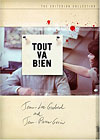
Over the course of our lives, we often leave some passions and ambitions in the past, as we move toward other goals. These ambitions can remain dormant for years or even forever, but sometimes, these passions can be stirred by major life events. If you find yourself with terminal cancer or even a small brush with death, you might go back to the things you used to love. In other words, a single event can make you remember what is really vital to you, even if it has been buried for decades. Jacques (Yves Montand) works in commercials, he directs ads that funnel in business for local outlets. This is not his passion however, as he once loved to direct artistic films, but in the name of economics, he has settled in his current trade. He is French, but his wife Suzanne (Jane Fonda) is an American, a reporter who works for a local wire service. A visit to a local factory is expected to be standard fare, but the couple finds themselves in a two day standoff. The workers have revolted in violent fashion, with demands for fair treatment. As the couple looks on, the struggle unfolds and the inner workings of the power plays weigh on their minds. When the ordeal has concluded and the two are released, they have experienced change of their own, change that will greatly alter their lives. Jacques decides to return to cinema and Suzanne eyes a more productive approach to news. But with so much change, what will become of the couple, now that both have gone through an evolution of sorts?
This is one of those movies that you’d think critics and film snobs would love, an elite level director in Jean-Luc Godard on a personal tangent of cinema. While Godard (Alphaville, Contempt) is an acclaimed filmmaker and can do little wrong in some circles, even his most dedicated fans have to admit that Tout Va Bien falls short in almost all respects. I’ve enjoyed a number of Godard’s pictures and believe some of them to be masterpieces, but this one is not even close. Yves Montand (Le Circle Rouge, Is Paris Burning) provides a great performance, while Jane Fonda (Barefoot in the Park, Klute) was at the top of her desperate cries for attention during the conflict in Vietnam. The cast is one of the few highlights here, with solid turns across the board, but when the material is can’t keep pace, those performances wind up buried. The film does mark an important shift in Godard’s career, as he moves toward more universal themes. So in a sense, Tout Va Bien is an important film, but it happens to be so dull and boring, its hard to watch. The social and political messages within aren’t always so obvious, but the depth is one of the film’s better elements. If you can endure the stale pace, you’ll be able to look deeper and find the true message of Tout Va Bien. Criterion’s treatment is quite good, but even so, I can’t recommend Tout Va Bien outside of a rental, even to Godard devotees.
Video: How does it look?
Tout Va Bien is presented in 1.66:1 anamorphic widescreen. I was stunned at how smooth and bright colors were, as previous releases have been drab and washed out. The colors still seem a little reserved, but I think that is intentional in the end. The hues look good and display no bleeds, while flesh tones appear warm and natural also. I also found the contrast to be much more defined, though some grain is still evident at times. The grain does knock this down a little, but in truth Criterion has done a fine deed by giving us a new & improved version of this film.
Audio: How does it sound?
This film isn’t very reliant on audio, so the original French mono track is more than adequate. The track seems pretty clean and little harshness is present, which is good for a film of this age. The dialogue sounds great, no evidence of distortion in the least and the vocals seem very crisp at all times. Of course, I don’t speak much French, but I can tell a sharp vocal track when I hear one. The rest of the elements are used in small doses, so this track handles them with no problems in the least. This disc also includes newly created English subtitles, which are a nice improvement over previous editions.
Supplements: What are the extras?
The most substantial supplement is Letter to Jane, a short that runs just over fifty minutes and serves as a kind of postscript to the movie. This is little more than Godard and Gorin focusing on the infamous picture of Fonda with Vietcong forces, telling us their thoughts on the photo. I have to assume narcotics were involved as this was created, as this is some off the wall stuff. But it does make a nice inclusion and while confusing, does have relevance to the movie itself. You can also view an excerpt from a 1972 interview with Godard, as well as a newly conducted interview with Jean-Pierre Gorin.