Plot: What’s it about?
As the planet’s population boomed, the world stayed the same size and sooner or later, the room was bound to run out. At that point, the decision was made that Earth was unable to hold mankind’s civilization, so new territories were sought out. A new solar system was found, one with many habitable planets and soon enough, a new home was christened. The central planets were governed by The Alliance, while those in the outer reaches resisted, wanting to maintain their freedoms. This led to a monumental conflict, which saw The Alliance force its control on those planets. Even now however, The Alliance can only do so much, so those on the outer borders can still play by their own rules. When a human weapon, trained by The Alliance, escapes, a full on search is put into motion. The weapon, a young woman named River has stowed aboard a small ship, but will she be turned over or allowed to test out her life in the free world?
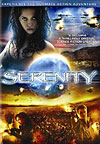
After the success of Buffy the Vampire Slayer and Angel, it would seem as though creator Joss Whedon could do no wrong on television. His next project was a sci/fi series called Firefly, a series that was quickly canceled and failed to even run a full season. But the show’s fans were rabid and when the show was issued on DVD, it was a hot seller. Whedon refused to let the story of Firefly just vanish, so rumors of a feature film were heard and now, we have that film, titled Serenity. The film isn’t just for fans of the show either, as Whedon has crafted it so that both fans and newcomers can enjoy the ride. This is smart sci/fi in all respects, well written and well performed, with goals of more than special effects and popcorn thrills. Even so, I didn’t think it was a great movie, but a very good one and much better than most sci/fi you find these days. Universal’s disc is a solid treatment, so if you purchase or rent, Serenity is well worth a look.
Video: How does it look?
Serenity is presented in 2.35:1 anamorphic widescreen. The visuals here are quite stylistic, with a broad scope of color and light designs. The image might be pitch black with faint shadows in one scene, then bathed in vivid colors the next, so the transfer had to be excellent. I saw this movie in the theater and while this transfer shows grain, so did the theatrical prints I saw. In other words, the grain and high contrast are part of the visual design, not transfer flaws. The lone concern I had was some light edge enhancement, but those were minor instances, so no real problems here.
Audio: How does it sound?
The audio is impressive here, with a creative and effective sound design that really puts the surrounds to good use. That doesn’t mean constant, loud presence, but it does mean a dynamic presentation that puts you right in the middle of the movie. When the scenes are dialogue driven, the surrounds cue up background noise and build atmosphere. The small touches can make a lot of difference and that is true in this case, as ambient noise is well handled. There is power to behold as well, with deep bass and some very cool surround presence, so this is just an excellent all around soundtrack. This disc also includes a French language track, as well as subtitles in English, French, and Spanish.
Supplements: What are the extras?
Whedon provides an audio commentary track here and given how personal this project was, he has a lot of insights to share. As he was so involved with the creation of the material, he can tell us about all aspects of not just the production, but the genesis of the concept and beyond. He isn’t a dull speaker either, so his sharp humor makes an already great session even better. This disc also includes a trio of brief featurettes, a collection of deleted scenes, and a reel of outtakes.