Plot: What’s it about?
I must admit that I really had no idea as to what to expect when I started “The Weather Man”. Yes, I’d heard of the movie and knew Nicholas Cage was in the lead. I turned the box over and saw that Gore Verbinski was the director. Ok, Michael Caine is also in it. Looking good…now what? “The Weather Man” is less about an actual “weather man” and more of a spiritual rebuilding of a man’s life. It’s a dark movie. Not “Heathers” dark, but some very dark undertones to it nonetheless. Evidently the life of a weather man is fairly easy (and Cage’s character isn’t even a meteorologist), in that it only requires about two hours of work a day and the pay is more than adequate. That said, Cage’s character is always looking and wanting more and somehow thinks that a higher-profile position and a move to New York will cure all of his woes.
Cage plays Dave Spritz, a weather man on a Chicago news station who has some clever catch phrases and has a tendency to get hit on the street with other people’s ICEE’s and other assorted junk. Dave has two kids and is recently divorced from his wife. His wife (Hope Davis) has moved on and is dating, his son is going through drug counseling and his daughter seems interested in archery and is being called some very interesting names at school. Let us not forget Dave’s father, Robert (Michael Caine), a Pulitzer-Prize winning author who is in poor health. Dave is being eyed as one of the replacements for “Hello America” with Bryant Gumbel (an obvious rip on “Good Morning America”), meaning a move to New York and a hefty salary increase. It’s not until he tries to reconnect with his kids, though, that he realizes what he has in life. His willingness to try and get back together with his ex-wife is not only futile, but borders on insane.
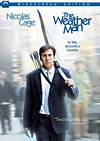
“The Weather Man” is a story about love and loss and of all things, growing up and accepting responsibility. Robert Spritz puts it best when he tells Dave “Did you know that the harder thing to do and the right thing to do are usually the same thing?”. Regardless of what profession you’re in, how much money you make and all the material things that you can own it doesn’t equate to happiness. Dave is searching for this all throughout the movie and learns a few lessons along the way. I might need to watch the movie again, as it took me so by surprise the first time around. I will say that I’m impressed by the Direction of Gore Verbinski. With movies like “Mouse Trap”, “The Ring” and “Pirates of the Caribbean” under his belt “diversity” should be this guy’s middle name. I enjoyed “The Weather Man”, but certainly don’t judge a book by it’s cover (art – that is).
Video: How does it look?
I was a bit surprised to find that “The Weather Man” filmed in a 1.85:1 aspect ratio. Most of Verbinski’s other films have been of the wider 2.35:1 variety. Still, the anamorphic transfer looks pretty darn good. I noticed no edge enhancement, artifacting or grain on the print at all. The only thing that really detracted from the overall presentation was a bit of softness on some of the outdoor scenes. Flesh tones seemed warm and natural (considering it takes place in Chicago in the winter) and the level of detail was impressive. No major complaints here as “The Weather Man” looks great on DVD.
Audio: How does it sound?
The Dolby Digital 5.1 soundtrack finds a few ways to sound impressive, but for the most part it’s a really good surround mix. Dialogue and channel separation are adequate and though the surrounds come into play during the film a few times, they’re not too overly active. I did find a few instances in which the LFE came into play, but not too many. This is a good mix, but nothing really stands out as being overly good or bad.
Supplements: What are the extras?
This is labeled as one of Paramount’s “Special Collector’s Editions” so we can expect a slew of supplements, right? Sort of. There are five featurettes and a trailer. The featurettes are all cleverly named, starting off with “Extended Outlook”: The Script which shows how the movie was written and the influences. Next up is “Forecast: Becoming a Weatherman” which is fairly self-explanatory. “Atmospheric Pressure: The Style and Palette” is interesting in that it shows the way (and why) the specific colors were chosen and how the overall mood affected the costume design. Finally “Trade Winds: The Collaboration” and some looks at the characters round out the special features.