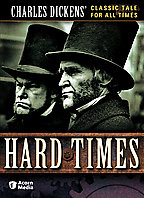
Plot: What’s it about?
The industrial city of Coketown is governed by business, thanks to the mills that pump out black smoke and provide the town with countless jobs. The social order seems to cut between two groups, those who own or manage the mills, and those who simply work in them. Josiah Bounderby (Timothy West) used to be on the poor end of the scale, but now he is wealthy and his outlook is not a bright one. He sees his workers not as people, but as tools to increase his own wealth through his mills. He is consumed by social status and reminds those around him that he made his own fortune, even as others lost theirs. A friend of his is Thomas Gradgrind (Patrick Allen), who also puts little value on much outside of facts and figures. He teaches his own children to ignore imagination and dreams, pay mind only to the facts in life. But when the tides begin to shift and the two men find themselves in unexpected situations, will they grasp at riches and facts, or turn over a new leaf?
I have always enjoyed the books of Charles Dickens, even if the film and television adaptations have often been disappointments. In the case of Hard Times however, that trend is bucked and this is perhaps one of the best adaptations of a Dickens book to ever come down the pipe. I always look forward to the costumes and other production design elements in these period dramas, so I was pleased to see accurate wardrobes and I do love the top hats. The story is quite faithful to Dickens’ book and is able to tell the story at just the right pace. I don’t feel like much was glossed over and even at over three hours, the time goes by fast, as you’re drawn into the story and characters. The performances are impressive also, with strong turns from Patrick Allen, Jacqueline Tong, Timothy West, and numerous others. Hard Times is a well crafted adaptation of a masterful book, not a simple task, but Dickens would be proud and this release earns a solid recommendation.
Video: How does it look?
Hard Times is presented in full frame, as intended. As was often in the case at the time this show was produced, the interior shots are on video, while exteriors are on film. If you’re confused, there’s a Monty Python episode that lampoons the concept, but that is for another review. The end result isn’t pristine, as the prints show grain and debris, but not to an extreme degree. The grain does cause some softness and a washed out texture, but again, this is never a huge concern. To be honest, the gritty look suits the material, even if it wasn’t intentional. So this is rough around the edges, but I think the material has held up well enough.
Audio: How does it sound?
The audio here is basic and a little worn, but it still sounds passable. I did notice a few instances of harshness and some muffled dialogue, but these were rare instances. On the whole, the vocals sound good and the other elements come across well. Not a great soundtrack, but it covers the basics and the tolls of time haven’t hit too hard.
Supplements: What are the extras?
This release includes a profile on Charles Dickens, as well as filmographies of prominent cast members.