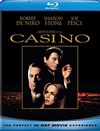
Plot: What’s it about?
After the success of Goodfellas in the early part of the decade, director Martin Scorsese and writer Nicholas Pileggi chose to team up once again in another tale of organized crime. With Scorsese’s filmmaking vision brought to a wider scale thanks to his efforts on Cape Fear and The Age of Innocence, the sites were set for Las Vegas and two of the main principles (Robert DeNiro and Joe Pesci) from Goodfellas costarring again in a tale of the luck of the draw, the rise and fall and the glitz and glamour that is Casino.
Meet Ace Rothstein (Robert DeNiro), he’s one of the best handicappers when it comes to sports betting, a fact that draws the attention to some people in the world of organized crime. Out in Vegas, the bunch from Chicago has gotten a hold of the Teamsters pension fund and with a great amount of money look to venture their business into the casino world of Las Vegas, running The Tangiers. How Ace fits is that they need someone to run the place legitimately. At the same time, one of the boys back home named Nicky Santuro (Joe Pesci) is keeping a sharp eye for the boys into this venture. Along the way Ace meets a hustling pretty gal named Ginger (Sharon Stone) that will be there for him during the good times and the bad but literally could also be the death of him.
Upon first viewing, this viewer didn’t know what to make of it in 1996 (when the film came out on video), and the result was a little less satisfying than most of Scorsese’s work. However, in the years since then it took a friend’s wild request of Joe Pesci movies to view the film amongst friends. It was through this film that one element about Martin Scorsese’s films was imminent. His films are so much better the second time around and more and upon second viewing, this viewer noticed one of the most visually striking films of any decade along with a great capture of the period as well as a solid three hours of film (started with a great title sequence by Elaine and Saul Bass (A LEGEND!!)) that go by as each element is presented during the ongoing operations of the casino.
The film has gangster elements in the film but if one were to nail a genre for this piece, one would consider a docudrama with elements in between of interaction. The narration from both views (Nicky’s and Ace’s) carry the film very well in its backgrounded moments.
Scorsese and Pileggi develop a tale that leads to little holes in the operation to an unexpected triangle between his wife and his guardian. One of the things I love about the film is the way Scorsese plays with the structure as well as playing with location and time titles in different points of speed and movement.
It also leads to some great trademarks of Scorsese, the crazy camera close up, the great selection of period music as well as a number of long takes one being almost 6 minutes into the picture showing “the holiest of holies” in Vegas. I also like the term “boys back home” to refer to the shady characters that were skimming off the casino.
As for the cast, the film is well cast all around. As Ace Rothstein, Robert DeNiro gives a great performance of a man who gives into luck when he doesn’t believe in it and pays the price in the long run as well as having a high level of trust with things he cares for the most, even the slightest of things (like chips or blueberries in a muffin).
Joe Pesci brings a fierce menace to Nicky Santuro as a man different from Tommy in Goodfellas in that their dangerous element is similar, but the difference being that Nicky is already a made guy and one that crosses the line too far when the time comes (as Tommy never got to that point). It also is worth noting of Pesci’s other co-star in both Goodfellas and Raging Bull, Frank Vincent as he plays Nicky’s associate that gives a moment that saves the best for last for Frank in the run of those 2 movies.
In the film’s sole nomination (there should’ve been more), Sharon Stone plays Ginger, a gal with the line on all the side people at the casino but with a line on the man in charge and a line of coke at the same time. She plays a gal that no matter how much love Ace gives to her, she sees herself still attached to her slimeball ex-boyfriend (played brilliantly by James Woods).
Another interesting element of the film is the many comics that fill serious roles amongst the films. All of them (Don Rickles, Alan King, Kevin Pollak, Dick Smothers and a cameo by Steve Allen) this viewer is sure has played Vegas at one point or another and to bring their presence non-comedically into the flow of Scorsese’s film is most welcomed and they do extremely well in their supporting parts.
Through all the good moments, Casino never feels overlong and follows in the long tradition of films made in Vegas as a thing of beauty visually (thanks to cinematographer Robert Richardson) and in all aspects is a film like many of Scorsese’s worth going back to if you haven’t and worth appreciating if it’s been your umpteenth time. Casino is a winner all around, bet, place and show.
Video: How does it look?
“Casino”, unlike “GoodFellas” is shot with a wider scope and the 2.35:1 VC-1 HD transfer gives us some pretty dazzling views of Las Vegas. Most of Scorcese’s movies have some different stock in them, though this one seems to be a bit more stylized. The transfer is an improvement over the previous standard DVD and gives us detail like we’ve never seen. The pores on DeNiro’s and Pesci’s faces, the individual grey hairs on some of the assorted mobsters and, of course, the glamour and glitz of Sin City itself all look marvelous in this HD offering. I found a few things that were off, namely some softness to a few of the outdoor scenes and a few of the scenes in the desert seemed a bit overexposed, but aside from that “Casino” has never looked better.
Audio: How does it sound?
We also get a new uncompressed sound mix with this new DTS Master Audio soundtrack that makes for a very interesting listen. Anyone who’s a fan of Scorcese’s films knows that the man can assemble a soundtrack. From Jimi Hendrix to the Rolling Stones, the sheer ambiance of some of the best rock and roll songs coupled with what’s happening on screen make for a very interesting listen. Dialogue is also very solid and suffice it to say that we can hear every “F” bomb that’s dropped (and there’s a lot in this movie). This is a step above the Dolby Digital Plus track found on the HD DVD and the Dolby Digital 5.1 track found on the standard DVD. I was impressed that this sounded as good as it did.
Supplements: What are the extras?
Universal has once again spliced up their supplements and given us somewhat of a special edition. We get the audio commentary with Martin Scorsese, Sharon Stone and Nicholas Pileggi though the “track” is actually just segments from their conversations about the film. Still it’s a worthwhile track and the trio do make for a rather interesting commentary. Two television specials are included “Vegas and the Mob” which pretty much delivers what it says and “History Alive: True Crime Authors Casino With Nicholas Pileggi” which gives us a look at the man who wrote the books which inspired both “GoodFellas” and “Casino”. This is by far the more interesting segment and worth a look for sure. There are also five minutes of deleted scenes. Next we get the “Picture-in-picture” feature which is exclusive to Blu-ray, like other discs that have this feature, they simply show some of the cut footage from the pre-existing featurettes and splice it into a small window while you’re watching the film. In a way, we do get the same supplements but it’s rather controversial (or as controversial as a Blu-ray can be) and a bit unwarranted. Nevertheless, “Casino” is worth a look and for those that have been waiting for it on Blu-ray, the wait is over.