Plot: What’s it about?
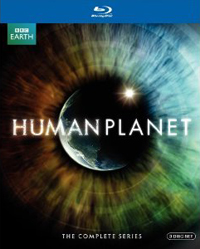
Earth Day is one of the “newer” events that we as a people celebrate and it was first brought to my attention by a high school science teacher. He was “eco-friendly” even when it wasn’t en vogue to be such. About half of my class too his Environmental Studies class simply because it was an easy “A” and me, never being the sharpest knife in the drawer, doubled in Math. Oh well. As we’ve seen, the Earth is much like our bodies, a very tough, yet very fragile thing. As pollution and our ever increasing lifestyles are starting to make an impact on our planet, we’re seeing that we need to take care of the planet that has provided for us for millions (billions) of years. And so we have “Human Planet”, a BBC produced series that focuses on certain aspects of our planet. This isn’t anything new as it’s the same team that brought us “Life” and “Planet Earth”, both of which were amazing to watch and reference quality video for your system. However as the focus was on plants and animals, the attention is turned to the top of the food chain – humans in this latest endeavor.
“Human Planet” is divided into eight different sections, each of which focuses on a different aspect of our planet. Starting off in “Oceans” we learn how humans have adapted themselves to swim and hunt in the vast oceans and seas of the world. “Deserts” shows us that despite the stark, high temperatures how we’ve adapted to live in the desert yet we can only go a short time without water. “Arctic” is the frozen wasteland that supports little plant or animal life, yet through ice fishing and other means we see how millions thrive in this environment. “Jungles” is the polar opposite in that it supports every type of plant and animal life. Dangers lurk everywhere and we see how humans have learned what to consume and what to stay away from. “Mountains” shows us an ingenious way to hunt – get the birds to do it for you! In the high mountains where hunting is nearly impossible the locals have learned how to rely on their winged friends to provide them with food. “Rivers” are beautiful to look at but can be dangerous and support deathly species. We witness a fisherman who has learned to adapt and thrive in this chaotic atmosphere. Finally we come to “Cities” where we see the underside of life – namely rats and pigeons. Yes, there are nearly 100 million rats in New York City.
“Human Planet” is a bit of a departure from earlier series like “Life” and “Planet Earth” as the main focus is on, well, humans. This is the world we live in and it really is amazing how we’ve learned over the years to adapt to our surroundings. Humans are a smart breed and we’ve managed to eek out life for millions of millions of years from an icy tundra to the tops of mountains to the barren wastelands that are deserts. Impressive. This series gives us a glimpse into what makes us special and celebrates it. Fans of these types of shows will certainly enjoy this as the BBC has produced yet another top notch mini-series.
Video: How does it look?
Each of these episodes is presented in a 1.78:1 VC-1 HD transfer that really showcases the beauty of our planet and our people. Just like other series’ in the same vein, “Human Planet” is impeccable in the quality. We see many different terrains from the tundra to the desert to the oceans. Detail is amazing, black levels and contrast are spot on and it’s very difficult to find anything wrong with the way these look. There are a few scenes in which a bit dirt is on the print, but considering the conditions that some of these scenes were shot under – it’s admissible. This is perfect way to experience how lovely our planet looks.
Audio: How does it sound?
Equally as impressive as the video is the DTS HD Master Audio soundtrack. We see and experience many different cultures and see all sorts of wildlife as well. We’re more like passive observers, but the front stage does take the brunt of the mix. Surrounds are active throughout and the LFE come to life as well. The series is narrated by John Hurt, so his calming voice does tend to set the tone and provides the consistent dialogue throughout.
Supplements: What are the extras?
There aren’t a whole lot of supplements to speak of, though we do get a “Behind the Lens” feturette that corresponds to every episode. Two additional featurettes are also included “Fez” and “Volcano” running around ten minutes a piece. Warner and BBC have also announced that more BD-Live features will be forthcoming.