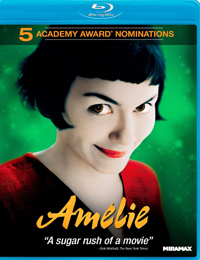
Plot: What’s it about?
In what is by far the year’s best comedy of 2001, Jean-Pierre Jeunet’s “Amélie” is as magical, mysterious and infectiously funny as any film I’ve seen in recent memory. The French title is actually “Le Fabuleux destin d’Amélie Poulain,” though distributor Miramax thought it an incapable mouthful for Americans to have to pronounce, let alone fathom, at the ticket counter. With a bit of the classic charm that befell the likes of Audrey Hepburn and Jimmy Stewart films, fused with an inventively modern visual flavor, “Amélie’s” will awaken every ounce of delight and wonder suppressed deep inside yourself. The film’s riotous introduction — both dizzying and hilarious – tells the tale of six people, whose lives will eventually change forever, through the fate of Princess Diana (not the way you’d expect) and the destiny of an old tin toy box. The opening sequence is shot in a fast-paced narrative vignette that will have you in a comical trance.
The film takes place in Montmarte, an enchanting, idealized, digital recreation of the classic Parisian world, where the word “quaint” could be used in a million different situations. It’s a unique modern day fairy tale, whose 23-year-old Princess Charming, Amélie’s, is a waitress at the local café.
On the day of Princess Diana’s death, Amélie’s (played wonderfully by Audrey Tautou) discovers an old tin box of childhood mementos hidden inside her apartment wall. Intrigued by the discovery, she’s determined to track down the man who once hid this treasure here long ago as a child. She does so anonymously, and after seeing first-hand the profoundly magical effect she’s had on his life, Amélie is determined to follow her path to Sainthood, trying to fix the lives of those who need it most.
The movie deals with her decision to manipulate the fates of her friends and neighbors for the better (and sometimes worse), while at the same time pursuing her own enigmatic relationship with the strangely eccentric Nino (Mathieu Kassovitz) — whom she encounters at the metro station assembling scrap pieces of photos he’s found underneath a quick-photo booth. She cherishes his harmless eccentricities and it is obvious writer/director Jeunet cherishes and celebrates them in each of his characters. From Amélie’s father, a war veteran who reveres above all else a porcelain gnome he received from his military unit, to Dufayel (Serge Merlin), a painter who paints Renoir’s “Luncheon on the Boat” over and over again, unable to capture the essence of the mysterious woman located in the center, to AmTlie, who constantly collects perfect skipping stones along the street to skip in the river, each character is a vivid statement about the free spirit of ingenuity and uniqueness. “Amélie” brilliantly captures these individuals in their moment, and thanks to Tautou’s performance, the film comes together in a glorious tapestry of memorable characters and situations.
Tautou is innocence perfected. Her smile is infectious and loveable, and her cute, quirky persona is a full of surprises, as is Jeunet’s film. The visual effects are some of the most inventive you will ever see, and unlike his American counterparts, he weaves them seamlessly into the storyline. Jeunet, who helmed the outlandishly surrealistic visual treat “The City of Lost Children” (1995) as well as the forgettable “Alien: Ressurection,” seems to have finally mastered the art of fusing visual effects into a storyline. In one stunning scene (among many), Amélie tries to maintain her anonymity to her true love Nino as he walks into the café. After being questioned, she embarrassingly walks away. As Nino leaves we see her literally melt off the screen and onto the floor, spilling out onto the tiles as her internal feelings become external reactions. She’s completely entwined to her world, as is every other participant, animated or not.
Video: How does it look?
It’s been nearly a decade since I first sat down and watched this film and now with its debut on Blu-ray, it’s truly a pleasure to “see” as opposed to just watch. I remember being very impressed with the visuals. The warm and vibrant colors set against the stylized Parisian backdrop made for a very interesting look to the film. Color saturation is warm, flesh tones seem very natural and suffice it to say there’s a lot of color used here. This 2.35:1 AVC HD offering removes anything that could have been construed as “bad” and we’re left with a film that looks so stunning, it’s simply a joy to watch. Take, for example, the scene where Amélie is skipping rocks across the pond – it looks nearly 3D without having been advertised as such. This is one fine-looking Blu-ray.
Audio: How does it sound?
We get a re-mastered DTS HD Master Audio soundtrack here and it sounds great! For those that haven’t seen the film, it is subtitled so this uncompressed mix is via French track. Surrounds chime in at just the right time, dialogue seems very warm and robust and the LFE even get involved a few times. While “Amélie” isn’t the epitome of a full-force soundtrack, it sounds just fine the way it is.
Supplements: What are the extras?
For those that own the original two disc standard DVD, I’m both happy and sad to say that the supplements are the same on this Blu-ray disc as the original DVD. Still, nothing was lost so there’s the silver lining to the cloud. We start off with two feature-length commentaries. The tracks are both by the director, Jean-Pierre Junet. One track is in English and the other in his native French. Naturally I had no idea what the guy was saying in French, as no translation was supplied, but suffice it to say that he had a lot more to say than in his English track. Still, his English track is pretty good, full of some little tidbits and facts here and there. His broken English is pretty good, but it’s a good effort for the two tracks. There is a sit down session with Junet and he adds to what he said in the commentary track, how the film came to be and the evolution of the title (it’s different in French). Interesting, and if you’re looking for some more little tidbits, then this is what you’re looking for. Some “home movie” footage is shown, though there’s no dialogue it does show a bit as to what the cast and crew went through to achieve the distinctive look of “Am&eacut;lie”. Some audition tapes are also shown and it’s interesting to see how the “Am&eacut;lie” character focused around her look (much like she has a secret and is just about to tell you), while the other members of the crew were just reading dialogue. There are some trailers from the United States and France as well as some cast and crew bios. An “Am&eacut;lie” Scrapbook is also shown, which is just a fancy way of saying “Production Stills”! I might have missed a few of the supplements, and I was a bit surprised that the commentary tracks weren’t even listed on the outside of the box. “Amélie” is a great little foreign film, and this is coming from someone who isn’t too fond of them.