Plot: What’s it about?
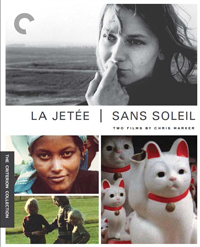
In La Jetee, the memory of standing in an airport as a young boy haunts a man. As a child, he was at an airport when a woman caught his attention and as he watched her, a man was murdered right in front of his eyes. Soon after, a nuclear war is unleashed and life as we know it comes to an end. The population now lives underground, in almost prison like conditions, as experiments in time travel are carried out. The young boy at the airport has grown into a man, recruited to travel to the past and help find a way to make sure this future never happens. But can he handle the path he is about to walk on? In Sans Soleil, we watch as footage from a worldly photographer is unveiled for us, images from all over the globe. In addition to the images, he also sends his own comments on the work, all mailed to a female companion. Do his images simply provide a travel guide of sorts, or is there deep cultural meaning behind his photographs?
Of course, we’ve all heard of La Jetee thanks to Terry Gilliams 12 Monkeys, which uses the material as a foundation of sorts for his dark futuristic tale. Now in this release from Criterion, we can revisit the inspiration of the original, plus a second film by the same filmmaker, Sans Soleil. I have to admit, both of these movies are experimental in nature and by design, are going to divide those who watch. Some folks will connect with the material instantly and love these unusual efforts, while others will dismiss them and find no value whatsoever. That seems to be the intention however, as filmmaker Chris Marker has crafted these visions and stuck to his guns, regardless of how the audience might take his work. For example, La Jetee is made up of still photos, an approach that is destined to frustrate some and delight others. Sans Soleil pulls no punches with its imagery and is open ended, leaving those who watch to draw their own personal conclusions. Not mainstream and not conventional, La Jetee and Sans Soleil are powerful works and for those with brave cinema appetites, are well worth a look.
Video: How does it look?
Visually these two films couldn’t look more alike, yet more different. Both are shown in a 1.66:1 AVC HD image that has mixed results, but considering both the age and source material – it’s to be expected. La Jetee is shown in black and white and is certainly the more polished of the two. There’s a moderate level of grain to be seen throughout and some of the footage has suffered from the test of time. Still, we all know that of any studio out there, Criterion does their absolute best to present their titles and this is the absolute best the film has ever looked. Moving onto Sans Soleil we find a much rougher, documentary-style feel to it. The image contains much more grain, again it’s also presented in black and white. Having said that, the original 16mm film inhibits the picture from achieving true beauty, but it is loyal to the source material.
Audio: How does it sound?
Both movies are graced with a mono track and, all things considered, it was to be expected. The PCM mono track for La Jetee is fairly strong and consistent, though there’s some occasional noise in the “background” during a few sequences. Both films are limited to only one track, so there’s absolutely no surround to speak of. Moving onto Sans Soliel we find the vocals a bit stronger, with the narration sounding fairly clear. Again, the film is limited to only one channel, so it’s a bit hard to get the full effect here. Both are solid mixes, though don’t hold a candle to some of today’s soundtracks – then again, they weren’t supposed to.
Supplements: What are the extras?
Those who already own this title on standard DVD won’t find any new supplements. While not too extensive, we do have get informative interviews with filmmaker Jean Pierre Gorin. He tries to provide us insight into Chris Marker as a filmmaker and artist in general, as well as his personal life. The features have been upscaled to appear I 1080i and while I wouldn’t call the information in depth, Gorin shares some good insights and these interviews are worthwhile. You can also watch two excerpts from Court-circuit, one that looks at how La Jetee inspired David Bowie’s music video Jump They Say, while the second looks at how Marker was inspired by Alfred Hitchcock’s Vertigo. And finally, we have Chris on Chris, a featurette by filmmaker Chris Darke that once again strives to show us more of Marker and his methods.