Plot: What’s it about?
When “Superman: The Movie” was released in December of 1978, I was almost exactly one month old. I wouldn’t know anything about it for several more years, but Richard Donner had just done something that no other director before him had ever managed to accomplish (and, I would argue, that any director would ever so exquisitely do again). For an entire generation of film-goers, comic book fans, and children too young to do much of anything but leap from their beds with towels wrapped around their necks, “Superman: The Movie” became an instant pop-culture and artistic classic, elevating an iconic symbol of Americana to never-before-dreamt-of levels of respect and cinematic spectacle. The marketing materials famously promised “You’ll Believe a Man Can Fly”, and the film delivered on that promise. Christopher Reeve, an unknown at the time, would become not only the quintessential Man of Steel for legions of fans, but also move on to achieve tremendous status, both on and (as fate would have it, even more so) off the silver screen. Gene Hackman made Lex Luthor a more comical figure than in the comic books, but brought such a gravitas to the role that it instantly became his own. Margot Kidder as Lois Lane possessed all of the spunk, energy and light-heartedly empathetic nature that was so sorely lacking in future big-screen incarnations of her character. Never before or since has a film so captured the imagination of children and adults alike, so thrilled us with state-of-the-art special effects, so touched us with its emotion and endearing humor, or so captivated us with its magic. There’s not a single frame of Donner’s film that’s not dripping with pulp-comic nostalgia or bathing us in gee-whiz sensibilities through charismatic performances, an absolutely timeless and evocative John Williams score or wildly imaginative visuals. For the time, or any time, “Superman: The Movie” stands today as it did then: as the greatest superhero movie ever made.
And then something peculiar and altogether tragic happened. Creative differences (read personal squabbling) between Richard Donner and producers Alexander and Ilya Salkind derailed Donner’s directorial efforts mid-way through the completion of “Superman II”, a film Donner had been shooting in conjunction with the first picture. After completing an unknown portion of the film (some reports put it as high as 70%), Donner was fired, and Richard Lester was brought in to finish the film. What resulted somehow still managed to be a tremendously satisfying superhero sequel – one that many fans actually preferred to the original. As I’ve aged, my esteem for “Superman II” has lowered nearly in direct correlation to my increasing adoration toward the first film. Now, I am comparing it to what I consider the high-water mark for the genre, to be sure, but “Superman II”, while still an undeniably great time at the movies that’s full of classic Supes moments and rousing battle scenes, simply doesn’t have the same magic as “Superman: The Movie” does. For all of its good intentions and relative success (both artistically and critically), “Superman II” is a more disjointed experience than its predecessor, due undoubtedly to the chaos erupting behind the scenes during its creation. Donner and Lester simply had different sensibilities and different priorities for what they wanted to show audiences, and that contrast left filmgoers with a very good, but ultimately uneven experience. Lester injected far more humor into the film than Donner had intended, much of which simply feels out of place in a film about three of krypton’s most deadly villains coming to Earth to challenge the Man of Steel. Reeve and Hackman are just as good here, if not better, than in the first film. The movie simply doesn’t have the same majesty as the 1978 film does. In 2006, Donner was allowed to restore much of what his vision of the film might have been had he been allowed to complete it. And while “The Donner Cut” proved an interesting experiment, it had little choice but to fall somewhat short of the Holy Grail status to which fans had prematurely elevated it, sight unseen. Whichever version of “Superman II” you choose to watch, however, both are satisfying, wonderful trips into the world of comic book superhero fun, just as the first film was. Both incarnations have their problems, and both are ultimately incomplete films. Both are fantastic, and both are deeply flawed. But which version is the REAL “Superman II”? I’d argue that neither truly is. That forever-lost film will have to remain the stuff of legend.
Those who lauded Richard Lester’s supposed success with “Superman II” fell immediately, deathly silent when “Superman III” reached theater screens in the summer of 1983. Almost immediately, talk turned to how much of “Superman II” had truly been Lester’s at all, and what might’ve been had Donner been allowed to carry on. “Superman III”, on the other hand, was undeniably a Lester film through and through – for better and for far worse. The film may not have completely derailed the franchise (Reeve was still phenomenal in the role, and the film still touts some well-known, near-iconic moments all its own), but the sharp shift in tone from Donner’s verisimilitude to Lester’s slapstick Richard Pryor star vehicle was a hard pill to swallow. I’d argue that the film has aged better than people may remember it. Today, we’re a bit more adaptable to changing takes on a character (such as the “Iron Man” films). But I have little doubt that it was a shock to the system to see Superman drunk in a bar or laughing maniacally at his Clark doppelganger while gleefully pulling the switch on a metal-crusher to squeeze him to death when people walked into this, unaware of what they were getting themselves into. Add in a healthy dose of Pryor, and an emphasis on a convoluted money-making scheme involving stealing half-cents out of corporate paychecks (fans of “Office Space”, take note), and you’ve got a recipe that was destined to disappoint fans of the first two films. I’m not saying that “Superman III” is a great film. It’s far, far from it. But what remains is, in fact, an entertaining one if you take it for what it is and don’t expect it to see the third film measure up to a series that began with such unparalleled greatness. “Superman III” is more crude, trite and laughable than either of the films that preceded it, and it’s been duly lambasted for those shortcomings for years. But it’s still Reeve in the suit, and the music (though recomposed by Ken Thorne since the previous entry) is still Williams’s material. And with those elements in place, it’s nearly impossible for a film to be all bad.
The operative word, of course, is “nearly”. I still remember seeing “Superman IV: The Quest for Peace” in theaters in 1987. All things considered, it’s a good thing for me that I was around eight years old. A few more years under my belt, and I probably would have remembered the experience not as another awesome Superman film on the big screen, but as one of the most crushing disappointments of early life. Had I been 12, “Superman IV: The Quest for Peace” probably would have been the movie which finally revealed to me that terrible films actually existed, and could actually sully the reputations of even characters I had loved virtually since birth. While blame could be laid at the feet of the studio (which somehow, even with three relatively successful films in the series under its belt, opted to slash the budget so drastically that it made the film’s effects impossible to realize convincingly) or even Christopher Reeve (who forgot the first rule of creating a Superman story when he attempted to inject the character into the real-world problem of nuclear disarmament), but in truth, it was no one’s fault exclusively. This film was simply doomed to be an abomination from the moment the first take began shooting. Not a single performance rings true this time around (even the usually terrific Reeve looks bored here, and rumor has it that he was only brought back with several brinks trucks full to the top with financial incentives in tow), and the story is just downright laughable. It’s as if some studio head went through all of the worst possible scripts for a fourth Superman film, excised the most hideous and embarrassingly awful elements of each, and threw a loosely-threaded narrative around the beats to hold them together in the most contrived and senseless ways imaginable by mortal man. Following an advanced screening that ran over two hours in length, “Superman IV: The Quest for Peace” lost a quarter of its initial length to the cutting room. And it’s honestly just as well. Every deleted scene I’ve seen is just as deplorable as what wound up in the finished film, if not more so. One in particular has Superman taking a child into ORBIT and having a CONVERSATION with him while there about how the world’s nations need to work together to solve their problems. I can add nothing to that as a critic. I can only add liquor.
2006’s “Superman Returns” is, quite simply, the most disappointing film I think I’ve ever seen. And I don’t mean to say that it’s that awful, because it really isn’t. It’s disappointing because Bryan Singer did exactly the right thing in exactly the wrong way when he conceived the film, and every unfortunate accident that could’ve happened to make this movie come off as a boring, self-indulgent exercise for a filmmaker that I truly believe had reverence for what worked about the early films all happened at once. I believe that Singer’s idea to continue where “Superman II” had left off was genius. I also believe his idea to leave the spirit, feel, look, music, and idealism of those Donner films intact was precisely the right choice. Sadly, it was likely those very ideas that eventually impeded Singer from making the film what it could have and rightfully should have been in the first place. It comes off as neither reboot nor true sequel. It’s a film out of place and out of its own time, trying to recapture rather than pay homage. It tries again and again to grab lightning that was already fighting its way out of the bottle way back in 1978. Brandon Routh turned in an admirable and tragically under-appreciated performance as Clark Kent / Superman, and bringing Jor-El back with archived footage of the late Marlon Brando was simply a masterstroke. And yet, for every element that’s there on screen which should have made “Superman Returns” a return to form, there are that many more that are there all-too-obviously to bring the story up to date (which would be fine if Singer’s approach to the rest of the picture weren’t so utterly untethered to 2006). The result is an incredibly uncomfortable balancing act, and a film that never finds any sure footing with its story, peripheral cast, or even its own identity. I believe Singer had the right instincts in his approach. Unfortunately, so many things went wrong in the pursuit of that approach that it will never be tried again – at the very least, never again on this scale. And that may be as unbelievably tragic as Superman is uplifting.
Video – How’s it Look?
For the purposes of brevity (imagine that), I’m going to lump all of these films into two paragraphs, one for “Superman: The Movie” through “Superman IV: The Quest for Peace”, and one for “Superman Returns”. The first four films (or six if you count the expanded edition of “Superman: The Movie” and “The Donner Cut” as their own animals) all look outstandingly pleasing on Blu-ray. Warner’s encodes present every one of these classic films in better quality than you’ve ever seen them before at home. Even if you have the collector’s silver tin that was released several years back on DVD (a fantastic product in its own right), these transfers alone may be worth the upgrade in and of themselves if you’re as hardcore a fan as I am. The theatrical version of “Superman: The Movie” underwent a full restoration on its own, though differences between it and the expanded edition are honestly quite negligible. It’s actually my preferred cut of the film (and yes, I have the 3-hour television cut as well), and so I’m pleased to see it included in this set. The theatrical cuts of “Superman II” and “Superman III” look even stronger, with “Superman III” edging out the earlier film in terms of fine object detail and overall clarity, though this is likely more attributable to Lester’s desired filming style than any defect in “Superman II”’s transfer. “The Donner Cut” is a bit rougher around the edges, due undoubtedly to the condition of the film elements (some of it screen test footage) used to assemble it, but it’s as great a presentation as anyone could hope for of a film most of us never thought would see the light of day. “Superman IV: The Quest for Peace” is nearly as strong as “Superman III”, and yet so much of the experience is hampered by the incredibly inept visual effects sequences (which plague nearly the entire running time) that it’s frankly hard to know where the transfer quality ends and the film’s lack of polish begins. As such, all I can do is judge the film based on comparable (i.e., non-effects) sequences. And on that level, it stacks up quite nicely to the other films indeed. Technically, blacks do waver a bit in the earlier films (more notably in some of the more roughly-edited sequences of “The Donner Cut”), but nothing too distracting or frankly unexpected for films of this vintage. Detail, as stated, is excellent. In fact, if I were put to it, considering the films’ age and the in-camera processes employed at the time, I’d say these transfers are near-reference quality. All in all, fans will be absolutely delighted with every one of these efforts from Warner. They’ve proven themselves second to none with respect to catalog releases, and this collection proves why yet again.
While I’ve got nothing but praise to bestow upon the Christopher Reeve Superman films’ picture quality on Blu-ray, it’s ironically the newest film, “Superman Returns” that comes up short – and does it ever. I’ve been a detractor of this film’s transfer ever since it first reared its ugly head on the format after the movie’s theatrical run, and I’ve been simply befuddled by all the love slathered onto it over the years. To my eyes, this movie is one of the ugliest HD experiences I’ve ever seen. The color palette certainly doesn’t help, replete with dark browns, hazy and smeary mid-tones, and newspaper-gray blacks throughout. I don’t know if it was the digital photography that went wrong or if it was simply a case of an over-zealous intern at Warner who thought the best way to make a good impression would be to turn Singer’s film into a Pixar movie minus all the vibrant color and fine object detail, but the results aren’t at all pretty. Virtually every problem I have with Blu-ray presentations is on full display here, from muddled clarity to inconsistent skin tones and an overall hazy feel to nearly everything on the screen. This simply isn’t a Blu-ray disc I enjoy watching; it’s that relentlessly unpleasing to the eye. I wish deeply that Warner had seen fit to revisit this film’s transfer for this collection as it did the other movies, and it remains the nadir of the set that this subpar transfer was left unimproved for those who had already purchased the standalone offering several years back. This is a major disappointment and (most of) the reason for the video score being no higher than it is. Subtitles are available in English SDH, French and Spanish.
Audio – How’s it sound?
Every film in the “Superman Anthology” except for “Superman IV: The Quest for Peace” has been graced with a newly-mixed DTS Master Audio 5.1 soundtrack, and the results are pretty wonderful overall. The new mixes are terrific for “Superman II” and “Superman III”, and fans will find the audio for “Superman: The Movie”, “The Donner Cut” and “Superman Returns” quite familiar if they’ve picked up the previous releases (the discs in this set are virtually identical to those released previously). Notably, Warner has done the right thing and once again made the original mix of “Superman: The Movie” available in DTS 2.0 as an option for purists (while I miss losing the surround envelopment, it’s the presentation I personally find most enjoyable, as many sound effects were added and/or replaced for the film’s 5.1 conversion that I find overly distracting). The mixes here are admirable (though admittedly, these are now some pretty old films, and they’re simply not going to sound like “The Avengers”), and fans of the films who’ve seen them multiple times will really appreciate the love and care that went into keeping the essence of what made the original sound designs so great intact for the expanded soundstage afforded with 5.1 lossless. Bass response is surprisingly punchy for films of this age, and I found that my eyebrows rose more than once at the sweeping directionality on display in the 5.1 tracks. Naturally, there’s a bit of a “limited” feel to these audio mixes, catalog titles as these are, but all in all I was pleasantly surprised. Dialog is always intelligible and clear, music is well-balanced and nuanced, and I detected no overt instances of peaking or harshness. The DTS 2.0 mix does have a more plugged-up and tinny feel to it than I would have liked considering it’s my preferred soundtrack, but it’s to be expected to a degree, as I’m sure this isn’t where Warner was investing its full efforts. As expected, the “Superman Returns” audio fares best from the newer production, with an incredible depth and detailing that simply can’t be matched by movies from the 70’s and 80’s. “Superman IV: The Quest for Peace” is the odd one out with a DTS-HD Master Audio 2.0 mix. It does just fine for what it is (and, to be fair, it contains none of the tininess of the “Superman: The Movie” 2.0 track), but we’re still talking about a stereo mix here, and it’s a shame Warner didn’t opt to make all of the presentations here at least consistent on a technical level, especially when they’d already gone so far above and beyond to create new mixes for the first three films in the series. French and Spanish audio tracks are also available, each in DD 5.1, DD 2.0 and DD Mono varieties.
Supplements: What are the extras?
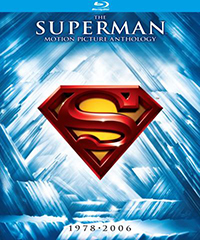
There’s simply no way around it: this one FULL box set. It’s stuffed to the brim with nearly everything a Superman fan could ever possibly want to see, and the wealth of material is absolutely staggering. I’m going to have to break this down by disc to have any chance of this section coming off as cohesive, and not a two or three page, run-on paragraph. While not absolutely everything I wanted was here (I’d have loved to see the three-hour TV cut of “Superman: The Movie” and the network television cuts of “Superman II”, “Superman III” and “Superman IV: The Quest for Peace” presented in their entirety somewhere in this set), it’s really hard to complain when so much fantastic material is included. So let’s dive in, shall we?
The first disc (which also houses the theatrical cut of “Superman: The Movie”) contains an audio commentary by Ilya Salkind and producer Pierre Spengler. It’s an informative and interestingly inner workings-centric commentary that should thrill those interested in the business behind the making of films. We also get a TV special from 1978 on the making of the film that runs nearly an hour, the 1951 feature film “Superman and the Mole-Men” (for those of you who need your vintage George Reeves fix), three Superman-related Warner Bros. cartoons collected from the 1940’s and 1950’s, and a selection of trailers and TV spots.
Along with the expanded version of “Superman: The Movie”, disc two offers up an audio commentary with Richard Donner and Tom Mankiewicz. These two are an absolute joy to listen to, bouncing off of one another effortlessly. There’s very little wasted time in this commentary, and fans will especially find it interesting to see the two butt heads over whether the inclusion of the extra footage in this version of the film is necessary (I happen to believe it is not). Next up is a three-part production diary hosted by Jimmy Olson himself (Marc McClure). Fans of the films will recognize these diaries from the previous DVD release, and they’re no less excellent than they were then. Totaling nearly an hour and a half, these three featurettes focus on story development, production and special effects. A 20-minute collection of original screen tests are also included, and are just fascinating to watch. We also get about 15 minutes of restored deleted scenes (all taken from the much longer KCOP television cut of the film), a few audio-only alternate score cues, and what I personally consider to be the crown jewel of this entire set: John Williams’s glorious score, isolated and in glorious surround sound. Isolated score tracks were something I’d hoped to see far more of as Blu-ray took off. Sadly, that was not to be the case. But if one film was going to include the feature, we could have done a lot worse than this one.
Disc three gives us yet another commentary track with Ilya Salkind and Pierre Spengler, which I actually preferred to their commentary on the first film. The behind-the-scenes drama of “Superman II” is simply more interesting, and the two don’t shy away from the tumultuous issues that troubled the production. We’re also treated to another vintage piece from the set, this time from 1980 (it runs around an hour, just as the first featurette does). There’s one rather silly deleted scene here involving Superman and Lois baking a soufflé in the fortress that I’m rather glad was excised from the finished film. We also get the Max Fleischer cartoons once again, but sadly they’re presented exactly as they were on the prior DVD release and have not been restored in high-definition as they rightfully should have been, and it’s one of the biggest disappointments of the set. The original trailer is here as well for completists.
Disc four begins with – you guessed it – another audio commentary, once again from Donner and Mankiewicz. While this track is a bit more energetic and non-stop than their track for the expanded version of the first film, it does have the unfortunate tendency to come off as more self-congratulatory than I would have liked at times. The two appear to be under the assumption that everything they had in mind for the second film was golden, while anything contributed by Lester detracted in some way from the film that could have been. While I tend to agree with that sentiment to a certain degree, I also concede that Lester did add some iconic and special moments to “Superman II”, and I think it’s a disservice to his work on the film to dismiss all of his efforts outright. As I’ve stated previously, I believe a complete version of “Superman II” may exist in some form, but it’s likely more a combination of the two directors’ work than a myopic use of the footage filmed by only one or the other. Donner introducing his cut of the film, however, is a thrill to see, and it certainly whets the appetite to view what’s in store. We also get an all-too-brief look at the reconstruction effort that went into “The Donner Cut”. I find these types of features intriguing, and I could have watched this one for much longer than 13 minutes. We also get a series of deleted scenes, and all of them will be familiar to those who’ve seen the expanded version of the film on network broadcasts. Lastly, we get the Famous Studios’ cartoons, which total a little over an hour in length.
The fifth disc in the set offers up yet another Salkind / Spengler commentary, which I actually enjoyed quite a bit. It’s rare to see “Superman III” talked about to this degree, and I found it refreshing to hear the issues of the film’s critical reaction addressed, as well as some choice behind-the-scenes anecdotes about production. Another vintage behind-the-scenes featurette is included here, and it’s more of the same style we’ve seen for the previous films – not that that’s a bad thing. It runs a few minutes shorter than the earlier features, but it is well worth a watch for fans. We’re also treated to around 20 minutes of deleted scenes, all of which found their way into the network television version of “Superman III” (not that all of them really should have). Still, as a fan, I’m happy to see them all presented here in one place. The third film’s trailer is also included.
Disc six, though housing “Superman IV: The Quest for Peace”, actually offers up some of my favorite supplements in the entire set. Screenwriter Mark Rosenthal’s excellent commentary track is a must for even casual fans of this series, as it details all the issues faced with production, and how a good thing went so very wrong in the end. I’m always fascinated to hear about what could have been straight from the people directly involved, and if this track does anything, it makes a strong case for the good intentions of those behind what would eventually become an atrocity of cinema. There is also a 50th Anniversary special included from 1988 hosted by Dana Carvey, which is worth a look, at least once. But the real section of interest for diehard fans is going to be the over half hour of deleted scenes. While the original cut of “Superman IV: The Quest For Peace” has long been a mythical creature for Superman fans, I think these scenes do just about all anyone could ever expect to prove that adding all of that footage back in really just wouldn’t have made the movie any better. Most of this footage is, in fact, even worse than what wound up in the finished film – if that can even be believed. Still, after all these years, it’s priceless to see all of this footage in some form, even if some of it isn’t exactly in pristine condition. There are entire subplots detailed in these scenes that actually inform much of what happens in the theatrical cut. I’m not saying that watching this really improves the film, but it does explain a few things and make the plot slightly less incomprehensible (if no less reprehensible). Once again, Warner has thankfully included the theatrical trailer as well.
While the quality of “Superman Returns” as a film remains debatable, the quality of its supplemental package is beyond reproach. There’s a lavishly-produced, nearly three hour (!) documentary included here on the making of the film, which is just wonderful to watch from start to finish. It covers just about anything you could ever want to know about the film’s production, and a few things that perhaps you didn’t realize you were interested in knowing to begin with. We also get Bryan Singer’s production diaries, which themselves total over 80 minutes of screen time. And if that’s not enough for you, Warner has (finally) seen fit to include the much-talked-about original opening in full 1080p. It’s a terrific scene that I think most people would agree should have stayed in the finished film. It’s simply stunning to look at, and it sets the tone quite well for the rest of the movie. We’re also treated to over 15 minutes of various deleted scenes, a look at how Marlon Brando was “resurrected” to reprise his role of Jor-El for the film, and both the teaser and final trailer, all in high-definition.
The set’s eighth and final disc presents us with my favorite of the bonus material. “Look, Up in the Sky! The Amazing Story of Superman” is presented here in high-definition for the first time. It runs nearly two hours, and is a joyous and fascinating look back through the long and varied history of the Man of Steel. I’ve returned to this documentary several times, and have even shown it to my seven-year-old son, who was captivated for nearly the entire running time. Simply priceless information is doled out here, and the narration by Kevin Spacey is extremely well-done. This one is not to be missed. Then there’s “You Will Believe: The Cinematic Sage of Superman”, which is an hour and a half-long look back at the making of the first four feature films. As a bigger fan of the Christopher Reeve incarnation of Superman than any of the other actors who’ve donned the cape over the years, this one was right up my alley, and it’s a great one-stop nostalgia trip for anyone wanting an inside look at how these incredibly entertaining films came to be. We also get to see a National Geographic special entitled “The Science of Superman”, a briefer featurette on Superman’s mythological overtones, and a curious (and cheesy) pilot for a series called “The Adventures of Superpup” (whoever thought the concept of Superman as told through the world of canines would ever catch on with audiences certainly had some peculiar ideas about popular entertainment). Rounding out the set (appropriately), we get a lovely and touching tribute to the late, great Christopher Reeve. With all due respect to Henry Cavill, whom I think we all at least secretly hope will revitalize the character and idealism of the Superman character for another generation, Reeve will always be my Superman. He proved himself every bit the hero in real life as he portrayed so majestically in front of the camera. Hollywood may reinvent Superman for a new group of moviegoers, but I doubt very much if they’ll ever get things quite so right again as they did 35 years ago. I’ll be turning 35 this November, and a lot of jaded cynicism has crept its way into my life. If it is indeed successful, I’m sure Zack Snyder’s “Man of Steel” may make people believe that the Superman franchise still has some life left in it. But this magnificent box set reminds me that Richard Donner and Christopher Reeve once did something far more. For one brief moment in December of 1978, people truly did believe a man could fly.