Plot: What’s it about?
The once promising career of actor Cuba Gooding Jr. has all but vanished over the years. It’s hard to pinpoint exactly what went wrong. He gave a wonderful performance in Jerry Maguire, a role that even won him an Oscar for best supporting actor. So what happened? Your guess is as good as mine, but he’s still just as good an actor as he was back in ’96. Sure, he’s done some turkeys here and there (Remember Boat Trip? Hopefully not), but he never quite got back on track. Maybe it’s just bad luck. In Life of a King he gives another great performance in a film you’d probably skip over in a heartbeat. For those willing to give it a chance, it proves to be a very rewarding experience. I’m glad I was able to see it and hopefully you can make time for it. I was also surprised that the film is based on a true story. It’s not mentioned anywhere on the case. I found out during the end credits when we get some notes about the real Eugene Brown.
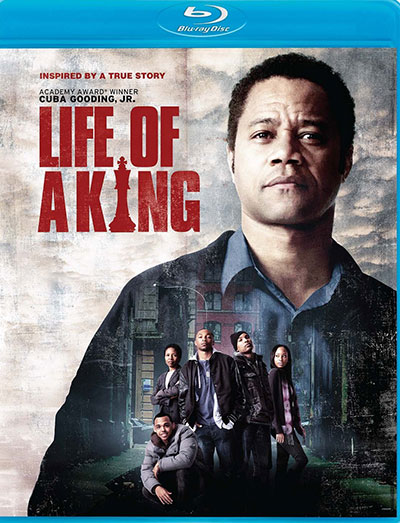
Gooding plays Eugene Brown, an Ex-con who starts a chess club for teens in Washington, D.C. The film begins with Eugene being released from prison. He’s unsure what to do with himself and, ultimately, he gets a job as a janitor at a high school. As he sits in for a teacher one day, he realizes that she won’t be returning. He takes up the job and eventually garners the students respect. We never learn exactly why Eugene was in prison, but that’s beside the point. The plot is more than a little formulaic and predictable, but it’s the execution that works here. We know that the students won’t respect him at first and we also know that they’ll eventually warm up to him. What works here is that the film is inspirational, but never heavy-handed in its approach. I think one factor is that Eugene is an Ex-con. It’s not as if he’s the most obvious role model and most films like this would have him spewing off sermons left and right, but that’s not the case here. He’s simply been around the block and knows a thing or two. There are other plot elements such as Eugene trying to reconnect with his family and a sub-plot involving a few students selling drugs. All that is fine, but the heart of the film is how he transforms this class (and himself) in the process. I admit that I’ve never been a big chess fan and it’s hard to get too excited over a film when its climax is a chess match with one of the students, but it’s very worth seeing. The chess match itself is handled well. It could’ve easily turned the other opponent into an enemy, but he’s simply another chess player.
Video: How’s it look?
Admittedly this film isn’t very flashy, but the transfer does serve it well. The AVC encoded (1.78:1) image displays strong colors with nice smooth details throughout. There are a few slight traces of grain here and there, but nothing too distracting. Facial details were strong throughout. I could spot a few bumps and pimples on some of the faces. Cuba Gooding Jr. has more than a few wrinkles at his age and they’re heightened here in HD. The print seemed clean to me. No worries here, the transfer satisfies.
Audio: How’s it sound?
The Dolby True HD track is about on par with the transfer, but that’s OK. Music comes through on occasion, but mostly this is front heavy. Lines seems smooth and natural and stayed audible throughout. I think the track serves the film as it should. I’m sure most who will see this film won’t be expecting the most robust track and with that in mind, this does the job. There are some moments when the rears are put to use and those moments satisfied.
Supplements: What are the extras?
All we get here are some previews for other Millennium titles.