Plot: What’s it about?
Before I saw “Breakin’ All the Rules”, I’d never really thought there was any kind of correlation between breaking up with a woman (or if you’re a woman – breaking up with a man) and getting fired. Having been fired from a previous job (albeit I saw it coming) and having broken up with a girl, I’d have liked to have had a copy of the book that Jamie Foxx’s character wrote in this movie. Would it have helped? I don’t know. It’s always helpful when there’s some sort of protocol to follow as opposed to just “winging it”. Any way you slice it, the two are really pretty similar. The job provides you with money and could be construed as a means to an end while the significant other can also be a really great thing (or a really bad one depending on the situation). Above all else, very few of us will go through life without having one or the other and odds are that some sort of relationship will end up severed, be it in the professional life or the personal one.
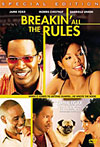
And so we meet Quincy Watson (Jamie Foxx), an up and coming writer who is asked by his boss (Peter MacNicol) to help in his company’s corporate downsizing. In an effort to appease his boss, he reads up only to find out that he’s the one who’ll be doing the firing as Phillip (MacNicol) wants to avoid any potential stalkers. Frustrated by this situation and his girlfriend leaving him, Quincy quits his job and takes what he’s learned to write a book: How to Break Up. The book becomes a best-seller overnight and soon he’s giving out advivce, mainly to his cousin (Morris Chestnut) on how to best break up with women. This would all be way too simple if this were the case, though. And, of course, it’s not. Quincy is sent by his cousin to meet Nicky (Gabrielle Union), to help the break up process. But Nicky has changed her look and though a little mistaken identity; Quincy and Nicky (who tells him his name is Mary) start to find some mutual attraction. Evan (Chestnut) immediately regrets his decision to break up with Nicky and now wants her back. Will there be a simple resolution to this mess or will evryone be hurt?
Video: How does it look?
The disc includes two versions of the movie, a full-frame version as well as a 2.35:1 anamorphic version. I found the widescreen version (the version reviewed) to look pretty darn good. There were a few times when there seemed to be a bit of dirt on the print, and in some of the lighter scenes there was the faintest bit of some streaking (if that’s the right way to describe it). These instances were few and far between, but I did notice them the first time around. The full-frame version looks solid and clear as well, but when you watch a widescreen version and then compare it to a full-frame version – there’s really no comparison at all. If there was ever a reason to prefer widescreen over full-frame, here’s yet another example. It is nice, though, to at least have a choice and not buy another disc if you want that particular version of the movie.
Audio: How does it sound?
This release includes a Dolby Digital 5.1 track, which contains some rather run of the mill audio. This is a dialogue based film, so the main surround activity is found within the musical score and soundtrack. Some subtle use can be heard, mainly during the club scenes, but the main focus of the surround is the music. This is a comedy though, so the dialogue is what’s important. This track offers crisp and clear vocals at a consistent volume, which never allows them to be drowned out by the other elements.
Supplements: What are the extras?
“Breakin’ All the Rules” comes with a few supplements, but none really too much worth mentioning. First up is a commentary with actress Gabrielle Union, Director Daniel Taplitz and the producer. Taplitz takes charge and tells of how he came up with the idea, etc. The track is rather lively, but not a whole lot of new information is learned just how some shows were done and so on. There is a Quincy Watson “mock interview” which is Quincy being interviewed on a TV talk show (in character) talking about his “Break Up” book. The typical “Making of…” featurette is also included as are some outtakes. What really baffled me was the colorized version of a Three Stooges short entitled “Hoi Polli”. In an bet, the stooges are the subjects that try to make them gentlemen. It really has nothing to do with the movie and it’s colorized, so it doesn’t really feel authentic. Maybe Columbia is just trying to promote the Three Stooges however they can. Widescreen and full-frame versions are included on this dual-layered disc.