Plot: What’s it about?
This film is, first and foremost, a character study. Realizing that fact and taking “Come Back, Little Sheba” for what it is and not what my post-modernistic eyes wanted or expected it to be was more of a challenge than I would have thought. There is such a tendency in today’s world of quick, meaningless celluloid eye candy to forget what makes the movies an art of escapism and indulge in that most innocent – and disturbing – of current trends. As I watched this film, I found myself unconsciously desiring more fluidity, more momentum and, ultimately, more excitement. But by the time I’d finished it, I found that I had unconsciously become a part of that new parade of moviegoers with no concept of the attention span of generations past. Films used to be about what you felt, not what you saw. I must admit a personal respect for a story that stands on its own two feet, without the gimmicks, gadgets, or slight of hand that suspends present day disbelief. There is an unmistakable beauty in simplistic filmmaking, and this is one of the best counter-arguments I’ve seen in quite a while against the predilection toward style over substance so prevalent on today’s big screen.
Doc and Lola Delaney are living on yesterday’s good intentions. Caught up in a marriage not so much forged on love as necessity and mutual responsibility, their lives have lost something by the time this film opens. There’s a certain drabness to the precision of their daily activities, one that at first seems rooted in years of matrimonial indoctrination, but quickly proves to be the product of cumulative, intangible compromises. Much to my surprise, I was quickly disarmed by this intimate story of two people struggling to find themselves through the banality of a marriage built on calm, structured security. When the two take in a young woman boarder, things quickly begin disintegrating from the inside out, exposing instabilities that were always just below a methodically civilized surface. Doc has just celebrated his first full year of sobriety, and Lola is unusually preoccupied with being a sterling example of the dutiful housewife. Marie, their new roommate and surrogate daughter, presents the perfect mixture of youthful enthusiasm and poorly concealed decadence, made all the more obvious through Doc’s paternal – and personal – interest.
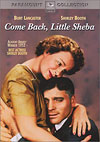
Shirley Booth won a well-deserved Oscar for her portrayal of the emotionally repressed wife who has tolerated a world built on one man far too long for her own good. Burt Lancaster plays a man with a coiled spring in his heart with tempered collectedness and, eventually, ferocity. The film builds to a climax that is both dramatically unsatisfying and yet somehow strangely inevitable. There’s a spherical structure to the narrative that serves to show us not only the shape, but also the depth of these two inseparably dysfunctional lives. When the final scene played out, I found myself questioning the characters’ respective motivations in earlier scenes that at the time seemed extraneous. It is a sad yet deeply telling story of how destructive patterns in a relationship can occur, repeat, and go unchecked with time, tolerance, and eventual complacence. While this movie did not grab my attention and keep me as intrigued as I’m accustomed to these days, it did take me inside the psyches of these characters and allowed me not only to see, but also to look around for a while. Such uncompromising risks are rarely taken in today’s world of popcorn flicks which come and go as quickly as the latest pop artists, and it’s good to be reminded of just how rewarding losing yourself in a film can truly be.
Video: How does it look?
“Come Back, Little Sheba” is presented in its original, full frame aspect ratio of 1.37:1. The results are a mixed bag, but for those with realistic expectations, this film’s transfer is sure to please on almost all counts. This is a black and white film, so contrast is a major concern. I’m pleased to say that black levels are deep and solid and there is virtually no edge enhancement present except slight instances in some outdoor scenes. These are few and far between, however, and do not distract in any way. Artifacts are the notable disappointment here, as specks and flaws rear their ugly heads time and again throughout the film. This is completely serviceable, however, and to be expected with a film of this vintage. Detail level, on the other hand, is excellent even in darker scenes. I was very impressed at the clarity of this presentation, especially given that this film is now over fifty years old.
Audio: How does it sound?
There’s not much to say in this area. Fidelity and range is about what you might expect from a Dolby 2.0 mono soundtrack. What is included here is perfectly fine for a character-driven picture such as this, with crisp, clean dialogue and only the occasional harshness to distract. Again, however, this is to be expected on a title of this age, and what we have here is more than acceptable. Nothing here is going to raise your eyebrows, but fans of the film shouldn’t have expected that to begin with. To this disc’s credit, the film never feels plugged up or muffled as a result of the mono track. Overall, a fine presentation that presents the film as originally intended.
Supplements: What are the extras?
If there’s one area to complain about on this disc, it’s that there are absolutely no extras to speak of. You’ve got a still-screen menu, set up (audio and subtitle options), scene access…and that’s it. Not even a trailer is included. Very disappointing for a movie that has stood the test of time as well as this one. Still, the video and audio presentation is solid, and this disc is likely the best this film will ever look. All things considered an easy recommendation.