Plot: What’s it about?
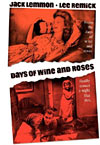
Like Billy Wilder’s “The Lost Weekend” that preceded it and Mike Figgis’ “Leaving Las Vegas” after it, “Days of Wine and Roses” is the story of alcoholism. This disease is something that has affected people around the world for some time, ever since alcohol was invented we might say. However the performances by Jack Lemmon and Lee Remick do more to show us that this disease, like Cancer, shows no remorse and affects people no matter what color their skin, what sex they are and how old or young they are. While movies have tried to tackle this subject, only a few have really come close to showing what it’s like and they usually aren’t that plesant to sit through. To put it bluntly, whenever I feel that I’ve had more than my fill, I watch “Leaving Las Vegas” and think to myself “Ok…I don’t have a problem and if I do, it’s not nearly as bad as that guy…” Jack Lemmon said that this was his favorite role to star in. I saw an episode of “Inside the Actors Studio” in which the host brought up this movie and Lemmon went into a trance and talked about the movie, concluding with “…I am an alcoholic.” Clearly this was a very personal movie for the late, great Mr. Lemmon and it’s reflected in his performance. We might think, in hindsight, that it should have been this movie he won one of his Academy Awards for instead of “Mister Roberts”.
As for the plot, well it closely resembles another Lemmon movie that he did prior to this. His Joe Clay is the same corporate go-getter that Bud Baxter of “The Apartment” was. But Bud loaned out his place to high-level executives to get ahead in business. Joe uses the corporate expense account to go to party after party (life in the Public Relations world), all the while drinking more and more. He meets (and then marries) Kirsten (Lee Remick), who he slowly draws into his world of partying and drinking. Things start out fine, hence the title of the movie. However, it’s not long until the honeymoon is over and both start to depend on drinking more and more. Gone are the happy parties, hanging out at the docks, but they turn bitter and hateful towards each other. I was reminded of Elizabeth Taylor and Richard Burton in “Who’s Afraid of Virginia Woolf” (another movie that glorifies drinking, but doesn’t really try to tackle the topic of alcoholism). Joe and Kirsten experience a slow downward spiral that, I think, only alcoholics can truly identify with. As the movie progresses, we wonder who to truly feel sorry for – after all, they did it to themselves – or are they a victim of circumstance?
Director Blake Edwards is better-known for his work in more light-hearted films like “The Great Race” (also starring Lemmon), “The Pink Panther”, “Victor/Victoria” and “10”. However, his touch is still felt here and it’s reflected in his insightful commentary track. Clearly he was out to make a statement, and one was made. While “Days of Wine and Roses” is a work of fiction, people deal with this exact problem every day. I found it a bit more hard-hitting than “The Lost Weekend” as the introduction of alcohol coincided with Clay’s work. It wasn’t a means to and end, but rather a way for him to mix business and pleasure and still quench his thirst for drink. Though today we see ads for beer and other alcohol, we don’t really know who to blame for the sheer amount of debauchery that exists. Is it Madison Avenue that tells us (and the characters of the movie) we need a beer in hand to fit in socially or is it a sickness within and alcohol and other drugs are ways to cope? Whichever the case, Jack Lemmon and Lee Remick make some wonderful performances in this movie. “Days of Wine and Roses” is one of the five titles that won the DVD Decision vote, so the movie evidently has a lot of fans. See Jack Lemmon at his best, most dramatic here.
Video: How does it look?
I’ve said it before and I’ll say it again…black and white movies that are anamorphic look simply marvelous on DVD. By the time that “widescreen” came around in Hollywood, most bigger budget films were going to color. “Days of Wine and Roses” is filmed in a 1.85:1 transfer that looks great. There is a large difference in grading color films versus Black and White. Some of the same flaws exist between both, such as artifacting and edge enhancement (both of which aren’t much of a problem for this movie), but color and hue aren’t really big factors. The film has a very soft look and feel to it, without that grit that’s associated with many older Black and White films of the day. Not many complaints here, as the image appears very clean. To compare, watch the trailers, also in anamorphic widescreen, but that haven’t been given the treatment that the main feature has. Quite a difference.
Audio: How does it sound?
Audio, however, is another thing all together. The mono track can only be “so” good and for a movie that’s forty years old, there’s just so much that can be done about the sound. The film, for the most part, sounds pretty good, being free of distortion. Naturally, surround effects, LFE and everything else are all thrown to the wind, but the dialogue representation is good, sounding natural on all levels. While some of the background noise does sound a bit shallow and brittle, the soundtrack as a whole is a little better than I had hoped for. Naturally, this can’t hold a candle to today’s soundtracks, but dialogue is most important here and the film sounds as good as it ever has.
Supplements: What are the extras?
As one of Warner’s five “DVD Decision” titles that was voted on by fans, we’re treated to some supplements, though not that many. The first and most comprehensive is the commentary track by Director Blake Edwards. Though many dead spots exist, he expresses his passion for the film and how it has help up throughout the years. As mentioned earlier, Edwards is known for his more comedic films, though this is their polar opposite. A good track which fans of the movie will want to give a listen. There is also a “Vintage Jack Lemmon Interview” in which we see Lemmon on the set of the movie, smoking a cigarette and answering questions on the phone. The other half of the screen is black (I kept thinking that something would pop up, but nothing ever did) and we can deduce from Mr. Lemmon’s answers what questions are being asked. This is a rather odd supplement, but still a bit informative and gives us a bit of insight into the making of the film. Lastly, two theatrical trailers, both shown in anamorphic widescreen, are included.