Plot: What’s it about?
The decade of the 1980s were filled with a lot of great movies and the rise of the music video. Some of the directors of those videos, such as David Fincher and Mark Romanek, have gone on to have success as feature film directors. One of the most goofiest novelty songs of that decade was a song called “Fish Heads”. It also provided for an amusing video. This particular one was directed by a little known actor at the time who had a few film credits and was most noted in a bit role in Stripes and would go on to be a part of one of the biggest movies of all time. His name is Bill Paxton. In 2001, after many years in acting, Bill finally got his chance to direct a feature film and with the help of some of his past co-stars and a solid script by a first time screenwriter the result is a dark twisted tale of suspense in a small Texas town during the summer of 1979 that can only be summed up in one word: Frailty.
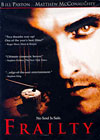
The night is rainy. The time is 10:30 PM. The place is the FBI building in Texas and FBI Agent Wesley Doyle (Powers Boothe) has a visitor at his office. For years, Doyle has been after a killer known as “The God’s Hand Killer” and this visitor will talk to only Doyle. The visitor identifies himself as Fenton Meiks (Matthew McConaughey) and, according to him, he knows who is the killer. He tells Doyle that the killer is his younger brother Adam, who earlier in the night had mysteriously killed himself. As Meiks goes back to the origin of these killings with Doyle, it leads to his childhood and a father (Bill Paxton) who was given a “sign” to take care of some unfinished business.
To give away the rest of this tale would be an injustice as each element is intriguing and hookable and along the way there are a few surprises. One of the big surprises of this movie is the direction of Bill Paxton. The years spent with these masters of the visual eye had paid off with many beautiful shots of Texas and a wonderful use of light that makes a difference in this film. What also drove this film were three things, the writing, the performances and the score.
It amazed a viewer that Brent Hanley’s screenplay was not only very well written but that it was an original screenplay. Usually, a story in this genre would be based on a novel or short story. The dialogue drives a lot of this film as well as its actions and the script is very well done and very quotable. The viewer wants to hang on to this story from start to finish and Hanley’s screenplay does more than that. It keeps you on the edge of your seat and leaves plenty of room for head after-shakes.
The script would be nothing without good actors to deliver those lines and Bill Paxton and Matthew McConaughey (fresh after their voyage in U-571) give solid performances in the lead roles. As Dad, Paxton brings a father that has led a stabile family by himself and a “sight” that threatens that stability and leading to possible future consequences. McConaughey is given screen time from the start and mostly voiceover flashing back to his childhood past, but he brings an individual that has something to confess of his past that he’s kept for quite some time as well as keeping something else inside that Agent Doyle is very curious to finding out and prodding the viewer into pondering just what that might be and if it is anything or nothing. He’s never been a disappointment since his breakthrough in A Time To Kill and he continues to be one of the finest actors. Also most of the acting credit goes to the two younger actors playing the Meiks children. Matthew O’Leary and Jeremy Sumpter bring a natural quality as the skeptical child of his father’s “vision” and the child that stays loyal to his father despite the skepticism.
As for the score, Brian Tyler brings a memorable score that combines touches of Bernard Herrmann and many well known horror films. Incidentally, his work in this film led to doing another solid score job in William Friedkin’s The Hunted and both make great use of Johnny Cash. His score drives the great title sequence as well as the flashbacks to 1979 without incorporating any music from that period.
From it’s intriguing setup at the start to the final minutes in the end, Frailty gives something refreshing to a genre that’s been laden with special effects for scares to giving subtle touches and recalling the theory that has driven some of the best horror films of all time: less is more.
Video: How does it look?
Frailty is in the 1.85:1 aspect ratio enhanced anamorphically and the print is clean but not short of flaws. The transfer is best in it’s darker shots and the light is nicely displayed without any oversaturation of color. Although, there tends to be a bit of a haze over the print that prevents the transfer from being totally sharp and nicely detailed. The transfer has a few specks but not many and the clarity for the most part makes for a decent transfer.
Audio: How does it sound?
The Dolby Digital 5.1 track is slightly better than the transfer spreading nicely throughout the channels and providing a very good balance between dialogue and score. The score was not overbearing like most desperate scare horror films and it comes across very clear throughout the front and the back speakers. The sounds throughout the film were effective and came in mostly through the rear but were evident throughout all channels. This disc also has English and Spanish subtitles.
Supplements: What are the extras?
Lion’s Gate gives the royal treatment for it’s titles and the Frailty disc is no exception to that. To start, the extras have the spellbinding trailer that would attract even the slightly curious. After, there are three commentary tracks.
The first is by director Bill Paxton, recorded in June 2002, and it is informative, descriptive and self-congratulatory without too much of all three. He shows his appreciation and is rarely silent on his track. The second is with editor Arnold Glassman, producer David Kirschner and composer Brian Tyler and most of the same information is given, not as reflective but more looser and laid back and amusing. The most intriguing of the three is the commentary by writer Brent Hanley as he shares similar info as well as his motivations, his choices script to screen and is a little more informative on his origins than the other two tracks. I felt like it was listening to an old friend from the neighborhood rather than a part of a film production and the result was a very good track to add to the other good tracks.
Next is the documentary “The Making of Frailty” and it documents the making of the production on set and off set with all the main players both on screen and behind the camera. It’s a good piece without being a promotional piece of fluff and it’s good to see Paxton at his double-duty best both acting and directing. It’s also good to note the preparation of visual shots with cinematographer Bill Butler. It’s short, it’s sweet and it’s good.
More informative and intriguing is the Sundance Channel’s “Anatomy of a Scene” program focusing on the scene involving Matthew McConaughey and Powers Boothe driving towards the climax of the film. It’s gets more technical than the making of and goes into a lot more info. It’s a good companion piece to the first piece and put together, it makes for one hell of a documentary.
Next there are 4 deleted scenes that are played straight through and range from extensions of a scene to small scenes that would’ve taken it away from the well paced narrative. This can be viewed with or without commentary from director Bill Paxton and it’s interesting to see why they were discluded from the final cut. The scenes are good and their deletion is understandable with or without commentary.
Finally there’s a photo gallery of forty pics (I love the pic of Paxton handling the ax with the daylight holes in the barn) and a storyboard gallery covering three scenes of the film.
Overall, one of the most satisfying screenplay and directorial debuts of the last five years makes Frailty a very good film and it’s extras make it a very satisfying DVD.