Plot: What’s it about?
Rikio Ishikawa (Tetsuya Watari) is one tough dude, so mean and vicious that he works as muscle for one of the most powerful yakuza organizations. He served some time in prison, after which he was sent to Osaka, to make sure he was back on his game. After all, if he was a loose cannon or softer thanks to his prison sentence, then better he should reveal that in Osaka, rather than back home. The trek to Osaka is not his by choice, instead his bosses have demanded a ten year stint there, to prove himself. If he keeps his act together there, then he will be brought back to resume his post. But his time in Osaka doesn’t help keep him calm, not even close, as his mind races and he is desperate to return home. He tires of the laid back, small time atmosphere there, so he soon decides to take matters into his hands. Even when in Tokyo however, his mind continues to break down and a new heroin habit only complicates the situation. As violent as the yakuza lifestyle can become, Ishikawa takes it to a new level, one in which he kills in brutal fashion, with no hesitation. Not just the normal hits either, but sick and twisted murders that shock even his fellow yakuza. But as horrific as his methods might be, his results are incredible and soon, he has moved from the bottom of the chain. Not the top man, but the most feared and respected of the toughs, so he is in a position of immense power. But sooner or later, his mind will snap beyond repair and when that happens, what will he be capable of?
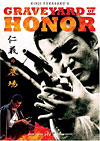
I should point out that this review covers Kinji Fukasaku’s film Graveyard of Honor from 1975, not the more recent remake by Takashi Miike. Fukasaku was well known for his unusual yakuza pictures, but perhaps none can match the violence, twisted nature, and ruthlessness of Graveyard of Honor. If you need a character to relate to in order to make it through, then you’re screwed in this case, as this movie is loaded with sick folks. You’d have to stretch to find an even moderate character, as the focus is on the sadistic, heartless characters, ones that make the mobsters from Goodfellas look tame by comparison. Fukasaku doesn’t do what most filmmakers are guilty of, which is glorifying criminals and the yakuza lifestyle, instead he swings the pendulum to the other extreme, as if these men were hideous animals. If you can think of an offense, this film probably has it, from common yakuza violence to cannibalism. So don’t expect to follow a hero through this mess of human trash, as Fukasaku doesn’t settle for a standard, by the numbers yakuza picture. Where other filmmakers focus on honor and pride in yakuza cinema, here Fukasaku drives home that these men possess no such traits. Tetsuya Watari (Brother, Stray Dog) has a tall order, to portray a man who is consumed by this twisted lifestyle, a man we feel no compassion for as he spirals downward into his own darkness. Watari does so with immense ease, in a natural and a little eerie performance, one of the better fully evil turns I’ve seen. As usual, Home Vision has prepared a solid presentation, so Graveyard of Honor earns a solid recommendation.
Video: How does it look?
Graveyard of Honor is presented in 2.35:1 anamorphic widescreen. Home Vision has worked some magic with this treatment, as this movie looks brand new. The print has been shined up and shows minimal flaws, as grain and debris are infrequent. This allows the visuals to be sharp and display much depth, which is excellent news, to be sure. The film has a kind of raw texture, which lends a real life feel to the experience, a visual design that is well preserved here. I found contrast to be excellent here, with smooth, deep black levels that serve as an ideal companion to the vivid colors. This is simply a fantastic visual effort from Home Vision, who has surpassed all expectations here.
Audio: How does it sound?
The original Japanese soundtrack is preserved here, via a somewhat dated, but more than acceptable mono option. This is a much cleaner, clearer presentation than I had expected, as very few age related defects can be heard. I heard a few minor pops and moments of harshness, but given the age of the material, this is a superb effort. Even the smallest sounds can be heard with ease, so nothing is ever drowned out or lost in the shuffle. No worries on the dialogue front either, as all the vocals are sharp and never muffled. This disc also includes newly refined, optional English subtitles.
Supplements: What are the extras?
A Portrait of Rage is the best of the supplements here, a twenty minute or so look inside the career of Kinji Fukasaku. There isn’t much here about this film in particular, but that is of no consequence, as the director is more than worthy of such spotlight. You can also check out an interview with assistant director Kenichi Oguri, which gives us a feel of what it was like to work with Fukasaku. I wish this was a piece with more duration, but even so, this is worth a look. This disc also includes the film’s theatrical trailer.