Plot: What’s it about?
”I’ll remember ya honey…you’re the one that got away.”
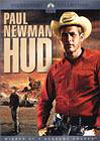
Let me tell you why Paul Newman is one of the greatest actors both on an off screen. Aside from playing parts that no other actor would touch and winning out roles that other actors couldn’t, he’s one of the most versatile actors of all time. At the age of 77, he was just nominated for yet another Academy Award for his work in “Road to Perdition”. However Newman was in his heyday back in the late 50’s and 60’s with roles in so many movies that it’s hard to pick one of his best. Though he (finally) won an Oscar for his role as “Fast” Eddie Felson in Martin Scorsese’s “The Color of Money” many feel that it was the Academy giving him the Oscar for work that he should have won for countless other films. Films like “The Long, Hot Summer”, “Cat on a Hot Tin Roof”, “The Hustler”, “Cool Hand Luke” and “Butch Cassidy and the Sundance Kid” were some that defined Newman’s already outstanding career, but many feel that his role in “Hud” might be among his best. For me, I have a hard time disseminating which he’s actually better in; even “Slap Shot” has its great moments. But for the role of Hud, Newman isn’t as we have seen him before, not the hero that he has been in so many other movies, but a selfish, semi-drunken cowboy who finds it better to play by his own rules rather than please others.
Hud Brannon (Paul Newman) is a cattle rancher who finds that his livestock is stricken with a disease (hoof and mouth) that threatens not only them, but his way of life and way of earning a living as well. Hud is responsible for the death of his younger brother and his father (Melvyn Douglas who won a Best Supporting Actor Oscar for his role) doesn’t ever want to let him live it down. Lon (Brandon de Wilde) plays Hud’s nephew who idolizes him and the stage is set for the reigns to be handed to Lon as they were to Hud. The movie is more of a rite of passage of men, yet somehow we see that there is a rebellious nature of it that we’ve seen in other movies of the time (Rebel Without a Cause and The Wild One to name a couple). Hud is self-centered and callous, but somehow we seem to identify with him and Newman’s performance brings out the life of the character we see on screen. The clash between Hud and his father represents what most every person goes through with their parents. However, not labeled as a “teen” movie, we see this on a different scale. For others, Hud is just one man, yet for Hud; he represents himself and all that he can be, regardless of the cost.
Director Martin Ritt seems to direct movies that feature solemn, yet outstanding performances by his actors. Perhaps better-known for movies like “Sounder” and “Norma Rae”, we see that the central characters are strong and often accomplish what they set out to do. Newman is as much Hud as anything and Ritt, who directed him in “The Long Hot Summer” with Jo Anne Woodward, used that to convey the deep performance of Paul Newman. Not every story has a happy ending and not every movie has a character that you can truly look up to. “Hud” is a movie that tells the values of the American people and shows normal, everyday folks at work. Farmers can be self-indulgent, swaggering womanizers too, you know. The only real crime of “Hud” is that it didn’t result in any Academy Awards for Newman. Though Douglas and co-star Patricia Neal did manage to win the statue, Paul Newman would have to wait another 23 years on his reprise of the character Eddie Felson to get his due. Though it doesn’t move at the speed of light, one of the better performances by Newman and one of the better American movies to come around, is “Hud”.
Video: How does it look?
One of the great things about watching countless movies is that we see how many ways a film can be shot. My personal favorite, when it comes to how a film is presented, is a 2.35:1 anamorphic black and white image. Such is “Hud” and such was “The Hustler”. Something about the way the colors look when framed between the two bars just makes me think of how good the image looks. Paramount has given this a brand new 2.35:1 transfer and it shows in every sense of the word. Though there are some scenes with some grain and dirt, I find it hard to believe that it’s the fault of the transfer. And, granted, the movie is now 40 years old and there is some leeway to be given here. The black levels are on target and though we don’t have the “depth” of a color film, I can’t imagine this film being shot any other way. I found this transfer to be excellent and is very than deserving of the treatment it’s been given.
Audio: How does it sound?
The Dolby Digital mono is what we might expect from a forty year old film. The mono track is fairly strong and well-defined, but there’s no depth to the track at all. Then again, we don’t expect any. There are long scenes in which only dialogue can be heard and any supposed “surround” effects don’t really add to the overall excitement of the film. I didn’t find any distortion or “hiss” that is usually associated with a film of this age and, as a result, I have to say that I was fairly pleased with the final result. For fans of “Hud”, viewers won’t be disappointed as this is the best the movie has looked and sounded.
Supplements: What are the extras?
Paramount only seems to do Special Editions with their new “hit” movies and their catalog titles that are in high demand. As such, this has been given the bare bones treatment that has plagued so many other Paramount titles.