Plot: What’s it about?
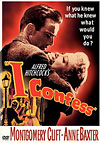
Cited by some modern-day film critics as one of Alfred Hitchcock’s few misfires, “I Confess” tells the story of Father Michael Logan, a devoted priest who finds his faith put to the ultimate test. After hearing the confession of a murderer, Logan must fight to maintain his integrity and prove his own innocence while still protecting the identity of the one responsible for the crime. This all plays out in the first few minutes, and it would seem as though we’re in for a nice, leisurely hour and a half of introspection and self-doubt. But then, this wouldn’t be a Hitchcock film if things were that simple, and it soon becomes clear that Father Logan has a dubious past. Before the end, Logan is facing trial for a crime he didn’t commit, facing a life he turned away from long ago, and attempting to bring the true killer to justice. A series of plot twists are dashed throughout, of course, with a presumed femme fatale thrown in for good measure. Deceptively complex, this is one of Hitchcock’s more straightforward films, with little to no more information divulged by story’s end than we had in the beginning. The only thing that has changed, however, is our perspective. This characteristic trait, after all, is what exemplifies all the best work from the master of suspense.
As you may have assessed by now, I disagree with many critics of this film – for the most part. I found the plot of this film to be intriguing, and Montgomery Clift (as the devout man of the cloth) gives a deeply emotional performance that I suspect was misinterpreted at the time as being too passive. Anne Baxter and Karl Malden are equally exceptional as the woman who still holds a flame for the young clergyman and the police inspector who suspects him of murder. All of these actors allow their respective characters to achieve a truly three-dimensional quality. I especially liked how the attributes of these people were allowed to be realistic and true to who they were, not merely sprinkled throughout to incite either contempt or sympathy at appropriate moments. Not everything about these characters – even the protagonists – is always morally sound, and the viewer is at times left to ponder how the line between right and wrong became so blurred in the first place. Even the guilty man (aptly named Keller, in an obvious pseudonym for “killer”) is given a story to tell, albeit a brief one. The point is that Hitchcock doesn’t allow for easy answers here, and in a film that could have so easily succumbed to melodramatic flourish on behalf of its hero, I applaud the decision to leave things more artistically ambiguous.
Probably my only problem with the film is its length. I wished there had been more time for us to get to know Father Logan at the start of the picture. I felt strangely detached from his ordeal for the first half hour or so, wondering why I should be expected to care so much about a man to whom I had not as yet been formally introduced. The film did assuage that complaint somewhat through various flashbacks, but I found the visuals more impressive than the dialogue, and a lengthier opening to add needed atmosphere to Logan’s world would have involved me more thoroughly. I also felt that the editing in the film was sporadically uneven. For instance, some scenes (like the flashback sequence) went on for far too long, embellishing in every detail possible. Others (like the pivotal jury deliberation scene) consisted of a brief, seemingly abandoned scene in which something intriguing is introduced and then inexplicably dropped. On the whole, though, these are minor complaints, rooted undoubtedly more in my own expectations of modern prose storytelling than in any real fault in the movie itself. I was entertained far more than I anticipated, and at the end of the day, that’s what counts. I find this film to be an easy recommendation – one whose reputation should continue to grow in years to come.
Video: How does it look?
Presented in its original 1.37:1 full frame aspect ratio, “I Confess” looks generally pleasing, boasting excellent minute detail, especially for a film of this age. Contrast is similarly well done, with deep, robust blacks and whites that aren’t overblown (at least not unintentionally). The only problem area here seems to arise from the print itself, and an inconsistency in the presentation is the unfortunate result. A slight pulsing of the backgrounds can be seen, especially in darker scenes. This is disappointing as so much of the film takes place in shadow, and it is apparent throughout. Edge enhancement, on the other hand, is kept to a thankful minimum, as is noticeable compression blocking. There is a fair amount of dust, specks, and other debris present, but nothing too distracting (or unexpected). There’s not anything that should disappoint fans here, but a full restoration would do wonders. Note: my video score reflects special consideration for the film’s vintage.
Audio: How does it sound?
The only track included here is a Dolby Digital 2.0 mono track, which will do just fine for the purists, but may leave the rest of us wanting a bit more. This is predominantly a dialogue-driven film, though Dimitri Tiomkin’s score features prominently in more than a few key scenes. It is in this area that the audio shows its age, and I noticed peaking more than once during music cues that should have demonstrated more fluidity and range. These are minor quibbles, to be sure, but for this first-time viewer, it was enough to take me out of the picture for a moment or two. All in all, though, when you consider what’s here to work with, not a bad presentation. Subtitles are available in English, French, and Spanish.
Supplements: What are the extras?
The main attraction here is the documentary, “Hitchcock’s Confession: A Look At I Confess”. Clocking in right at twenty minutes, this is actually rather insightful considering its length, with memorable production anecdotes from all involved. Topics touched upon include the personal nature of the film, the visual techniques, both indicative and atypical, of Hitchcock present in the film, and its initial critical response. The original theatrical trailer is also included for the deeply devout among you. Enjoy.