Plot: What’s it about?
The year is 2035 and mankind has advanced technology to far reaches, in ways that have impact everyone on the planet. The use of robots has been commonplace, even in normal homes, as assistants, workers, and basic companions. These robots are quite advanced and are driven by a code of ethics, which all robots must follow. The code states that a robot must never harm a human or by inaction, allow a human to be harmed. A robot must also obey orders given by a human, unless the order requires the first rule to be broken. A robot must also protect its own existence, unless that requires one of the first two rules to be broken. The code holds up well too, as robots function as safe and productive members of mankind’s world. In fact, it is thought to be impossible for a robot to break the code, at least until now. Dr. Alfred Lanning (James Cromwell), a high end scientist at US Robotics, has been murdered in brutal fashion. Detective John Spooner (Will Smith) is sent in to solve the case, but he finds unexpected evidence. He mistrusts robots, so when evidence points to a robot being involved in the murder, he isn’t shocked. But his known dislike for robots forces him to dig deeper and find more evidence. If a robot did in fact break the code, then nothing stands in the way of a total robot rebellion against mankind. Has a robot broken the code and if so, can Spooner make sure that justice is served?
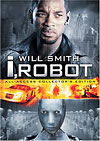
As a fan of Isaac Asimov’s incredible sci/fi works, I was worried when I saw Hollywood had an adaptation in the works. Those fears were compounded when Will Smith (Men in Black, Bad Boys) was signed for the lead role. After all, Smith has minimal talent outside of popcorn action films and even then, he isn’t an ace in the hole. The project started off as a premise that included elements of Asimov’s work, but soon became an official adaptation of I, Robot, though some elements of the original project were preserved. So could I, Robot, a story that relies on logic, be given justice by this movie, which seemed to promise the opposite? As expected, this movie tosses Asimov’s material in the trash and settles on being a cookie cutter action flick with sci/fi touches. The plot is simplified and rendered useless, but I suppose director Alex Proyas (Dark City, The Crow) didn’t want logic in the way of his loud, unrealistic action sequences. This is a surprise, as Proyas is a gifted filmmaker, but this is a serious blemish on his resume. I knew Smith would be bad, but I held out hope for Proyas, only to be disappointed. I, Robot should have been a brilliant, eerie look into the world of robots, but instead we have an ineffective action picture. This Collector’s Edition includes a lot of added extras, but the frustrating menus make it a chore to explore the supplements.
Video: How does it look?
I, Robot is presented in 2.35:1 anamorphic widescreen. Fox has issued another terrific new release treatment here, as the movie looks impressive. As expected, the print is in pristine condition and no debris or softness can be detected. The cold world within the film is well replicated here, with metallic tinged hues and stark black levels. These combine to create that cold, metallic visual design, as the filmmakers intended. I did notice some shimmering at times, but those were minor instances, never a distraction. So we have a clean, sharp visual presentation, not much else we could ask for in this case, so Fox has delivered once again.
Audio: How does it sound?
I was pleased to see the inclusion of a DTS option here, as Fox hasn’t included DTS on many of its recent releases. Of course, this is just the kind of movie that screams for DTS, but does the soundtrack fulfill that potential? I listened to both the DTS and Dolby Digital 5.1 tracks, both of which sound excellent and provide an active experience. This is a loud, brash action movie and that is what audiophiles love, as that means fast paced chases, explosions, gun battles, and other high impact audio elements. So the surrounds pulse and remain active throughout the movie, not just in the action driven scenes. A number of quiet, tense scenes have superb sound design, the kind of subtle touches that can really enhance atmosphere. I do think the surrounds are a tad juiced at times, but all in all, I, Robot sounds awesome. As usual, the DTS option offers a superior experience, but both of these tracks are impressive. This disc also includes French and Spanish language tracks, as well as subtitles in English and Spanish.
Supplements: What are the extras?
As the video and audio performance are the same as on the previous release, this is where this new Collector’s Edition has to shine. Alex Proyas provides his audio comments and is joined by Akiva Goldsman, one of the all time hack writers. I can’t imagine anyone wants to listen to Goldsman, but Proyas supplies a nice amount of insight into the production. I wish more was made of Asimov’s original work, but instead we’re treated to general behind the scenes information. A more than solid track, although Goldsman could have been replaced with someone else, perhaps a cast member or two, anyone who could add some worthwhile remarks. That track was on the previous release, but two additional audio commentary sessions are also found here, one with members of the production crew and one with composer Marco Beltrami. I found the technical session to be a solid effort, with a lot of information from numerous sources. The first disc also includes a selection of still photos, so those are worth a look.
The lion’s share of the supplements are found on the second disc, but thanks to a poor menu design, you’ll quickly tire of perusing the extras. You have to go through a terrible layout to access the features, which is just not what we want. If you can suffer through the menus however, you will find some insightful supplements, but that is no simple task. An extensive production diary is well crafted, but split into smaller featurettes, which throws off the flow of the piece. Even so, the featurettes total over one hundred minutes, so the piece is in depth and provides a genuine look inside the production. Another collections of featurettes focus on the special effects, but at only half an hour, don’t expect too much depth. You can also check out a half hour featurette on the robotic world, which is quite cool and deserves a look or two. This release also includes interviews on Asimov’s work, deleted scenes, and an alternate end sequence.