Plot: What’s it about?
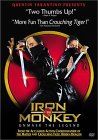
Before your crouching tigers, hidden dragons, red pills, and white rabbits, there stood an Iron Monkey, a Woo-ping Yuen-directed tale originally released in China in 1993. Now, eight years later, America is being exposed to some of the most impressive fight sequences in cinematic history, and on the big screen as well (the film was available in the U.S. on video for several years). But while these fights are very well choreographed, the overall picture falls flat with a cookie-cutter storyline, pedestrian themes, and ridiculous scenes that bring cries of laughter instead of the more serious overtones they tried to convey.
The story takes place in mid-nineteenth century China, where a corrupt government rules over a small village in the rural countryside. There is only one man who dares to go against the greedy Governor Cheng (James Wong) and his henchmen — the title’s Iron Monkey, a masked Robin Hood-type people’s hero who steals from the rich and gives to the poor. Infuriated by Iron Monkey, Governor Cheng sets up a plot to capture him, taking advantage of the fact that the infamous master boxer Wong Kei Ying (Donnie Yen) is passing through the province with his son. Governor Chang holds Wong Kei Ying’s son captive, and in order to see him safely returned, Wong Kei must find and destroy the Iron Monkey. But when an evil Shaolin monk takes over the town from Governor Cheng, Wong Fei Hung and the Iron Monkey combine their skills to take down the dangerous forces of evil.
If, out of all of this, you’re expecting another Crouching Tiger, Hidden Dragon spectacle, you are sorely mistaken. While many of the action sequences can be compared to those in Hidden Dragon (and in fact, some of them are better), other components, like story and dialogue, are weakly executed. While allowances have to be made for poorly translated subtitles, this only accounts for part of the problem. Instead of taking the time to develop multi-dimensional characters and a solid storyline, as in Crouching Tiger, Woo-ping decided to jump right in with little background or exposition. While this gets the ball rolling and hits all the bases in short order, it cheapens the film, and it is probably the sentiment of most intelligent viewers that a film should have more than just a collage of fight sequences.
Still, I don’t want to take anything away from Woo-ping’s direction, Donnie Yen’s choreography, or Arthur Wong’s cinematography, because the action in Iron Monkey is some the best fight sequences you’ll ever see. More impressive is that Iron Monkey was filmed over half a decade before The Matrix and Crouching Tiger, and in fact developed some of the gravity-defying stunts that were perfected in those later films. Following this film, Woo-ping did the fight choreography for The Matrix and Hidden Dragon, and it’s so consistent that it’s worth saying his style of choreography is almost unmatched by any other.
Besides that, though, there’s nothing else to look forward to in Iron Monkey — the segments of plot between fight sequences have the same effect as extra-strength NyQuil. Furthermore, the film quickly develops a Robin Hood-esque nature, so the plot is easily predictable — our hero, Iron Monkey, will be stealing from the rich and giving to the poor. The corrupt government will make numerous attempts to stop him (insert 10-minute fight sequence each time) and it will all lead up to a grand finale and final showdown between good and evil. Any hint of a story developing in between the fight sequences brings either laughter or a slap to forehead.
The cast is responsible for most of these moments. While some of the translations seem awkward or even incorrect, the actors continually prove two things throughout most of the film — first, that they know how to fight, and second, that they should stick to what they know.
Director Woo-ping also suffers occasional lapses in concentration, the biggest of which is near the end, when he calls for a medium-close shot on his child star Sze-Man Tsang. In addition to being poorly constructed and breaking continuity in lighting, it’s also more irrelevant than not. But what could have been the money shot just turned into another reason why this film was all about the fighting (which, occasionally, even failed to impress because some sequences went on too long without a break).
Mostly, though, Woo-ping is good at what he does, and Iron Monkey is proof that he’s the best in the world at creating some of the best-choreographed fights in modern cinema. But if you want a Crouching Tiger, your best bet is to rent Crouching Tiger, because Woo-ping certainly is no master at creating entire movies.
Video: How does it look?
Most wouldn’t know it, but Iron Monkey is almost ten years old. That’s right kiddies…just because it comes out as “new” on DVD doesn’t always mean that it’s “hot off the presses”. Still, the 1.85:1 anamorphic transfer is nearly pristine in it’s presentation here. The colors are very good, but a bit muted here and there. As one might imagine for some spots here, the colors are dark and artifacting minimal. There is little if no edge enhancement that I saw and I’ll be darned if I could spot that many errors. Not a bad transfer here, especially considering the age of the film…
Audio: How does it sound?
The included Dolby Digital soundtrack is consistent with most all of the “kung fu” movies you’ll find out there. Keep in mind that this came way before The Matrix and Crouching Tiger, Hidden Dragon so cut it a little slack when it comes to how the audio is presented. Still, I was fairly impressed by the soundtrack here as the surround effects were used to great expansion and the dialogue is very free of any sort of distortion. Not a whole lot to say here, but I can say that no one should be disappointed with how the disc sounds.
Supplements: What are the extras?
A typical Disney release here, containing two featurettes (though one does feature a raspy-voiced Quentin Tarantino) and the other with lead actor, Donnie Yew. Both are entertaining but not nearly long enough as compared to what’s out there. Also included is a musical montage (called a Score Medley) which is about 4 minutes long and serves very little point. Still, for all you fans of the movie, Tarantino has done you a favor and the disc isn’t that bad. Give it a look…