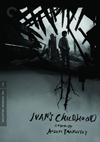
Plot: What’s it about?
Ivan (Nikolai Burlyayev) is just twelve years old, so he should be playing with his friends and living a carefree life, but the reality of his life is much more brutal. Even at such a tender age, Ivan was put into service for the Russian military for their battles of World War II. Even his fellow soldiers sometimes can’t believe he is actually part of the military force, but he is and is quite important, as he is tasked with some crucial assignments. Where his life was once bright and warm, with a family that loved him, now he is surrounded by darkness and depression. He is also consumed by rage, as German forces slaughtered his family, so now he pushes himself to try to gain some feeling of vengeance. As the war rages on and Ivan faces more and more dangerous situation, can he survive or at least find some kind of inner peace?
The career of director Andrei Tarkovsky is quite impressive, even though it spans only eight feature films. He helmed films like Andrei Rublev, Stalker, and Solaris, but his debut feature film was Ivan’s Childhood. This doesn’t seem like the work of a filmmaker on his first big shoot however, Ivan’s Childhood is a masterful creation. The movie is very dark in tone, with a deep sense of helplessness for the world within. In other words, if you need your spirits lifted, this probably isn’t the wisest choice. After all, the story centers on a young boy forced to fight in a brutal war. At its core, Ivan’s Childhood is a movie about war, but I wouldn’t call it a war movie, just a movie that deals with war. The escape from war is what we want as we watch, the brightness and hope from Ivan’s dreams, even in the midst of horrible atrocities. Ivan’s Childhood is a well crafted, powerful motion picture, but not one I would revisit often, so I think the best recommendation is a rental.
Video: How does it look?
Ivan’s Childhood is presented in full frame, as intended. This film was made in 1962 and as such, you wouldn’t expect a pristine transfer, but this restored and remastered edition is impressive. The print used still shows some flaws, but looks very clean and I doubt anyone will be let down here. The black & white image is strong and quite sharp, much richer and well detailed than I had expected. The black levels seem in fine form here, as contrast is blended to a solid end and no visible detail loss is evident. Once again, Criterion has issued an older film with a new transfer and once again, that transfer looks terrific.
Audio: How does it sound?
The film’s original Russian soundtrack is on deck, preserved in this passable mono option. The audio isn’t of much focus in this movie, but in a few scenes, you’ll hear explosions, fight atmosphere, and general warfare. In those instances, the audio is able to supply a little more oomph, but mono limits that to a great extent. The elements still sound solid however and in truth, dynamic presence and creative surround use would be out of place here and would probably lessen the experience. The dialogue is solid also, though the nature of mono sometimes causes some inconsistent moments. As always, Criterion has been kind enough to also include optional English subtitles.
Supplements: What are the extras?
Not a whole of supplements, as we have a video appreciation of the film and its director, as well as new interviews with star Nikolai Burlyayev and producer Vadim Yusov. While what is here is quite worthwhile, I guess I’ve been spoiled by some of Criterion’s more lavish releases.