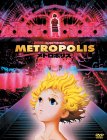
Plot: What’s it about?
Metropolis is a highly advanced, tri-level world filled with all the splendor technology can offer, with new additions being made all the time. Inside Metropolis, a chain of power is present like in any world and one of the most powerful leaders is Red Duke, who has some plans that could alter Metropolis forever. Red Duke is about to reveal to Metropolis the most advanced robotic being of all time, a creation he calls Tima. But Red Duke has a son named Rock and as it happens, Rock has an extreme distrust of robots, even though his own father is so closely involved in the process of robotic creation. As such, Rock has some plans of his own and they’re to find Tima, then demolish the robot beyond recognition. Tima winds up beneath Metropolis however, within the endless labyrinth that would confuse anyone, even a highly intelligent robot such as Tima. As time passes, Tima forges a friendship with the nephew of a detective and while the two make an odd pair, they do have some common traits. Will Tima survive long enough to be shown to the masses of Metropolis and in any event, what will become of Metropolis in the wake?
Destination Films has released the first anime title under its banner and their selection could have been much better, as it is Osamu Tezuka’s Metropolis. As the title suggests, Metropolis owes a little to the Fritz Lang masterpiece, but this adaptation of Tezuka’s comic book stands alone as a well crafted, simply stunning work of cinema. In short, Metropolis is a feast for the eyes, as it contains some of the most beautiful anime images I’ve seen and is consistent within them, so the entire duration never fails to be less than gorgeous. The use of color, the amazing animation, and terrific character design all combine to conjure up some images that are so beautiful, you’ll often find yourself lost within them. This is good in some scenes, as the film relies too much on well trodden paths in terms of storyline, as opposed to moving in new directions. Even so, the premise is good and while not always original, the details work well enough, I think. And while style over substance is not always welcome, this is one case where the visuals offer so much, the viewer will hardly notice the flaws, they’ll be too entranced with the images. I give this a high recommendation to those interested, especially since Destination Films has released a terrific treatment, complete with a Dolby Digital & DTS tracks, anamorphic widescreen, and a bonus mini-disc of supplements.
Video: How does it look?
Metropolis is presented in a 1.85:1 anamorphic widescreen transfer. As I mentioned above, this movie is a visual feast and as such, this transfer needed to be excellent and of course, it is all that and more in this release. I did notice a couple of small problems, but overall, this is a superb visual effort that allows the stunning visuals to shine. The print is very clean aside from some minor grain at times, so the image is very sharp and never hampered by print flaws, which is terrific news, of course. I found colors to be rich, bold, and vivid throughout, even the darker hues seem to leap off the screen, very impressive work indeed. No issues with contrast either, as black levels look rich and refined throughout, no murkiness or loss of detail to mention here. I wanted to give this the full five points, but I feel it falls just a tad short, though it still looks excellent.
Audio: How does it sound?
I think fans will be thrilled with the audio on this release, thanks to dual 5.1 surround options in Dolby Digital & DTS formats. The original Japanese soundtrack is given both Dolby Digital & DTS treatments too, which is most welcome, since a lot of studios upgrade the English options, but neglect the original language track. I have hear a lot of audio mixes and without a doubt, the DTS option on Metropolis is one of the finest I’ve ever experienced, not always for sheer power, but in terms of overall impact & experience. There is plenty of power in both mixes and your system will be pushed in a number of scenes, but with the DTS track, the subtle audio moments become clearer and more refined, though the Dolby Digital one is still terrific. In short, both tracks offer a top notch presentation, but if you have the option, the DTS is the better of the two, without question. This disc also includes an English language option (Dolby Digital 5.1), French language track, and subtitles in English, Spanish, French, Portuguese, Korean, Chinese, and Thai.
Supplements: What are the extras?
The movie disc houses the film’s theatrical trailer, but a second disc holds the rest of the extras and it is even a mini-disc, a cool idea indeed. The main attraction here is the Animax Special: The Making of Metropolis, a well made and in depth look into how Metropolis was moved to the movie screen. This piece runs just over thirty-three minutes and has offers optional English subtitles, so no one will miss out on all the insight provided within. A nice blend of interviews, conceptual & in progress images, and clips from the feature itself, The Making of Metropolis is something no anime fan will want to miss. You can also view additional interviews with the filmmakers, which have even more information about how Metropolis came to be, why the material was selected, and why the filmmakers took such a personal interest in the material. This release also houses a text based history of Tezuka’s Metropolis comic book, some multi-angle animation comparisons, a selection of conceptual artwork, and information on the filmmakers.