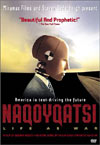
Plot: What’s it about?
“Naqoyqatsi” is the third installment in the “qatsi” series of what can be called movies. The first two, “Koyaanisqatsi” which literally means “Life out of Balance” and its sequel, “Powaqqatsi” literally meaning “Life in Transformation” were hailed as art have been copied ever since. Then again the first two were made in the 1980’s (1983 and 1988 respectively). We’ve all seen shots of city lights and cars streaming though the streets like liquid. It all started with “Koyaanisqatsi” as it showed us a new way to present the moving image. To say that these movies rely on imagery is a drastic understatement as there’s not any dialogue in all three. What we have instead is a series of images. This installment focuses on “Life as War”, and that takes on a whole new meaning after the recent terrorist activities throughout the world. The “star” of these films are the images (most have been digitally altered to take on a new meaning) and the amazing score by Phillip Glass. Though it’s been fifteen years since the second installment, the images still drive to the point. I read a review where the movie was compared to as a music video; and the more I think of it, the more that may be the most accurate description of the movie.
As “Life as War” indicates, we seem to imagine the fact that we aren’t welcome on this planet anymore. We see images of technology and think that we are being more and more assimilated with it. It’s rather troublesome when we think what we’ve done to our planet and the some 450 images shown throughout the film seem to describe our current state of being. As we walk down the street, it’s nearly impossible not to take note of any and all technological innovations. How many people are gabbing on cell phones talking about nothing? As we strive further and further into the future, we take a look at the world and it around us and start to wonder…are we really welcome or wanted here? The greatest thing about this series of movies is that without the power of the spoken word, we don’t have anything to polarize our view of what we see. It’s up to us to make of the images and our interpretation alone. Hell, we could all be making way too much of this film (and the others) and it’s just really a series of images for us to ponder. No matter what the case, this movie will at least provoke your mind and imagination and possibly make you wonder about the relationship between humans and the universe.
Video: How does it look?
Though the movie is enhanced for 16:9 televisions, it is composed of what we would call “stock” photography. Each of the some 450 images is taken from another source and as such, isn’t the most pristine in quality. Then again, it’s not meant to be. The images have been manipulated on a digital level to achieve some sort of emotional response, but when you get right down to it; they’re just like anything else you see everyday. This is probably the most perplexing “video” portion of a review that I’ve written, but there’s no easy way to summarize the video quality here. It looks good and the anamorphic widescreen does the best it can by bringing out the color and detail, but aside from that it’s about average.
Audio: How does it sound?
The Dolby Digital 5.1 track is a bit of a different story. Phillip Glass’s score is meant to reflect the mood and atmosphere of what’s going on-screen. Each “Part” has it’s own theme and as such, the track has a few different looks and feels. What I found most interesting about the soundtrack was the fact that it didn’t seem to “automatically” reflect what was happening on the screen. The music emanates from all channels and the surrounds are used at the appropriate times. There’s not a whole lot else to say here except that it sounds good and that’s all we can expect.
Supplements: What are the extras?
The trailers for the two previous films are shown as is an NYU Panel discussion of the movies. A conversation with Composter Phillip Glass and Yo-Yo Ma is also included.