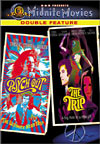
Plot: What’s it about?
In Psych-Out, a young deaf girl ventures to San Francisco in search of her brother, who sent her a strange postcard. She is Jenny Davis (Susan Strasberg), who is worried about her brother and wants to track him down. Soon after she arrives, she meets up with a man named Stoney (Jack Nicholson), who is part of a band called Mumblin’ Jim. He introduces her to the Flower Power lifestyle, one filled with music, drugs, and free love. While she is unable to hear the music, the drugs enhance her other senses and much to her surprise, she is able to experience the music, just in ways she never imagined. But as she becomes more involved in the lifestyle, she begins to go too deep, as she wants to avoid the real world. Will she ever find her brother and in any event, can she snap back into reality after her experiences? In The Trip, a television commercial director tries to escape his life through a small pill. Paul Groves (Peter Fonda) is in the midst of a bitter, heartbreaking divorce and he wants to leave it all behind for a while. So he visits a dealer named Max (Dennis Hopper), who supplies him with just the escape Groves wants, a dose of LSD. With his friend John (Bruce Dern) by his side, Groves embarks on his first psychedelic excursion. But will it supply the escape he needs, or simply add to his real life troubles?
A star studded psychedelic double feature is found here, as MGM takes us back to the days of free love & rampant narcotics. You’ll see stars like Jack Nicholson, Bruce Dern, Peter Fonda, Dennis Hopper, Dean Stockwell, and Susan Strasberg, while Richard Rush (The Stunt Man) and indie legend Roger Corman serve as directors. In other words, a ton of talent was involved in these productions, but in the end, the texture of the 60s is the focus. Both of these movies are loaded down with drug use, psychedelic colors, and of course, hippies of all kinds. So for those who are interested in all things 60s, this double feature is a time capsule of sorts, which means that of course, the material is quite dated. Then again, with movies that are so much products of their time, we can’t expect them to remain fresh over three decades later. And as it happens, the 60s nostalgia is the main attraction in both, as the storylines are paper thin and while the names are famous, the performances stand at acceptable at best. Even so, The Trip is a hilarious adventure into LSD, while Psych-Out offers a look at the darker side of the hippie lifestyle. I think these movies are very fun and a perfect match, so this is a well crafted double feature. MGM has issued this disc at a very low price, complete with a host of supplements, so don’t miss out on this one.
Video: How does it look?
Psych-Out and The Trip are both presented in 1.85:1 anamorphic widescreen. I found both treatments to be quite good and better than expected, though The Trip has aged with more grace than Psych-Out. The print on the latter seems more worn and speckled, while The Trip looks very clean and shows minimal debris. Psych-Out also looks a tad softer, but that seems to be intentional, as part of the film’s visual scheme. The colors come off as bright and bold in both, which is important, given the nature of the subject matter involved. As I said before, The Trip has a sharper, cleaner image and that produces more vivid hues, but both have good color presence. The same holds true for the contrast, which is smooth and well balanced. I didn’t expect too much here, but MGM has given these movies terrific presentations.
Audio: How does it sound?
I don’t have a lot to discuss in this area, as the mono soundtracks are passable, but of course, limit the material at times. As both are loaded with cool music, the experience might have been better with a surround option, but even so, the basics are covered in these tracks. The limitations of mono keep the music from being too immersive, but aside from that, I found both soundtracks to be more than acceptable. The sound effects are well presented and the material has infrequent age related flaws, which is good news. No problems with dialogue either, as vocals come across as crisp and never suffer volume issues. The Trip also features a Spanish language track, while both films include subtitles in English, Spanish, and French.
Supplements: What are the extras?
A nice selection of extras has been included here, with each side hosting supplements specific to each picture. In the case of Psych-Out, you’ll find a “Love and Haight” featurette and the film’s theatrical trailer. But if you flip the disc over, the supplements for The Trip are extensive and quite insightful. An audio commentary with director Roger Corman starts us off and as always, it is a pleasure to listen to his comments. Corman is talkative, but never in a self promotional fashion, he just talks about the cast, the shoot, and covers both humorous anecdotes and technical information, so this is a very worthwhile session. You’ll also find a special look at the film’s psychedelic visuals, the “Tune In, Trip Out” featurette, a psychedelic light box, an excerpt from American Cinematographer, and the film’s theatrical trailer.