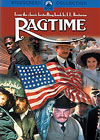
Plot: What’s it about?
For many years, James Cagney had been retired from acting work. In those years there had been several offers (including one for the film Logan’s Run) given to him to make a comeback of sorts and he turned them all down for one reason or another. As luck would have it, director Milos Forman had a chance encounter with Cagney at a party and had told him that he was casting for a new film he was doing and that it would be great for James to be part of it. After some resistance, they both made a deal with each other and after a reactive rehearsal, Cagney agreed to return for this one time only deal. He would be part of a wide ensemble cast telling a multi-plot tale involving one man’s vision, a rise and fall of a family, and a police commissioner forced to make a choice. This is the early 20th century, an America full of scandal, transition and the sound of Ragtime.
The year is 1906 and a lot of activity is going on in America. Harry Houdini is pulling off illusion after illusion successfully. President Roosevelt’s never seen better approval numbers and a woman (Elizabeth McGovern) has modeled herself for a statue. This is all well and good if only her husband (Robert Joy) can approve, which he does not. He builds up enough jealous rage that he threatens to kill the maker (Norman Mailer) of this statue. Meanwhile a middle class family find a big surprise, in the form of a baby, waiting for them on their grounds. They find out that one of their servants is the baby’s mother. What they don’t find out until later is that the father is a known piano player named Coalhouse Walker (Howard E. Rollins Jr.) and that he would do all that he can to be a good father, but some racial acts play against him and he is forced to bring himself into a situation that would also include a good part of the town, including Commissioner Waldo (James Cagney).
I remembered watching this film in bits and pieces through the years and watching it fully I can honestly say that Milos Forman’s film drew me in with it’s sense of a happy time in spurts where deep down, happy time appearances can be deceiving. The multiple storylines were not a distraction but somehow link into each other’s nicely.
The wide array of actors in this film are used to a great extent and it helps that there is a minimum of main title credits at the beginning of the film, for that many come on without expectation. The performances all around are exceptional particularly from Howard Rollins who’s Walker is a man who loves his music and wants to be more but tragically, the limitations of this period show that time is not on his side. It’s no surprise that he was nominated for an Oscar for his role and his performance certainly was worthy as well as a win.
And the sight of James Cagney is a welcome one as he’s given a small role in this ensemble but he makes the most of it with the period and what he injects in the character of Waldo is small but he does so much with so little. This was his last feature role and it was a nice one to go out on as he does well amongst the fine cast.
The look of the film is exquisite. Miroslav Ondracek’s eye captured the period nicely with the nice newsreel touches to the colorful palette given to the film both visually and literally. The film wouldn’t be called Ragtime without ragtime music and the score by Randy Newman is done as kind of a love letter to that period’s music. It’s rich, lovely and very well done.
It’s great that this is Milos Forman’s first foray into scope filmmaking. He uses the widescreen space very well in many scenes that give the film a more cinematic look from beginning to end. Now if only his good luck charm (Vincent Schiavelli) had a small part this would’ve kept in the continuity of his features. Nobody’s perfect and neither is this film, but despite few flaws in structure and an uneven story, Ragtime is an entertaining time worth spent.
Video: How does it look?
Ragtime is given an anamorphic transfer onto DVD and what a canvas this film has. The Panavision lens makes way for bold uses of color and black and white and it has few intentional specks but nothing severe. Like with Chinatown, Ragtime doesn’t have any elements of the time when the film was made so in essence it looks like a film from the early 20th century very well restored and with a gorgeous look and feel. The period is captured nicely and this transfer retains that beauty. A very good transfer.
Audio: How does it sound?
Ragtime has a English 5.1 Dolby Digital track that spreads effects and score nicely around all channels making for a very nice track, however dialogue comes much through the middle and a slight muteness is still apparent. The English Restored Mono keeps all sounds intact and is a satisfactory track as well with the intended muteness. All around it makes for a satisfactory track. This disc also has a French mono track as well as English subtitles.
Supplements: What are the extras?
I expected Ragtime to have the occasional trailerless ways for a bad vanilla release, which certainly wouldn’t have done justice for this film. If you look closely at the cover, there are a few (yet still trailerless) and they start with a commentary by director Milos Forman and executive producer Michael Hausman. They do share nice stories about casting as well as the Cagney casting as well. It’s rare that Milos does a commentary track and he’s always interesting to listen to along with the executive producer. Unfortunately, their comments, even though great, are few and far between and there are numerous gaps in the track. I wish there was more to say with them but the track remains good but yearning for more.
Then there is a twenty minute featurette “Remembering RAGTIME” that includes both of the commentators and others reminiscing about the production and it’s put together very well indeed. There are interesting tales and the featurette is never boring and it’s always a pleasure to hear the viewpoint of Forman which is rare. It’s a worthy extra and it fits in nicely on the disc. It’s a shame there was no mention of the recent Broadway musical.
Finally, there is a 10 minute deleted scene that is discussed on the commentary involving a little more of two of the characters and one other character that was completely taken out of the movie. The scene is partially in black and white which would fit in with the period of the piece, scratched and has a bit of age but would’ve been a most interesting scene had it been put back in the film.
Ragtime is an entertaining piece worthy of any addition into any DVD collection and it comes highly recommended despite the absence of a trailer.