Plot: What’s it about?
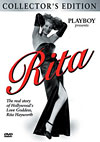
My first and only exposure to the phenomenon that was Rita Hayworth was from watching “The Shawshank Redemption” back in 1994. Ironically enough, this documentary on her life begins with that very scene (possibly as an admittance that the new generation would only relate to said scene). Shot more or less as an “E True Hollywood Story” style documentary, this one follows along a very similar formula. Ms. Hayworth’s life as presented here is complex, revealing, and predictably depressing. All the familiar bases are well covered in this documentary, ranging from Rita’s humble but stressful beginnings with her father to her subsequent rise to international superstardom. Many aspects of Rita Hayworth’s life came as a surprise to me, just as I suspect they will to others who count themselves amongst the uninitiated. The bad news is that this is a very formulaic piece, but the good news is that Ms. Hayworth’s life in and of itself presents us with its very own sense of drama. In effect, “Rita” does exactly what is required of it as a document of the life of a woman few knew, fewer understood, but all loved. Such a life naturally invites disillusionment, and this life is obviously no exception.
I don’t want to delve too strongly into the specific ins and outs of Rita Hayworth’s life in this review, as I feel that such an approach would defeat the purpose of watching the feature at all. What I will say, however, is that this is an extremely well made piece of biographical history. The participants conjure just the right amount of sentimentality and fondness to evoke an emotional response from the viewer. Such a style serves to make “Rita” one of the most interactive experiences I have seen in quite a while. More than once I felt as though I were going through Rita’s life with her, not knowing exactly what would happen next. For instance, just when Ms. Hayworth seems to find exactly what it is she’s looking for, things consistently transpire to force her back into the spotlight. This occurs more than once, and the viewer is eventually invested in the proceedings far more than I initially anticipated. As the documentary drew to a close, I was surprised at how engrossed I had become in Rita’s life and how much I cared about the actress who only ever wanted to be a normal person. I suspect this is indicative of more stars than not, and it was an eye-opening experience to watch.
The last line of this documentary left me with a bittersweet impression of the whole feature. I felt on one level that Rita’s life had been so inherently saturated with tragedy that an “upbeat” documentary would have been impossible to produce (and, at the very least, such a documentary would necessitate a very selective presentation of facts). Rita Hayworth’s last wish, however, was that nothing be said about her life that was sad. Part of me wished I had not watched all 58 minutes of this documentary. The life she lived has left such an indelible legacy that to focus on the negatives seems almost disrespectful. On the other hand, this is a fitting testimony to the strength of heart that Ms. Hayworth brought to her own life and to everyone around her. What endures today is not the troubled, disillusioned young woman who longed for privacy and some semblance of a normal life. What resonates now is much more than anyone saw in Rita at the time. More stays with us than her many film roles, her numerous failed marriages, or her eventual shattered psyche. What remains is the image of a woman whose buoyancy of spirit created more in a lasting American culture than she could have ever dreamed. I suppose it would suffice to say that Rita Hayworth is far more to me now than that poster on Andy Dufresne’s wall. I can think of no greater compliment.
Video: How does it look?
“Rita” is presented in its original aspect ratio of 1.33:1. The image here is quite serviceable for a full-frame effort, and no one will be disappointed. There is a mild amount of edge enhancement and a few slight instances of compression banding, but nothing too terribly distracting. I noticed no problems with contrast or artifacts. Some of the old footage of Rita’s life is understandably dated far more than the main feature, but this is of course to be expected. Again, there’s nothing spectacular of note here, but nothing to detract from the presentation, either. In short, probably about what you’re expecting with a release like this. Just don’t expect a demo disc and you won’t be disappointed.
Audio: How does it sound?
A Dolby Digital 2.0 Stereo track is included on this release, and it’s quite good, all things considered. Some of the older footage used in the documentary has its own issues with vintage audio sources, and this makes for a difficult disc to grade on audio in a traditional sense. The “new” footage sounds decent enough, although there is nothing particularly exciting about a feature comprised exclusively of dialogue.
Supplements: What are the extras?
A bevy of extras are presented along with the main feature, and they are well worth a look. “Additional Home Movies” is a rather sentimental look back at Ms. Hayworth at various stages in her troubled life. “Rita’s Honeymoon With Prince Aly Aga Khan” is a brief glimpse of Rita’s discontent with such a public life. “Additional Clip From Rita’s Appearance On The Carol Burnett Show” is a very short clip of Rita’s scene on the show, running under a minute. “Extended Interview Segments” is, in my opinion, the best extra on the disc. Although simply a collection of several one-minute interview segments, these serve to compliment the main documentary quite well. “New Interviews” is similar in form and length to the previous extra on the disc, and presents an equally complimentary selection of clips. A photo gallery (oddly the only thing on the disc presented in anamorphic 1.78:1 widescreen video), filmography for Rita Hayworth, and “Trouble In Texas”, a full-length western from 1937, are also included as a bonus.