Plot: What’s it about?
The World is Yours
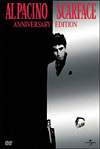
“Scarface” is as much a remake as it is an original movie. That is to say that though the name is the same, the story isn’t always. The movie of the same name was made by Howard Hawks (“Briging Up Baby” among others) and starred Paul Muni. The movie was extremely violent for its time and was criticized (as was the remake) for it. Patterned after the life of Al Capone, it showed the rise and fall of a man and lends truth to the phrase “Power corrupts”. When the remake came around some fifty years later, there needed to be a fresh story. Enter Oliver Stone. Stone wrote the screenplay and did a damn good job of it, though he had directed a few movies, their less than successful track record left him to be just the screenwriter and not the director. Brian De Palma took the reigns after Sidney Lumet (“12 Angry Men”, “Network”) signed off after seeing how violent the film was. After seeing this and “Carlito’s Way” it’s hard to imagine a more powerful pair than De Palma and Pacino.
Roger Ebert comments in his review of the movie that: “The movie has been borrowed from so often that it’s difficult to understand how original it seemed in 1983, when Latino heroes were rare, when cocaine was not a cliche, when sequences at the pitch of the final gun battle were not commonplace. Just as a generation raised on “The Sopranos” may never understand how original “The Godfather” was, so “Scarface” has been absorbed into its imitators.” This is true, of course, and though we’ve grown up with violence, it had to start somewhere. The movie is essentially the life story of Tony Montana (Al Pacino) as we see him from lowly Cuban immigrant that is transformed into the king of the world. He has a fascination with his sister, though controlling and not of incest, and of drugs and power. Together with his friend Manolo (Stephen Bauer), they rise and fall together.
The central theme of “Scarface” shows the ruins of power, money, greed and essentially every other negative human emotion. Some have compared this version to a modern-day version of “Treasure of the Sierra Madre” in that once the money (in this case, cocaine) starts to accumulate, that human nature takes over and the power corrupts. No amount of cash, violence or women can satisfy the urge that Tony Montana feels and we know that nothing will ever truly satisfy him. Though a different character than that of Michael Corleone, they are almost one and the same. They’re both bad, though they believe in their hearts that they are doing the right thing and helping those who wouldn’t be helped otherwise. A victim of his own product, the world crumbles around Tony and his empire. This is what some say is Pacino’s greatest role and sports a cast of then unknown actors. Robert Loggia, Mary Elizabeth Mastrantonio and Michelle Pfeiffer to name but a few. “Scarface” is almost required viewing if you consider yourself a film buff. Highly recommended.
Video: How does it look?
The transfer for “Scarface” is so much better than the original DVD that it’s even hard to draw a comparison. Whereas the old disc wasn’t enhanced for widescreen televisions, this one is. The 2.35:1 anamorphic ratio brings out the color (mainly red, for obvious reasons) and detail in the print. And while talking about print, there seems to be a new print used for this version; one that brings the transfer to a whole new level. Granted the movie is twenty years old now and there will be a little artifacting here and there, but for the most part it’s a very solid transfer than looks astounding on any TV. Fleshtones are warm and natural, though they tend to vary from scene to scene. This isn’t a fault of the transfer, but rather the way the movie was shot. While this does have it’s drawbacks, one thing is clear (besides the picture), this merits a purchase if only for the improved transfer alone.
Audio: How does it sound?
Universal is a studio that is proud of their DTS. Yes, now every major studio has dabbled in it, but Universal seems to add it to most every disc they have, regardless of age. There is a difference between the Dolby Digital 5.1 track and the DTS, but I’d say go with the latter. While dialogue is the key here, the action and very 80’s soundtrack (synthesizer) do take over from time to time, the surround effects do come into play. As I listened to the score, I couldn’t help but to be reminded of “A Clockwork Orange” with it’s very modern track. Granted the two movies are night and day (or are they), but the music really comes into play in “Scarface” and sets the tone for most of the scenes. The Dolby Digital track sounds almost as good, but the separation isn’t as clean. I’d give the edge to the DTS, but you have a choice and this is only my opinion.
Supplements: What are the extras?
Now a full-fledged “Two-Disc Special Edition”, “Scarface” has room on the first disc for the transfer and a few 5.1 soundtracks. The second disc is for the supplements. We start off with three featurettes that can be played all together or selected individually. First up is “Scarface: The Rebirth” which focuses on the need (or desire) to do another movie by the same name as the original. The featurette tells of how and why it was thought up and who might be involved to play the lead. Different names were brought up as to who would star and direct, but we see the ending result and can’t picture anyone else in the film. Next up is “Scarface: The Acting” which focuses on the cast and how they prepared for the parts. Additionally it tells how each member was cast (Al Pacino was the only “sure” thing) and the Producer’s impact on the overall role of the film. Lastly, we have “Scarface: Creating” which tells of the locations used for shooting (they wanted to use Miami for the whole movie but were run out of town by Cuban’s thinking it was a “Pro-Castro” film) and how certain scenes were shot, choreographed, etc. This leads us to the deleted scenes, shown in non-anamorphic widescreen and without any explanation as to why they were cut. A nice feature, but some reasoning would help here. “Origins of a Hip-Hop Classic” shows the influence of the movie on some of today’s top rappers. Most notably Snoop Dog and Puff Daddy (or whatever he’s called this week). Though their feelings seem to be really genuine about the violence and the man himself, I just feel a bit degraded knowing that a movie inspired such popular performers. Or maybe I’m just getting old. Next up is a comparison between the movie and the “cut” version that was used for TV. I think this was actually the most interesting supplement as it not only shows how chopped up the language and action is, but it’s also a great explanation of why widescreen is so much better than full-frame. Lastly, we have some Cast and Crew bios of the major stars of the film. If you don’t already own this film on DVD (and even if you do), then you’ll need to buy this again as the audio and video is a drastic improvement on the original DVD. As the back of the back of the box exclaims “Better than original picture quality”.