Plot: What’s it about?
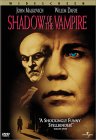
Shadow of the Vampire is a throwback to the way movies used to be. Nowadays, it seems that everything must involve bombs, computers or a little bit of both. In it’s simplistic way, Shadow of the Vampire shows us not only the way movies used to be made, but also how much direction a director had when the films were silent. Though the cast is limited to a few major stars, John Malkovich and Willem Defoe headline the movie which was also produced by Nicolas Cage. Willem Defoe was also recognized with an Academy Award nomination this past year for his role as Max Schreck. Though you’ll never know it’s Defoe behind all the makeup, he is the one who truly steals the show as the “method actor from hell”. Malkovich delivers another good performance, but seems to have some trouble shedding his trademark accent and delivering a pure German one. Still, in his role as F.W. Murnau, he is the one to watch. As the opening credits tell us (and this goes to show how much I know), the estate of Bram Stoker refused to sell the rights to his novel, Dracula. Murnau (Malkovich) wanted to make a very realistic version of the novel, but when he was refused the rights to it, he simply changed the name to Nosferatu. Simple enough, and the movie has since gone onto be one of the most classic and popular early horror movies of all time. Shadow of the Vampire is the telling of how Murnau made the movie and it’s troubles with the lead actor…Max Schreck.
As mentioned above, German filmmaker F.W. Murnau has set out to make an adaption of Bram Stoker’s novel, Dracula. Having been denied by Stoker’s estate, Murnau simply changes the name of his film to Nosferatu. In this time, movies were a burgeoning art form. The theater (stage) was still were all the stars were and wanted to be, as said best by Greta Schroder (Catherine McCormack) “The lens takes life away from me, while the stage brings it”. Clearly, Murnau has a vision of the future, knowing that many more people will be able to enjoy the performances for time to come, on celluloid. The script is set, the cast and crew are all in place except for one person…the lead actor, Nosferatu (Willem Defoe). Said to be the most method actor ever, Nosferatu (also known as Max Schreck) has agreed only to be filmed at night (when vampires do their business) and in full makeup. The cast accepts this and has been told that Max was of the Royal Russian theater. The way they figure it, someone this eccentric has got to be good! As they reach Czechoslovakia, where Max has been for months “soaking up the atmosphere”, they are greeted by him for the first time on film. Max, still very reluctant and reclusive is still a big mystery to the cast and crew of the film. Had this kept up, it would have been normal, however as fate would have it, members of the cast and crew start to disappear. It’s not long after that a new cameraman has to come in. Fritz Arno Wagner (Carey Elwes) takes the helm in the final shoots of the movie, and it’s becoming questionable to the cast if Nosferatu is really Max Schreck or if he really might be a vampire.
I’ve seen this in print somewhere before, so I’ll put quotes around it so I don’t get charged with plagarism…”Shadow of the Vampire is a good movie with great performances”. That nails it. I’ve never seen Willem Defoe in a better role. Though he doesn’t say a whole lot, he doesn’t need to. His makeup is so severe that you’ll never know it’s him unless you read the credits. Malkovich is a bit questionable, but still delivers a good performance and Carey Elwes is good, as always. While the movie as a whole won’t blow you away, it’s good to see that three veteran actors still have it in them to perform their roles this well. Shadow of the Vampire is entertaining, but that’s about it. Universal has tried to sweeten the deal by including some extras (Commentary, DTS…), so if you’re at all inclined, I’d suggest a rental before you buy the disc. However, if you do, I don’t think you’ll be disappointed.
Video: How does it look?
Shadow of the Vampire is shown in a 2.35:1 anamorphic transfer. While this is a new to DVD film, I wasn’t sure if the film was supposed to be this grainy or not. I can assume so, as I put in some other DVD’s and saw that they looked fine. Being a movie about Vampires, you can expect it to not only be dark in nature, but physically dark as well. The fleshtones seemed to be a bit bright and I kept seeing “noise” in the picture. Like I said, I’m not sure if it was intentional (you assume that it must be), but nevertheless, the picture for the most part looks good. Though not a reference quality transfer, I shudder to wonder what this would be like on VHS. The broad scope makes things look that more appealing, and the attention to detail throughout should be noted.
Audio: How does it sound?
As Universal tends to do, they have included a Dolby Digital 5.1 track and a DTS track as well. Both sound very good, as they always do, but I would have to give the edge (once again) to the DTS. While DTS has less compression, it’s understandable that it will sound better. However, Shadow of the Vampire isn’t a movie for audio. I only caught the surrounds working a few times (though the scene that involves a certain flying object takes the cake for being the best audio in the movie). On the whole, the sound is ample and while (again) not reference quality, I don’t think any will be disappointed in how this sounds.
Supplements: What are the extras?
Though not labeled as a special edition, Shadow of the Vampire has it’s share of extras that make the disc a nice little package. First is the feature-length commentary track by Director Elias Merhige, though it’s not one of the better tracks I’ve heard, it’s full of useful information (as one can expect with a “historical” film such as this) and it’s one I’d listen to again. A behind the scenes featurette takes a look at some filming of the movie, essentially if you’ve seen one “behind the scenes…” then you’ve seen them all. A couple of interviews, one with Willem Defoe and the other with Director Elias Merhige are shown as well. These are seperate features, though I rather liked the one with Defoe. He describes his role and motiviations for doing such an off color character, though not lengthy, very interesting. A bonus treat is an interview with Producer Nicolas Cage, though interesting I think they only interviewed him because of who he is and not as his Producer role. But that’s just my opinion…Lastly, some photo galleries, a theatrical trailer, cast bios and some production notes round out the features. Add all this with a DTS soundtrack and you have a nice little disc here.