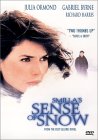
Plot: What’s it about?
Esajas is a six year old Inuit child and not long ago, his dead body was found after it had fallen from a roof. The case seems open and shut, as there is little evidence to show anything other than an accidental fall. But Esajas had a friend named Smilla (Julia Ormond), who knows that he was afraid of heights and as such, it would be unlikely that he would have been near the ledge. This small issue is what sparks Smilla’s insistence that the case is not that simple, but as she delves deeper into the matter, she discovers even more evidence to support her ideas. But the local authorities discourage her presence and tell her to move on, which leads her to think they’re hiding something and that drives her even harder to uncover the truth. Using her uncanny sense of snow, ice, and the cold, Smilla traces even the smallest trails of evidence, until she stumbles upon much larger ones. With the support of a mechanic (Gabriel Byrne) who lives by her, Smilla pushes deeper and deeper into the case, but little does she know how deep these connections run…
I love the basic premise of Smilla’s Sense of Snow, but I think it falls short of the material’s true potential. Now, the movie is still well made and offers some great performances, but I just don’t think it is as good as it could have been. The storyline gets a little tangled up at times and some parts are a little hard to accept, but Smilla’s Sense of Snow is still better than average in the end. The premise is fantastic and the basic structure works well enough here, but the detail is where the film falters, as some points are left open, which can be confusing at times. But in terms of mature suspense films, Smilla’s Sense of Snow is very good and in a genre with few entries, that is more than welcome. The cast is headed by Julia Ormond in a stunning performance and also includes Gabriel Byrne, Vanessa Redgrave, Richard Harris, and Robert Loggia. Add in terrific production values, a good score, and some dynamic visuals, and you’re more than in business. As I said, I do think this could have been better, but it is still more than worth a look.
If there is a single element that saves Smilla’s Sense of Snow, it would be the terrific performance of Julia Ormond. I’ve liked several of her turns in other films, but here she really comes to life and often times, is able to hold together scenes on the brink of collapse. On more than a handful of instances, she is forced to compensate for Gabriel Byrne’s lackluster work, but she does so and then some. Ormond hasn’t been in a wealth of pictures to this point, but I do feel this the finest performance she’s given. Other films with Ormond include Nostradamus, Sabrina (1995), Captives, First Knight, and Legend of the Fall. The rest of the cast here includes Gabriel Byrne (The Usual Suspects, The End of Violence), Robert Loggia (Independence Day, American Virgin), Richard Harris (A Man Called Horse, Patriot Games), and Vanessa Redgrave (Cradle Will Rock, Mission: Impossible).
Video: How does it look?
Smilla’s Sense of Snow is presented in a 2.35:1 anamorphic widescreen transfer. This is a more than average presentation, but some flaws surface that keep the score down. Most scenes come off as very sharp and impressive, but a few scenes display some issues that trouble me. A lot of edge enhancement and shimmering are present in a handful of scenes, which is bad, but since the scenes are infrequent, I won’t knock the score much. The rest of the image is terrific however, with bold colors, accurate flesh tones, and razor sharp contrast levels. The sparkling snow looks radiant in this transfer, which is of course, vital to the visual impact of the picture. A few rotten apples almost spoil this bunch, but the rest of the transfer is enough to sweep the flaws under the rug in the end.
Audio: How does it sound?
You’ll find a Dolby Digital 5.1 included here, but don’t expect a dynamic performance, as this material doesn’t have much need there. The track is open and effective however, with some good use of the surrounds for atmosphere and at times, some muscle is flexed by the speakers. But most of the time, this is a rather conservative mix, although the musical score is terrific and expansive within this option. No issues with the dialogue either, as vocals seem rich and crisp at all times, no signs of volume hiccups here. As I said, this isn’t the most powerful mix on disc, but it kicks in when it needs to and offers a nice overall experience. This disc also contains 2.0 surround tracks in English and French, as well as subtitles in Spanish and English.
Supplements: What are the extras?
This disc includes a six minute behind the scenes featurette, as well as the film’s theatrical trailer.