Plot: What’s it about?
We all know the story of Robin Hood, though these days most of us are more familiar with the Kevin Costner version as opposed to the brilliant version being reviewed here. Robin Hood is one of those stories that, like the O.K. Corral, has been done about a zillion times in Hollywood. Now, granted, this isn’t a bad thing as some versions of the film are infinitely more enjoyable than the others. Even for having the worst English accent, Costner’s version has it’s upsides. But I digress. This was the first Technicolor Warner Brothers movie and what a glorious way to present Robin and his Merry Men than in the brightest greens and colorful colors of the rainbow (even before Dorothy and the gang followed the Yellow-Brick Road, too)! The movie wasn’t without it’s problems, though. James Cagney was originally supposed to play Robin Hood, but stormed off the set only to be replaced by the dashing Errol Flynn. Flynn’s star was on the rise (while Cagney was already a major Hollywood presence) and this movie gave him the role he’s most identified with and established him as a leading man. The direction also lacked some key action scenes and Michael Curtiz (best-known for directing “Casablanca”) was brought in to replace William Keighley (though both are credited as directors). So with all this going against it, would the film be a success?
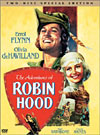
Of course! Revered as one of the best-loved movies around, this ranks at #164 on the Internet Movie Database’s list of the Top 250 of all time. Now that says something as this list is voted by fans of the movie and there’s more than 50,000 to choose from. And as far as the plot goes, we mostly know that by heart; but for those who have been living in a cave, here we go. Robin Hood (Errol Flynn) is the defender of the Saxons, when Prince John (Claude Rains) assumes power of the throne from his absent brother, Robin vows to oppose the new ruler and recruits help for the cause. He becomes an outlaw and along the way gathers his bunch of “Merry Men”. A colorful (no pun intended) group of characters that include: Friar Tuck (Eugene Pallette) and Little John (Alan Hale) to name just a few. Naturally, they face obstacles and the Sheriff of Nottingham (Melville Cooper) stands in their way. Robin, along the way, robs from the rich and gives to the poor in his effort to thwart the powers that be. Lest we forget, the lovely Maid Marian (Olivia de Havilland) whom Robin woos and may or may not end up with the girl in the end (though most of us already know the answer to that question).
In a year when Frank Capra’s “You Can’t Take it With You” took home the prize for Best Picture, this movie walked away with three Academy Awards for Best Film Editing, Best Art Direction and Best Music. It was also nominated for Best Picture. To say that they don’t make ‘em like they used to is a drastic understatement. “The Adventures of Robin Hood” has all the qualities of that traditional Hollywood type of movie that we’ll likely never see again. While today’s younger audiences will likely lean towards the newer version of this timeless tale, it’s a shame that this could possibly be overlooked by them. Yes, the felt hat of Robin is something that looks corny, there are one-liners that no one would even consider muttering today and even before the opening credits roll, we all know what will happen in the end. Still, this is a classic and it deserves to be seen. All of the elements are in place here, we have a great storyline, a swashbuckling hero we can all look up to and action (albeit “1938 style” action) to boot. See it for the great performance by Errol Flynn or see it mainly because it’s one of the better American movies around. But do see it! Highly recommended.
Video: How does it look?
Warner raised the bar with their catalog title releases in terms of picture quality with their release of “Singin’ in the Rain” last year back. I can remember how impressed I was (and still am) at the way it was presented on screen. So it was with great hope that I was expected even better things out of this first Technicolor release. Now I may catch some feedback for this, but I was really kind of let down. Now don’t get me wrong, for a movie of this age the picture does look stunning in all it’s full-frame glory, but I don’t feel that it packed the same punch that “Singin…” did. The entire image seemed to look a bit like a mist was in the air. The colors of Robin and his merry men look great, they almost jump off the screen. But the three strip Technicolor process used here does the best at creating a very colorful adventure for us all. I’ve never seen the film before, so I have no real basis of comparison and I’m guessing that the movie looks as good (or better) than it ever has. At any rate, the film looks good, but just not up to the standard that I had hoped it would. Take that for what it’s worth as I don’t think anyone will be disappointed.
Audio: How does it sound?
Naturally, the sound here is the original mono mix and we couldn’t really ask for much more. Though other soundtracks from this era have been remixed in Dolby Digital 5.1, there’s only so much that can be done with a mono mix. For as old as the film is, I was actually pleasantly surprised by the way this sounds on DVD. Having no basis for comparison, the dialogue sounded very natural and clean and while no “surround” effects are present per se, there was a general ambiance that I must admit, I didn’t expect. A few parts sounded a bit dry and “broken”, but for the most part this soundtrack delivers where it’s expected. No real complaints here.
Supplements: What are the extras?
“The Adventures of Robin Hood” is the latest in Warner’s line of two-disc Special Editions (it’s being released with “Treasure of the Sierra Madre” and “Yankee Doodle Dandy”). A heavily-requested title, this hits the mark in terms of supplements. The first disc houses a few supplements while the rest are on the second. We start off with an audio commentary by film historian Rudy Behlmer. Behlmer is very talkative here and obviously knows his stuff. He does give a lot of information about the troubled shoot and seems to deliver the kind of track that only someone who has been studying his material for a long time knows. He does. A music-only track that features Erich Wolfgang Korngold’s score is also included. Lastly, on the first disc, we have the “Warner Night at the Movies 1938” which attempts to re-create what is would have been like to see the film at the theater back then. Hosted by Leonard Maltin, we are greeted with his introduction and shown a number of theatrical trailers, a newsreel and even a cartoon. Also included is a trailer gallery of Errol Flynn’s movies.
This brings us to the second disc which houses the remainder of the bonus material. We start out with a documentary “Welcome to Sherwood: The story of The Adventures of Robin Hood”. Interviews with writers and filmmakers are shown as is the production of this great movie. Leonard Maltin, Robert Osborne (host of Turner Classic Movies) and others share their thoughts on the film at hand. It’s this kind of high-quality work that make Warner’s editions so beloved by fans. We then have a slew of shorter featurettes “From the Cutting Room” has some outtakes of the movie and the “Breakdowns of 1938” showcasing all the bloopers from all of Warner’s movies of that year. Next up is “Robin Hood through the ages”. Even as old as this movie is, it had been done before and this showcases some of the earlier screen versions. “A Journey to Sherwood Forest” shows some rare home movies shot on the Warner studio lot during the film’s production. Not the most informative of features, but a neat little feature nonetheless. Some classic cartoons are shown as well, the Looney Toons shorts “Rabbit Hood” (with Bugs as Robin Hood” and “Robin Hood Daffy”. “Splitting the Arrow” is a focus on the Academy Award winning Art Direction (which included Costume Designs, storyboards and some cast and crew photos). The original Robin Hood radio show is broadcast (audio only, naturally) with the stars of the film as well as a piano session with composer Korngold. Lastly, Angela Lansbury narrates “Glorious Technicolor” which follows the evolution of Technicolor through the ages. “The Adventures of Robin Hood” was the first Warner picture to use this process, so this is naturally a welcome addition. All in all, Warner continues their tradition of some great two-disc Special Edition and this is no exception. Now if we can only get them to release “Who’s Afraid of Virginia Woolf”, “Bringing Up Baby” and “Cool Hand Luke” then we’re in business…