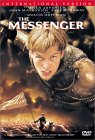
Plot: What’s it about?
Like so many other stories in Hollywood, this one has been told time and time again. And until I watched “The Messenger” my closest association with the legendary “Joan of Arc” was one of the group of historical figures that traveled with Bill and Ted (Bill and Ted’s Excellent Adventure). Of couse, there is much more to Joan or Arc than doing jumping jacks at a mall! It’s also noteworthy that this film is directed by none other than Luc Besson. I personally love his work. He has a “vision” and is one of the best at putting it directly onto film, so if you haven’t seen such visually moving films like “La Femme Nikita”, “The Professional” or “The Fifth Element” check at least one of those out, as you’re missing out on some great films. It seems that a common theme in his films is to focus on the “underdog”, someone who must overcome impossible odds to accomplish their goal, is this true in The Messenger as well?
Giving a bit of history to Joan of Arc (Jeanne D’Arc) the film starts in her childhood where she is a mere peasant girl, fleeing soldiers. She travels home where she finds her sister in a hiding place. In what is probably the most gruesome scene of the film, her sister gives up her safety and is found by the soldiers; then killed and raped. Joan is beside herself with guilt and despair and travels to the local church seeking a rational explanation for what has just transpired. Joan is a devout Catholic, she goes to Mass three or four times a day, enough to make even the priests annoyed, but her explanation is that maybe God has another higher purpose for her. We then travel ahead and meet the soon to be King, Charles VII (John Malkovich) who has been receiving strange, cryptic letters from a peasant girl who wants a meeting with him. Not knowing what to do, he begrudgingly accepts the invitation, only to try and trick her by replacing himself with one of his noble aides. His logic is that if she truly is from God, she will know the true King, and if she is an assassin, then she will kill the wrong person. Unusual logic, but it made sense back in the Middle Ages during wartime, I’m sure.
Slowly, through her divind guidance, she persuades the armies of France to follow her into battle. What looks like impossible odds are nothing under her psuedo-leadership. Walls tumble, armies fall and time after time, the seemingly invincible troops of England fall at the hands of the French. We learn in the featurette that the actual course of Joan of Arc was two years (from her age of 17-19), but the movie actually shows about four or five battles that concentrate and show the influence she has over the French. Now it’s said that “All good things must come to an end…”. This could never be more true that the turning point of The Messenger. At what seems to be the peak of the French military height, with the English falling at many battles, things start to slow down. It seems that Joan is on a mission of her own and some start to question her motives and if she is still, truly, receiving signs from God. King Charles VII already has his crown, which is what he was after in the first place, and now has lost interest in the military aspect of France. Slowly, but surely, he weens Joan away from the resources that she has become so used to and the armies are affected. No longer are the French “inspired”, but rather they retreat!
It’s at this time that Joan becomes captured by a neutral country and is literally auctioned off between England and France to the highest bidder. The English, being the arrogant race that they are, pay the ransom and hence have control over Joan. She has been the source of humilitation and embarassment to them for the past few years and they stop at nothing to have her pay for what she has done to them. France has all but lost Joan to them, they do raise a hefty $10,000 ransom fee, but we’re led to believe that the King had plans for it other than giving it away as ransom. And so it begins…the trial of Joan of Arc. It’s at this point in the movie (if you can’t tell by now, this is a lengthy movie) that we finally meet the character of Dustin Hoffman. He plays “The Coinscience”. Knowing the character’s name helps define his role, as I beleived that he was God. His part is small, but being the great actor that he is, he executes is wonderfully and adds a whole new depth to the movie. We know what happens to Joan of Arc, as it’s a true story, but Milla Jovivich (who is easily one of the most beautiful women in the world, even when dressed like a man) plays the part eloquently.
The Messenger was a movie that I had certain reservations about, I had not seen the Artisan verison with Lelee Sobieski (or however you spell her name), but I’m curious as to what it’s like now. After seeing how wonderfully Luc Besson did this movie, I can say two things: I can’t wait for his next film and I have a new respect for Milla Jovivich (she was a bit annoying in The Fifth Element). While the movie clocks in around 2 hours and 40 minutes, I beleive that it’s worth it. The sheer visual imagery and grandeur scale of it all are something you don’t see that often. Fight scenes rival that of Braveheart and are at sometimes even more gruesome. You can come to your own conclusions about this movie, but for me…it’s a keeper.
Video: How does it look?
In true Columbia/Tristar form, The Messenger is presented in a terrific 2.35:1 anamorphic transfer. I couldn’t find a single element that was wrong with the picture. There was a brief layer change, but that makes sense due to the length of the movie. Also, the layer change is different depending on what type and brand of player that you have. Colors are sharp and vivid and fleshtones look great. The scale of the movie, meaning the amount of extras used in the film come into play here as well. The many battle scenes take a few screenings to take in all the action and they look great in the wider gauge ratio (which Luc Besson is fond of). When you see this image, this is what a DVD should look like. Excellent.
Audio: How does it sound?
As if the sheer image wasn’t enough, the sound is equally as stunning. The battle scenes radiate sounds and effects from all five channels, and many scenes (when she receives her visions) have a definite 360 degree effect. Also, and I hope I’m not giving away anything, but when Dusin Hoffman as The Conscience speaks, his voice (which is already powerful and deep) illuminates through all five channels in an “echo” effect, heightening the expeience all the more. As mentioned earlier, the battles sound great and the effects are very well placed. A top notch soundtrack.
Supplements: What are the extras?
Columbia/Tristar has included a few more extras than on their standard discs, we get a 20 minute featurette from HBO with Milla Jovivich as our host (looking more like a lady with her hair grown out and a black dress on…yes!) it shows the history of Joan of Arc and some of the work that went into making this film. They made over 300 suits of armor!! There is also a feature that I’m growing more fond of, which is the Isolated soundtrack. The soundtrack itself is impressive, but the isolation of it sounds even better, of course you will really have to like it to listen to all 160 minutes of it, but nevertheless it’s nice to have the option. There are also talent files and a trailer. To top it all off, we are treated to the “International Version” which has 10 more minutes of footage inserted into the movie, so it makes it all the better. I didn’t see the movie when it was out, so I don’t know what was added. All in all, a very solid disc that I will watch many more times.