Plot: What’s it about?
In the motion picture industry, many films have been recycled from earlier work — no matter how often studios sell their productions as completely original, it’s just as often very apparent as to where many of the ideas came from. In The Others, for example, Spanish filmmaker Alejandro Amenabar came close to creating an outright carbon copy of the smash ghost-story thriller The Sixth Sense. But the writer-director put enough of his own spin on the story, and told it uniquely enough to create his own original, eerie piece.
The supernatural elements of The Sixth Sense are what made it one of 1999’s most popular films, and in the moviemaking business, it’s smart to capitalize on past successes — provided you can add your own twist on the idea. Writer-director Amenabar did that by setting his spooky tale in England at the close of World War II, where Grace (Nicole Kidman) lives with her two children in a large, secluded house on the island of Jersey. When three new housekeepers arrive to work there one day, we learn Grace’s children have a severe case of photosensitive allergies and cannot be exposed to any light stronger than that of a candle. Soon strange things start happening, and because the house is kept in complete darkness, the stage is set for a very haunting film.
Amenabar, a young filmmaker whose credits are all Spanish, can even be compared to Sixth Sense writer-director M. Night Shyamalan as far as his technique is concerned. Both seem to have a strong knowledge of acting, lighting, and storytelling. Amenabar got newcomer child actors Alakina Mann and James Bentley to perform much better than most actors of their age, much as Shyamalan did with Haley Joel Osment in The Sixth Sense. Nicole Kidman also gave a near-flawless performance as the strict mother and employer who seemed to be almost too protective of her light-sensitive children. She simply won’t believe that her house is haunted, and she carries much of the film with her stern beliefs and actions.
Given that the children are photosensitive, the lighting in The Others is very significant, and Amenabar and his cinematographer were well aware of this. They framed and lit each scene very well, and because the children must live in darkness, the dim-lighting was crucial not only to their health but to the film’s haunting ambiance. This, coupled with the facts that we can only see the children in darkness and that most of the supernatural incidents are witnessed only by them, makes the setting very surreal. Along those lines, Amenabar could have made the film scarier, but he stuck more to a believable story rather than concentrating on making the audience jump.
Like M. Night Shyamalan must have done with Sxith Sense, Amenabar started with his ending and worked from there. It worked a little better for Shyamalan because he crafted an engaging, believable film from the start and then pulled out the surprise ending. For the most part, Amenbar did this too, but he leaves too much in question during the middle of the film. This will inspire many people to see the movie again — also a filmmaker’s goal — but he could have focused more on making the entire film more enjoyable instead of teasing the viewer with an excess of open storylines. Many of these stories were eventually cleared up (like Grace’s husband returning from war, or the three housekeepers discreetly conspiring about something) but they created a sense of doubt you don’t necessarily want to have in the middle of your movie.
Otherwise, Amenbar had a great premise by taking elements of The Sixth Sense and putting them into a more classic horror setting like the huge Victorian mansion. Additionally, he put a lot of effort into it, from writing the script to composing the score, and it showed. Other copycat filmmakers should take note, because that’s the trick to successfully recycling an idea in Hollywood.
Video: How does it look?
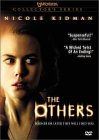
The Others is presented in an anamorphic 1.85:1 transfer that, for the most part, looks very good. The main problem with the movie is that it’s extremely dark and therefore doesn’t translate that well to DVD. Luckily, Buena Vista has thought of this and included the movie on one disc and left the supplements on the other disc entirely. What does this do, you ask? It allows for all of the space to be used for the audio/video quality and leaves the extras for the other disc. I suppose it’s Disney’s equivelant of a Superbit disc, minus the results! Actually, that’s misleading, the film does look very good, plenty of indoor smoky scenes aren’t the least bit troubled and it’s representation on the television is above average. So while you won’t find all colors of the rainbow on the disc, you’ll find a good-looking transfer here.
Audio: How does it sound?
Leave it to us DVD reviewers to whine about every little thing, in this case it’s the audio track. While the supplied Dolby Digital 5.1 track is very stong, there is another version of this DVD (overseas) that has a DTS version to go along with it. While I’m sure the DTS would sound better, it’s not on the disc. I’m not going to ask why, I just call ’em like I see ’em. Only during a few times does the audio really get a chance to show its true colors, but when it does…watch out. One scene in particular comes to mind that will make you literally jump out of your seat. The dilogue is strong and while the surrounds aren’t used as much as they could be, it’s a great track and even minus the DTS, you won’t be disappointed.
Supplements: What are the extras?
The Others is part of Dimension’s Collector’s series. A rather hit and miss series if time tells it right, but it’s nice to see them trying to go the extra mile and do it right the first time (though I doubt we’ve seen the last of this disc on DVD). The extras are really nothing more than four featurettes, a trailer and some still photos. Still, they are interesting and they start with "A Look Inside: The Others". This is a 20+ minute featurette that actually takes place after the movie has been released. They comment on the success of it, how it worked, etc. I found this to be a nice touch as so many of these are just the same old thing time after time. Next up is "Xeroderma Pigmentosum" which is a closer look at the ultra-rare disease that the kids supposedly had in the film. The Mahar’s are interviewed as their daughter is one of only 1,000 known cases. We then find "An Intimate Look at Director Alejandro Amenabar". It’s a shorter featurette at 7 minutes, but has some behind the scenes footage with the director. Lastly, we find a five minute visual effects piece. There are 8 different scenes in which we see the before and after of them. While interesting, much more has been done on this, and it’s a little old now. Still, better to have than have not! A still gallery with some 40 behind the scenes pictures is up next, and it’s essentially what you get, too. To round it out, the film’s theatrical trailer is shown in full-frame. As mentioned before, not a lot of extras, but fans of the movie should get their money’s worth.