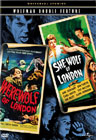
Plot: What’s it about?
Dr. Wilfred Glendon (Henry Hull) is about to venture to Tibet, in hopes of finding the Marifasa Lupina, a very rare plant. This flower is only seen in bloom within the moonlight, so most folks aren’t looking then and even if they are, it is almost impossible to find one. Glendon has been warned by many of the dangers in the area, but he insists on making the expedition. As he searches for the flower, he is attacked by a strange animal, but survives and soon after, returns to his home in London. He is then visited by Dr. Yogami (Warner Oland), who informs him that a rash of murders back in Tibet is not the work of humans, but of werewolves. He then explains that the sole antidote is the Marifasa Lupina, the same flower Glendon had ventured to locate. Glendon of course laughs at Yogami’s claims, but when the moon begins to turn full, he soon realizes how true those claims were, to be sure.
We start off this werewolf double session with Werewolf of London, a fun horror picture, but one that could have been much better, I think. This was made before the classic The Wolf Man, but has a similar theme and in the end, falls short of that film’s greatness. But this is not a bad movie by any means, so don’t pass it by without a look, as you’d be missing out on a very solid horror movie from Universal’s golden era. Henry Hull (Portrait of Jennie, The Fountainhead) gives a memorable and energetic turn in the title role, while Warner Oland (Charlie Chan Carries On, The Return of Dr. Fu Manchu) is terrific as his nemesis. There’s a lot of suspense to be found here and while not as much atmosphere as other Universal horror releases, enough to slide by on, I think. A very enjoyable werewolf picture, Werewolf of London is quite recommended and in a release like this, there’s no reason to miss it.
The streets of London have become a dangerous place to be, as a local park has become a real slaughterhouse of late. A rash of violent, brutal murders has begun, with no end in sight and no real clues to speak of. As a result, Scotland Yard is in the dark and has no serious leads to follow, which isn’t good news for the local residents. At the same time, Phyllis Allenby (June Lockhart) is being haunted by strange dreams and a sense of intense paranoia. She is terrified that she is going insane, but even more worried that she might have the “Allenby Curse,” which is what killed the poor girl’s parents. This curse has a bitter process, in which the victim is turned into a werewolf, which is what Phyllis fears has happened. She explains her situation to her fiancee and then leaves him, but he is convinced of her innocence and plans to prove she isn’t the killer.
Those werewolves must love London, as the second half of this double features also takes us there, in She-Wolf of London. This movie was made eleven years after Werewolf of London, more toward the end of Universal’s golden era of horror movies. I wanted to like this movie and I love the idea of female werewolves, but in the end, this is an average film at best. It has some good moments and all, but it lacks the usual elements we expect, to be sure. The plot is overly simplistic and you should have it solved within ten or fifteen minutes, which doesn’t help matters much. It also moves at a slower pace than most Universal horror, which would be fine, but there’s no need for it here, as time just passes and very little happens. But fans of werewolf movies and Universal horror should give it a look, just to test the waters. If this movie were alone, the recommendation would be hard to make, but with a superior film packed in, this release is worthwhile.
Video: How does it look?
Werewolf of London is presented in a full frame transfer, as intended. Universal has done some great work here, as this 1935 film looks clean and sharp, very impressive indeed. The print still shows some problems, but it looks terrific and much cleaner than I ever expected, to be sure. The black & white image looks smooth all around, with accurate black levels and no detail loss in the least, superb work. I can’t imagine that anyone will be less than thrilled here, as this is the kind of visual treatment fans have been waiting for, without a doubt.
She-Wolf of London is also presented in a full frame transfer, as intended. This another solid visual presentation, though it also has some flaws to report. I found this print to be in worse shape than Werewolf of London’s, even though this film is over a decade younger. The debris and marks aren’t extreme however, so there’s no reason for concern. The contrast is stark and never falters much, which results in a pleasant black & white visual experience. It might not be as good as some other Universal horror titles, but it is very good nonetheless.
Audio: How does it sound?
Both films sport the original mono audio options, which seem to be enough in these case of these movies. I was unable to detect any serious flaws, including age related ones, which is great news. No hiss is evident and while some slight distortion can be heard on Werewolf of London, it’s never that bad. The dialogue remains clear and well balanced here, while sound effects and music are terrific also. Of course, these are older mono tracks and that means limited range, but on the whole, these are more than solid audio efforts. Each film has also been given subtitles in English, Spanish, and French.
Supplements: What are the extras?
You’ll find production notes, talent files, and theatrical trailers for both films.