Plot: What’s it about?
Winner of the Best Picture Oscar in 1961, “West Side Story†is a classic film musical that demands respect. The story is an updated version of William Shakespeare’s “Romeo and Julietâ€, transferred from the streets of Verona to the streets of Manhattan. If you do not know the story of these star-crossed lovers, then you are not the kind of person who will appreciate this film, much less be able to read this review, so what are you doing still reading this? Go check out the review of the new Vin Diesel film. Go. Now. Or else, check out Baz Luhrmun’s pre-“Moulin Rouge†film “Romeo and Julieteâ€.
Okay, for those of you who finished Junior High School, this is Romeo and Juliet, but instead of Montagues and Capulets you got rival street gangs the Jets and the Sharks. The twist here is that the Jets are troubled white teens and the Sharks are troubled Puerto Rican teens. And of course, Tony (Romeo) falls for Maria (Juliet), going against all the norms of their society and families. But let’s be honest, you don’t watch “West Side Story†for the story—this is a classic because of the music. I’m guessing “West Side Musical†just didn’t have the same ring to it. (Many years later, Martin Scorsese would make his own “Gangs of New Yorkâ€, but it would portray far meaner streets than these).
The incomparable Leonard Bernstein composed the score, and the lyrics were written by a young man who became quite a Broadway presence in his own right, Stephen Sondheim. The musical numbers in “West Side Story†are stunningly photographed. If the balletic basketball and fight scenes start to elicit a snicker (you know who you are, I already told you to go find that Vin Diesel film instead) then just remember how far ahead of its time Jerome Robbins’s choreography was. Are the dancing fight sequences all that different from the highly choreographed martial arts fight scenes repeated in movies today? Not really, and in “West Side Story†they’re all done without the benefit of wires to suspend them, or computers to make them defy gravity—these dancers are doing it for real. And Robbins won a special Oscar for his choreography achievements.
The numbers are all integrated in to the plot, yet still they are allowed to exist in their own space and time. In one scene at the big church dance, when Tony and Maria first meet, the background walls (a vibrant red repeated often in the film) melt away to become shimmering lights in limbo. My favorite number has to be “Americaâ€, with its high energy rooftop performance. It’s such an impressive scene that it was ripped off not too long ago for a Gap commercial. For me, though, the real charm is in Sondheim’s witty, biting lyrics. As the Puerto Ricans sing about the pros and cons of their new life in America, you get gems like, “Free do be anything you choose / Free to wait tables and shine shoes.†At this point I’d like to point out one of the great features that is unique to watching this film on DVD—the subtitles. I turned on the subtitles during the musical numbers so I could sing along. Do it. It’s fun. Nobody’s going to hear you with that fancy surround sound system. “Maria, Maria. I just met a girl named Maria. MARIAAAA!â€. You might even catch yourself singing along to “I feel pretty, oh so prettyâ€. If nothing else, you’ll appreciate the genius wordsmith of Sondheim.
The film bravely takes on racism in 1961 on the big screen—the play originally was performed on Broadway in 1957. Not only does it confront racism between the whites and Puerto Ricans, but it also ridicules the bigoted cops who abuse their power. Okay, so they cast Natalie Wood as a Puerto Rican with a questionable accent—she was still a great talent and a real beauty. Meanwhile, Rita Moreno–who gives a scene-stealing performance–won the Oscar for best supporting actor in 1961 and then became relegated to mainly playing Latin roles throughout her long career.
Both Moreno and her real-life boyfriend George Chakiris, who played Maria’s brother, won Best Supporting Actor Oscars in 1961. Robert Wise, who started out his career as an editor on such classic films as “Citizen Kaneâ€, won for best director and would win again a few years later for another musical, “The Sound of Musicâ€. He shared the director Oscar with Robbins, but apparently a personal feud kept either one from thanking the other in their Oscar speeches. Natalie Wood was nominated for best Actress, but not for her role in “West Side Storyâ€, rather she was nominated for “Splendor in the Grass†in which she starred with an unknown Warren Beatty. (She lost to Sophia Loren).
The transfer is beautiful. The colors in the print are rich and eye-popping, especially the reds, which are repeated throughout the film. Many times, the walls look like they were just freshly painted (realistically not a good thing, but this is a musical, so they should be afforded a bit of a license). It is presented in widescreen, which is especially important given the dance numbers that take full advantage of the frame, and the fact that it was shot in 70mm. The sound is good, as long as you’re not singing along too loud (see above). And for goodness sake, don’t skip through the overture, or stop it before Saul Bass’s ingenious title sequence at the end. If you still can’t get enough of the great music in “West Side Storyâ€, track down a copy of Tom Waits’ “Blue Valentine†featuring his soulful rendition of “Somewhereâ€. Like the film, it’s a real beauty.
Video: How does it look?
This new edition of “West Side Story†features a new anamorphic transfer, though as an owner of the original DVD version, I couldn’t tell all that much difference between the two. The original 2.20:1 anamorphic image is, by far, the best the movie has looked on home video and there’s a cheap “new†version that has only the full-frame version on it, don’t buy that! Colors are bright, vivid and look very good considering the age of the movie. There is a bit of artifacting, but it’s to be expected. Unlike so many other “classic†movies that undergo the restoration treatment, this doesn’t look as good as movies like “Singin’ in the Rain†or “North by Northwestâ€, but those set such a high standard, it’s hard for anything to look that good. A few scenes tend to look a bit muddy, but the anamorphic transfer ups the level of detail and this is truly the way the movie was meant to be seen.
Audio: How does it sound?
Again, the set claims to have a new Dolby Digital 5.1 track, but I really couldn’t tell the difference between this one and the original release. Either way, the soundtrack has never sounded better and if there’s one way to hear “I Feel Prettyâ€, it’s this way (with a close second being Adam Sandler’s and Jack Nicholson’s rendition in “Anger Managementâ€) kidding, of course. Dialogue is rather clean and I was impressed how the original six track soundtrack held up. Certainly movies of this age were usually mono and sound aged and dated today, but “West Side Story†brims with excitement and sounds very good on DVD, to be sure.
Supplements: What are the extras?
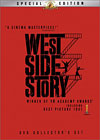
The movie is housed on the first disc with the remaining extras on the second. Don’t let the packaging fool you (this is one hefty case), as the “real†extra is the scrapbook. There is a documentary entitled “West Side Stories†with new interviews with the cast and even some Hollywood legends. Running almost an hour, they tell of the production, reaction to the movie, etc. though this could (and should) have been longer, this gives a newbie plenty of history to the world of “West Side Storyâ€. A storyboard to film comparison simply shows how the scenes were laid out and how they translated to the screen. A theatrical trailer is also included (to compare how good the movie looks, compare it to the quality of the trailer). The real bonus is the scrapbook, an actual book included with this Limited Edition. It contains an introduction by Ernest Lehman, the entire script and photos from the set. Truly every fan of the movie will want to own this version as opposed to the earlier edition. “West Side Story†is a classic and this new DVD cements its status as one of our favorite movies.